
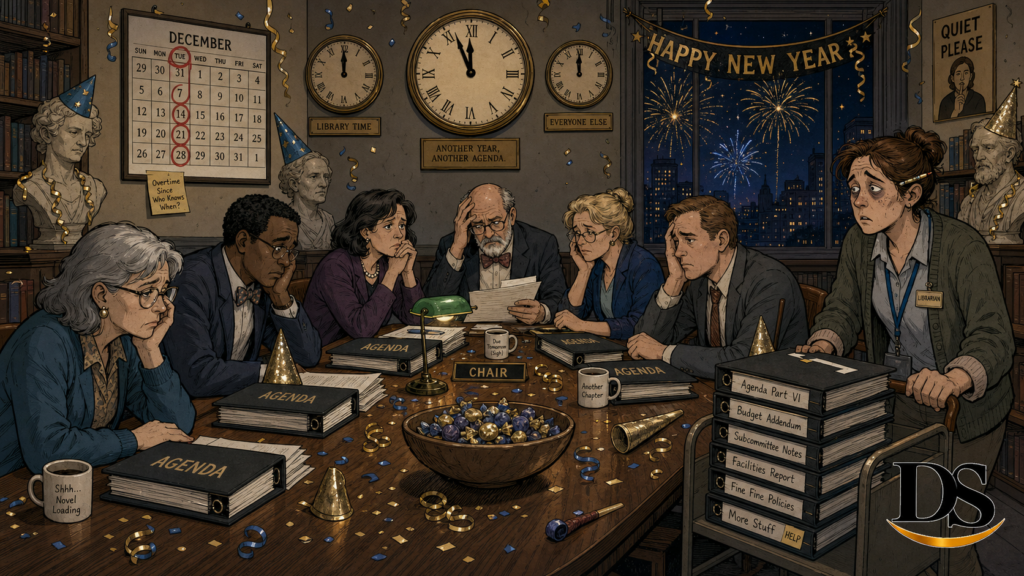
The Clock Ticked, Then Ticked Some More
The fluorescent lights of the Oakwood Public Library’s community room hummed with a peculiar intensity last Tuesday. Outside, a crisp autumn chill hinted at the coming winter, but inside, the Oakwood Public Library Board was already deep in the throes of New Year’s Eve. For six grueling hours, board members, led by the indefatigable Chairperson Mildred McMillan, pored over spreadsheets, debated balloon inflation techniques, and meticulously dissected the optimal trajectory for confetti cannons. The air, thick with the scent of stale coffee and earnest dedication, vibrated with the weight of their task: ensuring Oakwood’s most memorable New Year’s Eve celebration to date.
A Policy Steeped in Tradition (or Perhaps Just Paperwork)
The extraordinary session was prompted by a recent amendment to the library’s operational policy, a document known for its thoroughness and, at times, its labyrinthine clauses. The amendment, passed with little fanfare during the summer off-season, specifically addressed “Major Holiday Event Planning Protocols.” Chairperson McMillan, a retired accountant with a penchant for proactive fiscal management, had championed the policy, emphasizing the need for rigorous preparation for significant public events. The board, having recently overseen a successful, albeit modest, Fourth of July book sale, was eager to apply similar diligence to the year’s grand finale.
The Great Midnight Countdown Conundrum
Discussions ranged from the practical to the existential. Should the library’s iconic lion statues be adorned with festive hats? What was the acceptable decibel level for carol singing? The most heated debate, however, centered on the procurement of a professional fireworks display. Mr. Barnaby Finch, a local historian and board member, argued for a more subdued, historically accurate approach, perhaps involving a synchronized reading of the town charter. Ms. Clara Bellweather, a graphic designer and advocate for modern flair, countered with impassioned pleas for laser light shows and a DJ capable of spinning “timeless techno.” The six-hour marathon saw multiple break-out sessions, a catered lunch of surprisingly robust tuna sandwiches, and a brief, but memorable, moment of panic when the official library-issued party popper malfunctioned.
A Clarification, Like a Quiet Whisper After a Roar
As the meeting drew to a close, with the board having tentatively approved a budget for 5,000 noisemakers and a contingency fund for emergency glitter removal, a junior librarian, shyly clutching a binder, approached the dais. Bartholomew “Barty” Higgins, known for his meticulous cataloging skills, had been tasked with cross-referencing the new policy with existing procedural documents. He cleared his throat, a sound almost lost amidst the collective sigh of exhausted relief.
“Excuse me, Chairperson McMillan,” Barty began, his voice barely audible. “I was reviewing the policy addendum, particularly Section 4, Subsection B, regarding ‘Major Holiday Event Planning Protocols.’ It appears… there might be a slight misunderstanding regarding its applicability.”
Mildred McMillan adjusted her spectacles. “A misunderstanding, Mr. Higgins? We’ve spent the entire day planning for New Year’s Eve. The policy is quite clear on the need for comprehensive foresight.”
Barty nodded, his brow furrowed. “Yes, the foresight is crucial. However, the policy, as amended, specifies that these particular planning protocols, the six-hour orientation and the detailed budgetary approvals for large-scale festive events, are to be conducted *exclusively on Tuesdays*. It’s a… a Tuesday-specific directive.”
The Tuesday Clause: A Twist of Fate, or Bureaucracy?
A palpable silence descended upon the room. The spreadsheets, the confetti strategies, the meticulously debated hat decorations for the lion statues – all of it, suddenly, seemed to hang in the air, suspended by the weight of a single, overlooked word: Tuesday. Chairperson McMillan’s jaw tightened almost imperceptibly. Mr. Finch, who had been sketching elaborate quill-pen-and-ink invitations, looked up with a bewildered expression. Ms. Bellweather’s hand, poised to demonstrate a dance move, froze mid-air.
“Tuesday?” Mildred McMillan repeated, her voice flat. “But… this is Tuesday.”
Barty wrung his hands. “Indeed, Chairperson. It is. However, the policy states that the *planning* for these events, the extensive, multi-hour sessions, are to be confined to Tuesdays. The actual event, New Year’s Eve, of course, occurs on December 31st, regardless of the day of the week. But the *planning*… it’s a Tuesday affair.”
Repercussions and Renewed Resolutions
The implications were staggering. The board had, in effect, followed the policy to the letter, but the letter itself was a peculiar beast. The policy was designed to consolidate holiday planning into a single, dedicated day each week, ensuring that such preparations didn’t bleed into other critical library functions. The oversight was not in the planning itself, but in the assumption that New Year’s Eve planning had to occur on a Tuesday *because* New Year’s Eve was a major holiday, rather than the policy dictating that the *planning session* for any major holiday must be held on a Tuesday.
“So,” Barnaby Finch ventured slowly, “you’re saying we could have had this entire six-hour discussion… next Tuesday?”
“Or the Tuesday after that,” Barty confirmed, looking apologetic. “Or any Tuesday leading up to the event, as long as the planning itself adheres to the Tuesday mandate.”
Community Impact: A Celebration of Bureaucracy
News of the “Tuesday Clause” spread through Oakwood faster than a dropped book in a silent reading room. Residents expressed a mixture of amusement and grudging admiration for the library board’s unwavering commitment to protocol. Local businesses, initially gearing up for an influx of New Year’s Eve party supplies, found themselves fielding questions about whether their Tuesday sales would be subject to similar policy-driven planning sessions. The Oakwood Diner announced a “Tuesday Special: Policy Primer Pancakes” in honor of the occasion.
The library itself saw a surge in visitors, many curious to inspect the policy documents or to offer their own, unsolicited advice on New Year’s Eve festivities. Some suggested a silent disco, others a competitive gingerbread house building contest. The board, though initially taken aback, found a renewed sense of purpose. Their six-hour ordeal had not been in vain; it had, at the very least, generated significant community engagement and a profound appreciation for the nuances of municipal policy.
A New Year’s Eve, A New Approach
As the meeting finally adjourned, Chairperson McMillan, with a weary but resolute smile, addressed her fellow board members. “Well, team,” she announced, her voice resonating with a newfound, albeit slightly strained, clarity, “we have certainly learned a valuable lesson today about the importance of precise language in policy. And, more importantly, about the strategic advantage of having our significant planning sessions exclusively on Tuesdays.”
The board agreed to reconvene the following Tuesday, armed with the knowledge that their New Year’s Eve plans, while perhaps slightly delayed in their *official* inception, were now firmly rooted in the bedrock of Oakwood’s unique, Tuesday-centric administrative tradition. The fireworks, the DJs, and the historically accurate quill pens would all have to wait until the next designated planning day. For now, Oakwood’s New Year’s Eve was planned, meticulously and, most importantly, on a Tuesday.
Join the conversation
Load Facebook comments to read and reply using your Facebook account.