
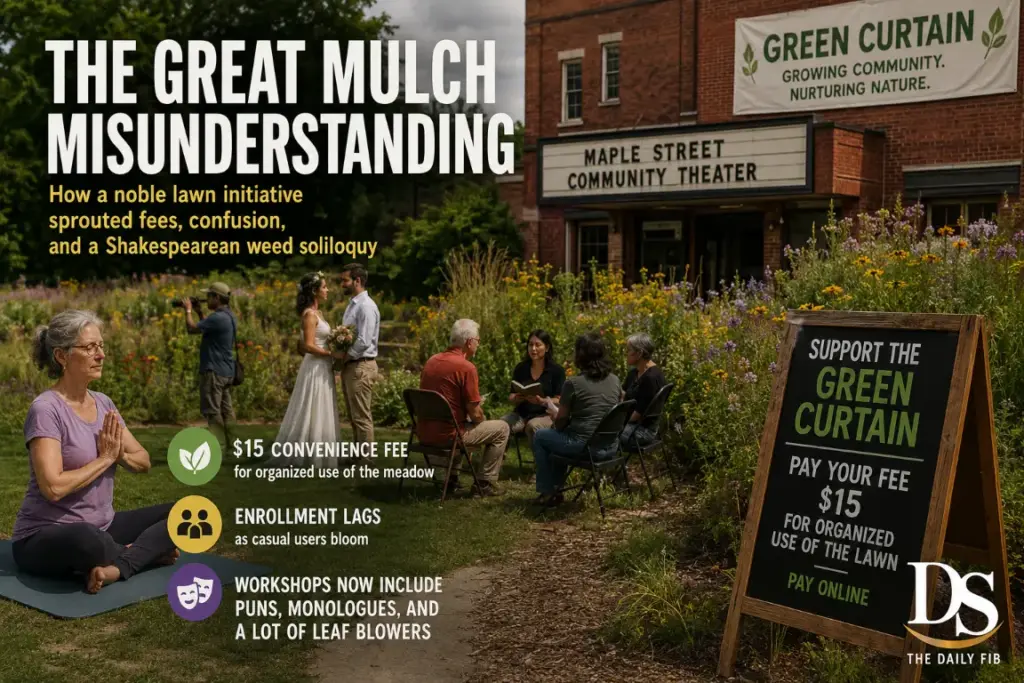
The Maple Street Community Theater’s ‘Green Curtain’ project began with noble intentions: transform the neglected lot behind the auditorium into a thriving native-plant meadow to offset carbon emissions from stage lighting and foster neighborhood pride. Volunteers planted milkweed, coneflowers, and little bluestem last spring, and by midsummer, the once-weedy patch had blossomed into a pollinator haven.
A Convenience Fee Takes Root
As the meadow grew, so did demand for access. Residents began asking to host yoga sessions, birdwatching tours, and even small wedding photo shoots in the space. To manage wear and tear and fund ongoing maintenance, the theater’s board voted in August to introduce a $15 ‘convenience fee’ for any organized use of the lawn, payable via an online portal.
The fee was framed as a modest contribution to cover mulch replenishment, path edging, and seasonal cleanup. Theater director Lena Cho emphasized it was ‘not a barrier, but a way to share stewardship.’ Signs went up at the gate: ‘Support the Green Curtain — Pay Your Fee.’
Enrollment Lags, But Benefits Bloom Unevenly
Yet participation in the formal enrollment program — designed to grant regular users perks like priority booking, waived fees after five visits, and a commemorative seed packet — remained stubbornly low. By October, fewer than 20 residents had completed the multi-step registration, which required creating an account, agreeing to terms, and attending a 10-minute orientation.
Meanwhile, casual users continued to arrive. A book club met weekly under the goldenrod. A tai chi group flowed through the switchgrass at dawn. None had enrolled, yet all benefited from the meadow’s upkeep — mowed edges, invasive species pulled, and benches repaired — funded precisely by the convenience fees paid by others.
Voices From the Meadow
‘I love coming here,’ said Marco Ruiz, a retired librarian who leads the birdwatching group. ‘I didn’t know I needed to enroll. I just show up with my binoculars and pay the fee when asked. Seems fair.’ He had paid $60 in fees over three months but had not completed enrollment.
Contrast that with Priya Desai, a theater volunteer who enrolled early. ‘I filled out the form, went to the orientation, got my seed packet,’ she said. ‘But I mostly use the lawn to rehearse monologues alone. I’ve only paid two fees.’
The theater’s treasurer, Benicio Vale, noted the irony. ‘We’re seeing higher revenue from non-enrolled users,’ he admitted. ‘The fee is working as a use-based contribution, but the enrollment perks aren’t driving behavior we expected.’
Community Impact and Unintended Incentives
The meadow has become a de facto commons, its vitality sustained by a patchwork of small payments. Local ecology professor Dr. Aris Thorne observed, ‘It’s fascinating — the space thrives not because of formal governance, but because people voluntarily contribute when asked, even without joining a program.’
Still, the theater worries about long-term engagement. ‘We wanted to build a community of stewards,’ Cho said. ‘Instead, we’ve got a lot of generous visitors and a small core of enrolled members who may feel their effort isn’t reciprocated.’
Some enrolled users have begun questioning the value. ‘Why did I bother with the orientation if I get the same access as someone who just taps pay?’ Desai muttered after a recent rehearsal.
Adjusting the Plot
In response, the theater is piloting a simplified model: drop the separate enrollment tier, retain the convenience fee for all organized use, and redirect surplus funds toward visible upgrades — new benches, interpretive signs, and a seasonal wildflower sowing event open to all.
‘Maybe the fee itself is the enrollment,’ Cho mused. ‘If you pay, you’re invested.’
As autumn deepens and the meadow grasses turn amber, the Green Curtain endures — not through perfect compliance, but through the quiet, uneven arithmetic of care: some pay more, some participate less, but the flowers keep blooming.
The Great Mulch Misunderstanding
Just as the theater’s new lawn-care enrollment portal went live, a rogue intern accidentally replaced the fee schedule with a script for Our Town, Act III. Prospective participants were greeted not with pricing tiers, but with Emily Webb’s poignant monologue about the value of everyday life — followed by a blinking ‘Pay What You Can’ button that linked to a Venmo account labeled ‘Stage Left Snacks Fund.’ Confusion bloomed like dandelions in July. One retiree, Martha P., enrolled three times, convinced she was signing up for ‘emotional landscaping’ and brought a thermos of chamomile tea to the first workshop, only to find herself handed a leaf blower and a safety vest. ‘I thought we were doing improv with yard waste,’ she later told the Daily Smirk, ‘but no — turns out, I’m just really good at blowing leaves into neat piles while contemplating mortality.’ Meanwhile, the theater’s treasurer discovered that the Venmo link had been redirecting to a Kickstarter for a one-man show about sentient weeds, which had already raised $2,300 from people who believed they were funding ‘eco-theatrical resistance.’
Curtain Call on the Crabgrass
The saga reached its absurd zenith last Saturday when, mid-way through a demonstration on edging techniques, the lead instructor — a former Shakespearean actor turned horticulture enthusiast — dropped his hoe, clutched his chest, and declared, ‘To grass, or not to grass: that is the question!’ Before anyone could respond, he launched into a full soliloquy about the tyranny of dandelions, complete with iambic pentameter and a dramatic fall into a pile of freshly cut clover. The audience, half expecting a punchline, half waiting for an intermission, erupted in applause. When the laughter died down, the theater’s artistic director stepped forward, wiped a tear of mirth from her eye, and announced that henceforth, all lawn-care workshops would begin with a five-minute ‘grounding monologue’ — chosen by audience vote. As for the fee structure? It’s been scrapped. In its place: a ‘pay-in-puns’ system, where attendees settle their dues by delivering one original lawn-related joke per session. Early returns suggest the theater may finally break even — not from money, but from groans. And somewhere, Emily Webb is smiling, knowing that even in the absurdity of suburban upkeep, there’s still beauty — especially when it’s delivered in verse, with a side of leaf blowers and bad puns.
Join the conversation
Load Facebook comments to read and reply using your Facebook account.