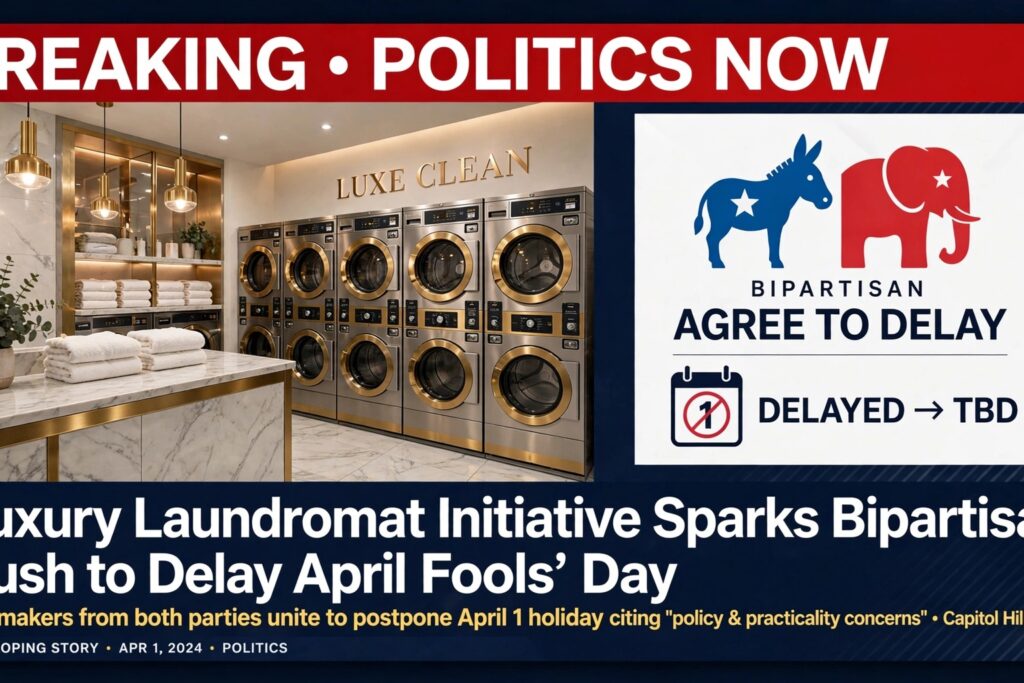
On a quiet Tuesday morning, the marble foyer of The Spin Cycle — a luxury laundromat in Portland’s Pearl District known for its cashmere-only wash cycles and complimentary oat-milk lattes — became the unlikely nerve center of a national conversation. Between the hiss of steam presses and the soft chime of completed loads, a group of seven sat around a reclaimed walnut table, sipping matcha from hand-thrown ceramics. Their agenda: to delay April Fools’ Day.
The Commission Forms
The idea was born, according to founding member Daphne Ruiz, after three consecutive years of increasingly elaborate pranks left her startup’s demo environment compromised. ‘Last year, someone replaced all our test user avatars with pictures of raccoons wearing tiny hard hats,’ she said, stirring her latte. ‘It was funny. Until the investor demo.’
Ruiz, a former UX designer turned clean-tech advocate, joined forces with Marcus Bellweather, a retired federal cybersecurity advisor who now consults for high-net-worth individuals on digital hygiene, and Lila Ngo, a professor of behavioral economics at Cascade University. Together, they invited representatives from both major political parties — not as partisans, but as stewards of public discourse.
‘We’re not trying to cancel humor,’ Bellweather clarified during a break, folding a freshly pressed linen napkin into a crane. ‘We’re trying to preserve the signal from the noise. When every platform is flooded with fake announcements, even real ones start to feel suspect.’
The Demonstration Account Threat
The urgency, they say, stems from a little-known vulnerability in the nation’s shared demonstration account infrastructure — a sandbox environment used by schools, libraries, and small businesses to test software updates without risking live data. Buried in a 2022 interagency memo, the account has an automatic lockdown trigger: if more than 12,000 failed login attempts occur within a 48-hour window — often driven by prank scripts mimicking mass sign-ups — the system locks out all users for 72 hours.
‘It’s not theoretical,’ said Ngo, pulling up a printed log on her tablet. ‘In 2023, the demo account locked on April 2nd. Schools couldn’t test new grading software. Libraries couldn’t verify e-book licenses. A rural clinic in Nebraska almost missed a critical patch for its patient portal.’
The commission argues that the proliferation of AI-generated pranks — convincing fake press releases, deepfake celebrity endorsements of absurd products, and coordinated fake-outages — has made the current April 1st window untenable. They propose shifting the observance to the first Monday in April, creating a buffer for recovery and reducing the risk of systemic disruption.
Reactions Across the Aisle
The idea has drawn unexpected support. Senator Ingrid Tolliver (D-OR) praised the commission’s ‘pragmatic approach to digital resilience,’ while Representative Chuck Whitmore (R-TX) called it ‘a rare moment of bipartisan common sense — like agreeing that daylight saving time is outdated, but without the yelling.’
Not everyone is amused. The International Society of Satire and Parody issued a statement warning against ‘the bureaucratization of jest,’ arguing that humor is a vital social pressure valve. ‘You can’t schedule spontaneity,’ said its president, Milo Fitch, via encrypted chat. ‘Besides, who’s to say the pranksters won’t just move to March 32nd?’
Local businesses, however, are cautiously optimistic. At The Spin Cycle, owner Javier Mendez reported a 20% drop in apricot-scented detergent sales during April Fools’ week last year — customers, he said, were too busy checking if their email had been hacked to focus on stain removal. ‘If people aren’t stressed about fake invoices, they might actually fold their clothes,’ he said, smiling as a steam press hissed behind him.
Community Impact and Next Steps
The commission has launched a pilot ‘Digital Quiet Week’ in three cities — Burlington, Madison, and Asheville — encouraging schools, libraries, and small businesses to suspend non-essential online testing during the traditional April Fools’ window. Early feedback shows a 40% reduction in help desk calls related to phishing confusion and a notable uptick in patrons actually reading the fine print on software updates.
A national advisory vote is scheduled for June, administered through a coalition of nonpartisan civic tech groups. If approved, the shift would take effect in April 2026, giving pranksters a full year to adapt — or, as Bellweather put it, ‘to find a new outlet for their creativity that doesn’t involve impersonating the IRS.’
Back at The Spin Cycle, the cycle continues: towels tumble, espresso shots pull, and the debate simmers. As Ruiz folded the last napkin crane and tucked it into her tote, she glanced toward the window, where a delivery person struggled with a package labeled ‘Urgent: Do Not Open – Contains Confetti.’
‘Some traditions,’ she murmured, ‘are worth postponing.’
Fact or Fiction?
FICTION. This article is a work of satire. The Spin Cycle, the Bipartisan Commission to Postpone April Fools’ Day, and the demonstration account lockdown mechanism are fictional constructs. While concerns about digital fatigue, prank-related disruptions, and the societal impact of misinformation are real, no such commission exists, and April Fools’ Day remains fixed on April 1st by tradition, not legislation.
Join the conversation
Load Facebook comments to read and reply using your Facebook account.