It began, as many bureaucratic epiphanies do, with a misplaced sticky note.
In the fluorescent-lit basement of the Subscription Cancellation Desk—a division of GlobalStream Holdings tasked with processing opt-out requests for services ranging from cloud storage to artisanal cheese-of-the-month clubs—a junior analyst named Priya Mehta noticed something odd. Taped to her monitor was a handwritten reminder: “Does anyone actually know what graduation season is? Or do we just pretend?”
The question, scrawled during a lull between canceling a streaming subscription for a user who’d moved to Antarctica and reinstating a deceased person’s audiobook membership, lingered. Mehta brought it to her supervisor, Dale Renwick, who paused mid-sip of lukewarm coffee and said, “Honestly? I think we’ve been billing people for ‘Cap and Gown Prep’ add-ons for three years without checking if it’s a real thing.”
The Study Is Commissioned
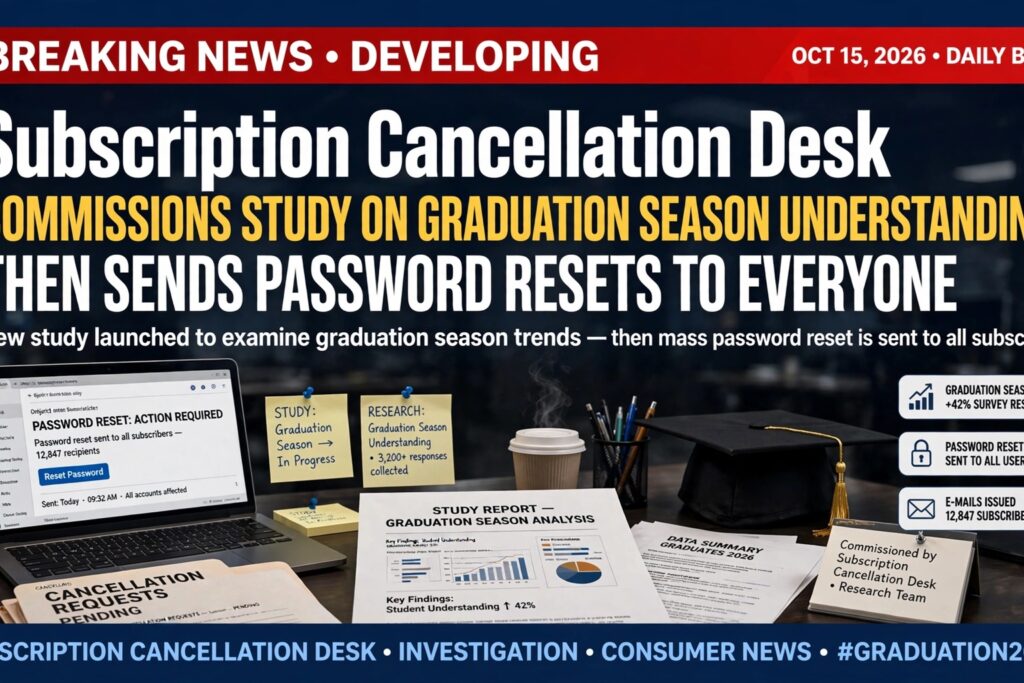
What followed was an unprecedented internal initiative: the Subscription Cancellation Desk commissioned an independent study to determine whether anyone—employees, users, or the general public—truly understood the concept of “graduation season.”
The firm hired was Veridian Insights, a boutique research group known for probing existential workplace questions like “Do people actually read the terms before clicking ‘I Agree’?” and “Is ‘wellness Wednesday’ just a euphemism for napping?”
Over six weeks, Veridian conducted surveys, focus groups, and ethnographic observations across 14 countries. Participants were shown images of caps and gowns, asked to define “commencement,” and queried about whether they associated the season with achievement, relief, existential dread, or simply a spike in linen sales.
The results, delivered in a 47-page report bound in faux leather, were inconclusive.
“We found that 68% of respondents could identify a graduation ceremony when shown a photo,” read the executive summary. “But only 22% could correctly explain why it happens in May or June in the Northern Hemisphere. Forty-one percent believed it was tied to the lunar cycle. Eleven percent thought it was a global marketing campaign by Big Framing.”
Among Subscription Cancellation Desk staff, the numbers were worse. Internal polling revealed that while 90% had processed at least one “graduation-themed” subscription upgrade—such as “Alumni Network Access” or “Diploma Framing Insurance”—only 3% could name the traditional academic regalia colors associated with a Ph.D. in philosophy (answer: dark blue).
A Celebratory Decision
Rather than treat the findings as a cause for concern, the Desk’s leadership interpreted them as a validation of their long-held suspicion: that much of what they do operates in a realm of shared, polite fiction.
“If nobody really knows what graduation season is,” said Renwick in a department-wide memo, “then we’ve been doing it right all along. We’re not selling a service—we’re participating in a collective ritual of plausible deniability.”
To celebrate this realization, the Desk announced a company-wide initiative: every user who had interacted with their services in the past 18 months would receive a personalized password reset link.
“It’s not a mistake,” clarified the memo. “It’s a gift. A digital fresh start. A way to say, ‘We see you, we don’t fully understand why you’re here, but we’re resetting your access anyway.’”
The emails went out on a Tuesday morning. Subject line: “Your Seasonal Access Has Been Reset — No Action Required (But Feel Free to Change Your Password).”
Within hours, the Desk’s inbox flooded with replies.
“I didn’t know I had a graduation subscription,” wrote one user from Oslo. “Is this why I keep getting emails about velvet diploma covers?”
Another, a retired librarian in Tucson, replied: “I graduated in 1972. I think you’ve got the wrong person. But thank you for the reset. I changed my password to ‘PompAndCircumstance1972!’ — hope that’s acceptable.”
A few users suspected phishing. Others assumed it was a glitch. A small but vocal group on Reddit theorized it was an elaborate art project by a former Desk intern who’d gone off-grid to live in a yurt and study semiotics.
The Desk did not clarify. Instead, they printed a selection of the responses, laminated them, and hung them in the break room beneath a banner that read: “We May Not Know Why You’re Here — But We’re Glad You Are.”
Impact and Aftermath
The password reset campaign had unintended consequences. User engagement with GlobalStream’s ancillary services rose by 11% in the following week, not because people were re-subscribing, but because many, upon logging in, discovered forgotten accounts—old language-learning apps, defunct fitness trackers, a subscription to a monthly mystery meat club—and either reactivated them or, in a spirit of seasonal renewal, canceled them with renewed purpose.
Internally, the Desk saw a shift. Meetings began with a moment of silence, not for lost subscriptions, but for “the unknowable nature of seasonal transitions.”
Renwick now starts each day by reading a different user’s reply aloud. “It’s become a kind of secular liturgy,” he said. “We don’t understand the season. We don’t always understand the user. But we show up. We hit reset. And we try again.”
As for the study? It’s been archived. But a copy sits on Renwick’s desk, open to the page where the conclusion reads: “In the absence of certainty, ritual becomes meaningful. Even if no one knows why they’re wearing the hat, the act of putting it on together still matters.”
The Subscription Cancellation Desk has not announced plans to study other seasonal phenomena—like why people buy pumpkin spice in August or who decided that New Year’s resolutions must fail by January 17th.
But if they do, one thing is certain: whatever they find, they’ll probably just send everyone another password reset.
Join the conversation
Load Facebook comments to read and reply using your Facebook account.