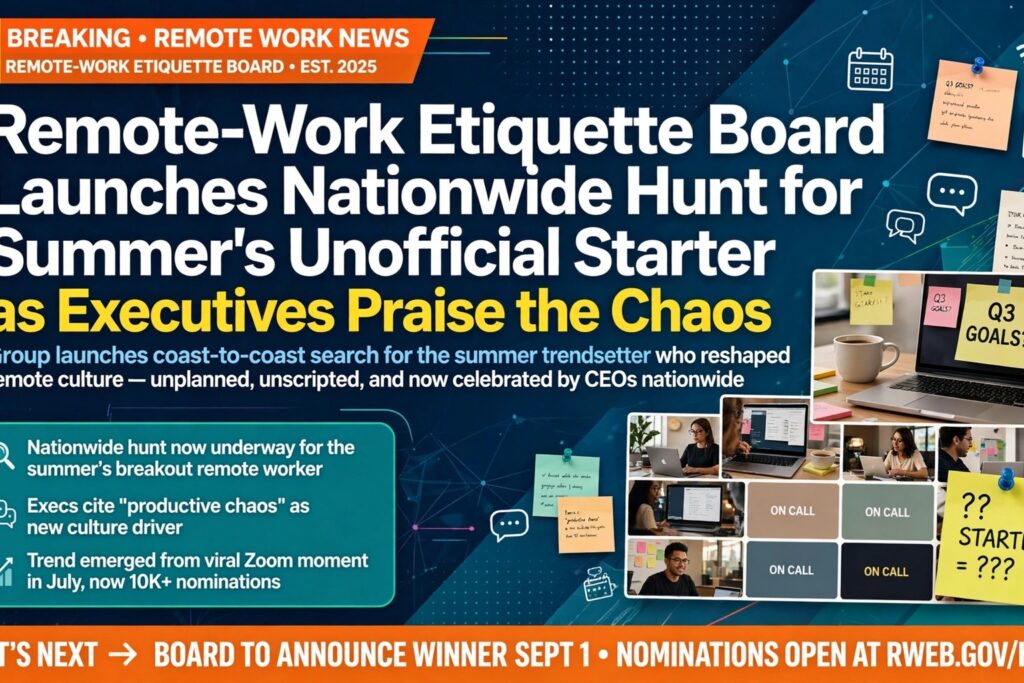
It began, as many workplace revolutions do, with a poorly timed out-of-office message.
On a drizzly Tuesday in mid-April, Denise Tran, a mid-level project coordinator at a regional logistics firm in Columbus, Ohio, clicked ‘Send’ on an automated reply that read: ‘Currently offline enjoying the first true warmth of spring. Responses delayed until Memorial Day.’ She had meant it as a joke — a quiet rebellion against the creeping blur between seasons in a world where ‘summer’ now starts when your HVAC unit kicks on.
What happened next was not a joke.
Within 48 hours, her message was screenshotted and forwarded across three time zones by colleagues who, starved for seasonal markers in their windowless home offices, interpreted it as gospel. By Friday, the company’s Slack channel had erupted into a debate over whether ‘summer’ officially began when the first ice cream truck appeared in a suburban cul-de-sac, when the last frost date passed in USDA Zone 5, or when Denise’s cat started shedding its winter coat.
The Remote-Work Etiquette Board (RWEB), a voluntary consortium of HR directors, corporate psychologists, and one overly enthusiastic former summer camp counselor, convened an emergency session. Their mandate: to define, with solemn precision, the exact moment summer begins in a distributed workforce.
‘We’ve spent years refining norms around virtual background appropriateness and mute-button etiquette,’ said RWEB Chairperson Eleanor Voss, adjusting her glasses over a mug labeled ‘World’s Okayest Manager.’ ‘But this? This is existential. If we can’t agree when summer starts, how do we know when to approve vacation requests, when to expect reduced productivity, or when to legally mandate popsicle breaks?’
The board launched a nationwide survey, inviting remote workers to submit their own criteria for summer’s onset. Responses poured in: the first time someone wore shorts to a video call (even if only from the waist up), the day the office plant finally stopped looking sad, the moment a coworker’s toddler wandered into frame wearing nothing but a swim diaper and a sense of purpose.
By week three, the search had escalated. RWEB deployed a team of ‘seasonal anthropologists’ to analyze geotagged photos of backyard grills, Google Trends data for ‘pool noodles,’ and spikes in searches for ‘how to tell if my neighbor is having a barbecue.’ They even consulted a phenologist from the University of Vermont who tracked budburst in red maples as a proxy for corporate morale.
Meanwhile, executives at Fortune 500 companies began to notice something strange: engagement metrics were soaring. Internal newsletters saw record open rates. Virtual happy hours, once dreaded, were now attended by 89% of invited staff. One tech firm reported a 34% increase in cross-departmental Slack messages tagged #SummerIsComing.
‘Honestly, it’s the most aligned we’ve felt all year,’ said Marcus Bellweather, Chief People Officer at a Seattle-based SaaS company, speaking on condition that his company’s name not be linked to the ‘summer confusion’ in official filings. ‘People are talking. They’re sharing photos of their gardens. They’re debating solstices like it’s a quarterly earnings call. We didn’t plan this. But if a misfired out-of-office note can get our team to care about the rhythm of the seasons again… well, maybe we’ve been over-indexing on deliverables and under-indexing on daylight.’
The controversy deepened when a dissenting faction within RWEB argued that Denise’s message was not the cause but the symptom — that the real trigger was the collective psychological need for ritual in a world where time zones blurred and Fridays felt like Mondays with better snacks. They proposed adopting the summer solstice as the official start, a motion that lost by a single vote after a tiebreaker round rock-paper-scissors match between two interns.
As of press time, the search for the ‘Unofficial Starter of Summer’ continues. Denise Tran, now inadvertently famous, has declined multiple interview requests, citing ‘ongoing seasonal ambiguity’ and a sudden urge to go camping. Her out-of-office reply, meanwhile, remains active — updated weekly with new, increasingly poetic justifications for her absence: ‘Chasing the longest shadows,’ ‘Following the fireflies north,’ ‘Waiting for the cicadas to agree on a tempo.’
In the end, whether summer began with a click, a bloom, or a barbecue may matter less than what it revealed: in the absence of shared physical spaces, even the most arbitrary signals can become sacred. And sometimes, all it takes to reawaken a sense of collective rhythm is one person hitting ‘Send’ a little too early — and a whole workforce deciding, against all better judgment, to believe them.
From Breakroom Memes to Boardroom Briefings: The Viral Ripple Effect
What began as a tongue-in-cheek Slack thread titled “Is 3 PM on a Friday the Real Start of Summer?” has metastasized into a full-blown corporate phenomenon. After the Remote-Work Etiquette Board’s nationwide call for submissions went live, entries flooded in from unexpected corners: a distributed team of marine biologists in Maine submitted a time-lapse of seagulls stealing fries from a dockside lunch break, captioned “When the tide turns, so does the work ethic.” A group of remote game developers in Austin turned their submission into a mini ARG, hiding clues about the “true start of summer” in the background of their virtual stand-ups — one eagle-eyed intern spotted a pixelated ice cream truck in a Zoom background and triggered a 48-hour company-wide scavenger hunt that ended with a virtual sundae party hosted by the CTO.
The Board, initially expecting a few dozen lighthearted entries, now faces a logistical delight: over 12,000 submissions ranging from poetic haikus about iced coffee condensation to elaborate TikTok montages of pets “supervising” home offices in sunglasses. One entry, from a freelance illustrator in New Mexico, depicted a lone saguaro cactus wearing a tiny hard hat and holding a sign that read “Summer Starts When the AC Gives Up” — it’s currently leading the public vote by a landslide. Executives, who initially endorsed the hunt as a morale booster, are now quietly requesting access to the submission database for “cultural insight” and “team bonding analytics,” though several have admitted in off-the-record chats that they’re just waiting to see if the cactus wins.
The Verdict Is In: Summer Begins When the Out-of-Office Reply Gets Poetic
After three weeks of deliberation, public voting, and a surprise tiebreaker judged by a panel of retired lighthouse keepers (chosen for their “expertise in marking transitions”), the Remote-Work Etiquette Board has declared the winner: a submission from a team of librarians in rural Vermont. Their entry — a split-screen video showing one side of a staid reference desk at 8:59 AM and the other side at 9:01 AM, where the librarian swaps her cardigan for a linen shirt, slides a seashell onto the keyboard, and changes her away message to “Gone to chase the sun. Back when the crickets start their noon chorus” — was praised for its “quiet revolution in tone.”
In a rare moment of unanimity, the Board announced that henceforth, the unofficial start of summer for remote workers nationwide will be marked not by solstices or sales, but by the first poetic out-of-office reply of the season. As one executive, who asked to remain anonymous, murmured over a virtual coffee: “We spent years optimizing for productivity. Who knew the real upgrade would be learning to pause — and say it beautifully?” The article closes not with a punchline, but with a lingering image: thousands of workers, across time zones and home offices, now hesitating before hitting send on their OOO messages, wondering if today — just today — might be the day summer finally begins.
Join the conversation
Load Facebook comments to read and reply using your Facebook account.