It was 10:47 a.m. on a bright May Saturday when the screen stuttered. Valedictorian Maya Chen had just begun to speak about resilience in the face of climate anxiety, her voice cracking slightly as she described planting native wildflowers in abandoned lots — and then the feed froze. For 11 agonizing seconds, the 8,000 viewers watching Lincoln Preparatory Academy’s graduation livestream saw only a pixelated blob where her face should have been, accompanied by the faint, looping chime of a hold tone usually reserved for municipal water bill inquiries.
By the time the image returned, Chen had moved on to thanking her lab partner, and the moment — the emotional pivot where personal struggle met collective hope — had been lost to buffering. Parents in the comment section typed variations of “Was that it?” and “Did she say something important?” while alumni from the class of 2008 shared screenshots of the glitch, now meme-ified with captions like “When your future depends on the town’s Wi-Fi.”
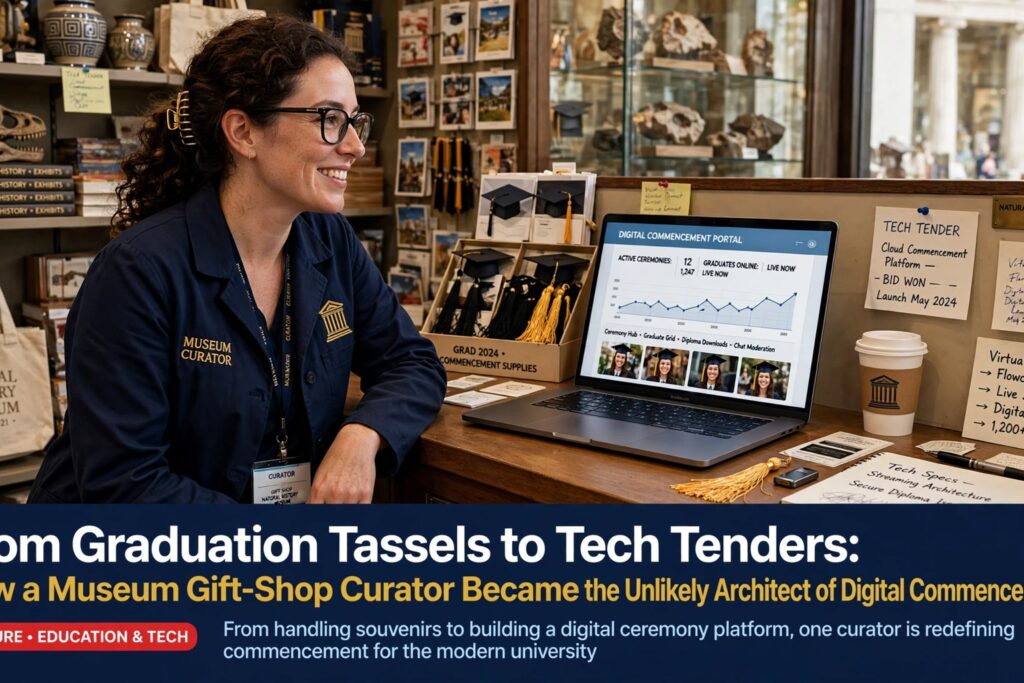
The incident might have faded into the annals of mildly embarrassing school tech fails had it not been for Eleanor Voss, 58, curator of the gift shop at the Granite City Museum of Natural History. Two days later, Voss received an unsigned email from the school district’s interim communications director: “We need someone who understands both legacy systems and human emotion. Can you help us fix graduation streaming by Friday? No RFP. No committee. Just results.”
Voss, who has spent 22 years arranging ammonite fossils beside locally roasted coffee beans and selecting the perfect shade of slate blue for tote bags that read “I Survived the Cretaceous,” was initially skeptical. “I told them I know how to display a trilobite so it looks majestic, not how to debug a CDN,” she said in an interview conducted amid the hum of the museum’s climate-controlled storage wing. “But then I realized: graduation isn’t really about the stream. It’s about making sure nobody misses the part where someone says, ‘I did it.’”
Her approach began not with bandwidth tests or encoder settings, but with observation. Voss attended three graduations the following week — one at a rural charter school, one at a tech magnet, one at a continuation high school — taking notes not on audio levels but on human behavior. Where did people lean forward? When did they pull out phones to record? What made them cry, laugh, or check their watches?
“At the continuation school,” she recalled, “a graduate thanked his probation officer by name. The mom in the front row started sniffling before he even finished the sentence. If that moment had buffered, we wouldn’t just lose audio — we’d lose the reason we bother showing up at all.”
Voss proposed a hybrid solution: retain the school’s existing livestream infrastructure for broad accessibility, but layer on a lightweight, locally hosted backup stream triggered by motion-sensor cameras in the auditorium — the kind used in wildlife exhibits to capture elusive species without disturbing them. The system, built using open-source software and repurposed Raspberry Pi units from the museum’s abandoned dinosaur dig exhibit, would activate only if the main feed dropped below 720p for more than three seconds, switching seamlessly to a local feed with synchronized audio from the venue’s house mic.
She also insisted on a human buffer: a designated “stream steward” at each graduation — usually a drama teacher or yearbook advisor — trained to hit a big red button (labeled, at Voss’s insistence, “SAVE THE MOMENT”) if the tech faltered. The button, housed in a 3D-printed casing shaped like a tiny T. rex, now lives in a drawer beside the graduation programs.
The first test came at Westridge High, where a squirrel chewed through a main campus fiber line during the salutatorian’s address. The backup kicked in at 10:03 a.m., capturing the student’s tribute to her grandmother, who had watched the stream from a hospital bed via tablet. The feed remained stable for the rest of the ceremony. Comments that day included: “I saw her cry.” “I heard the grandma say ‘I’m proud’ in the background.” “No glitch. Just grace.”
Reactions have been cautiously optimistic. School district officials, speaking on background, praised the “low-cost, high-touch” solution. “We were ready to spend six figures on a consultant firm that would’ve delivered a PowerPoint and a shrug,” said one administrator. “Instead, we got a woman who knows where to find the extra-long USB-C cables in the museum’s supply closet and why lighting matters when someone’s showing off their first-generation college acceptance letter.”
Some educators remain skeptical. “It’s sweet,” said a retired AV coordinator from a neighboring district, “but what happens when the T. rex button gets stolen? Or the pi overheats during a two-hour speech?” Voss shrugs. “Then we’ll fix it. Like we do when the mammoth exhibit’s humidity sensor fails. You don’t stop showing the mastodon because the hygrometer’s acting up. You adapt.”
The real impact, however, may be less technical than cultural. At this year’s graduations, families began arriving earlier, not just to secure seats, but to wave at the cameras — knowing, perhaps subconsciously, that someone was watching not just for technical compliance, but for the quiet, unscripted instants that make the day matter. One parent left a note in the museum’s suggestion box: “Thank you for seeing that the tassel turn is worth protecting.”
As graduation season winds down, Voss has returned to her usual duties: restocking the “Jurassic Jam” snack packs, debating whether the new line of fossil-shaped erasers is too on-the-nose, and occasionally glancing up at the live feed of the museum’s honeybee hive exhibit. She doesn’t mention the T. rex button. But if you ask her why she took the job, she’ll smile and say, “Because everybody deserves to be seen clearly — especially when they’re saying something brave.”
In a world where technological solutions often prioritize scale over soul, Eleanor Voss has quietly reminded us that the most vital transmissions aren’t measured in bits per second, but in the breath between a name being called and a hand reaching for a diploma. And sometimes, all it takes to keep the signal alive is someone who knows how to light a display case just right.
Join the conversation
Load Facebook comments to read and reply using your Facebook account.