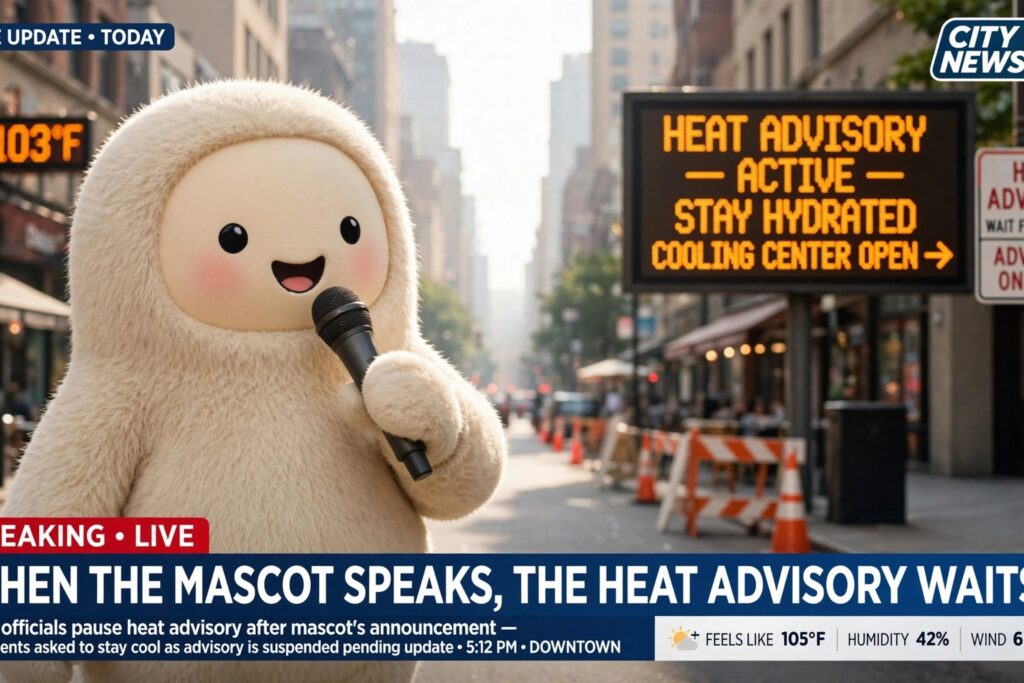
It began with a squeak.
Not the kind you hear from a loose floorboard or a protesting stapler, but the high-pitched, slightly nasal whine of Blaze, the anthropomorphic firefox mascot for HelixCorp’s regional soccer team, echoing down the marble hallway of the company’s wellness wing. Blaze had been stationed outside Director Elise Vaughn’s office for 47 minutes, holding a hand-drawn sign that read: ‘NO ROOT CANAL, NO GAME DAY.’
Vaughn, a former Olympic rowing coach turned corporate wellness architect, had just finished drafting the city’s first official heat advisory for the summer—a 10 a.m. memo urging employees to hydrate, shift outdoor meetings indoors, and avoid prolonged sun exposure between 11 a.m. and 4 p.m. She was about to hit send when Blaze tapped on the glass.
‘I’ve got molars like a shovel,’ Blaze declared, according to three witnesses who requested anonymity to avoid being assigned to mandatory mindfulness retreats. ‘Last Tuesday, I bit into a frozen yogurt swirl and felt something crack. Now I can’t cheer without wincing. If you want me to jump through flaming hoops at halftime, you better cover my crown.’
What followed was not a protest, but a pivot. Vaughn, recognizing the mascot’s distress as a legitimate occupational hazard under HelixCorp’s expanded ‘Whole Self’ wellness framework, did not dismiss the claim. Instead, she invoked Article 7.3 of the company’s Internal Wellbeing Accord—a rarely used clause allowing for temporary deferral of public health advisories when ‘non-physical employee wellbeing indicators’ reach critical thresholds.
Within hours, she convened the Bipartisan Commission on Mascot Health and Environmental Readiness (BCMHER), a body comprising two HR reps, one union delegate, the team’s nutritionist, a retired dentist from the company’s employee assistance program, and, oddly, the mayor’s deputy chief of staff, who had been seconded to HelixCorp under a public-private ‘Civic Wellness Exchange’ initiative.
The commission met in Conference Room B, where a whiteboard quickly filled with flowcharts titled ‘Tooth Pain → Morale Dip → Decreased Fan Engagement → Revenue Risk.’ Blaze, seated in a specially reinforced chair, presented a slideshow of dental X-rays annotated with arrows pointing to ‘potential fracture lines’ and a meme of a crying tooth fairy holding a union card.
‘This isn’t about snacks,’ said Dale Porritt, the union delegate, adjusting his tie. ‘It’s about precedent. If we ignore the mascot’s mouth, what’s next? Ignoring the janitor’s back? The barista’s wrist? The mascot’s dignity?’
The commission’s recommendation, delivered in a 12-page memo with appendices on fluoride protocols and the psychosocial impact of mascot discomfort, was clear: delay the heat advisory by 48 hours to allow time for Blaze to see an in-network endodontist and receive a temporary night guard. The advisory would be reissued only after a follow-up ‘oral readiness check’ confirmed the mascot could safely perform his signature ‘Flame Spin’ without risk of mandibular dislocation.
Reactions were mixed. In the breakroom, opinions split along snack lines. Those who favored granola bars praised Vaughn’s ‘holistic approach.’ Pretzel enthusiasts muttered about ‘mission creep.’ One anonymous engineer noted that the delay meant the city’s official heat warning would now coincide with the team’s playoff game—a potential liability if fans fainted in the stands.
Outside HelixCorp, the story leaked to a local blog, then picked up by a regional news outlet. Commenters debated whether the mascot’s demand was a legitimate labor issue or a symptom of wellness culture gone awry. A dentist from a neighboring town posted a video titled ‘My Professional Opinion on Blaze’s Bite,’ which garnered 14,000 views before being taken down for ‘unverified dental speculation.’
By day three, Blaze returned to work, sporting a temporary acrylic crown and a newfound reluctance to accept high-fives. The heat advisory was released as scheduled, albeit with a footnote: ‘Employees are encouraged to monitor not only their own hydration but also the wellbeing of workplace symbols, mascots, and other non-human morale agents.’
Vaughn declined to comment on whether she expected similar requests from the office plants or the breakroom espresso machine. But as she walked past Blaze, who was now gently tapping a cooling gel pack against his jaw with one paw, she paused.
‘You know,’ she said, ‘in my rowing days, we didn’t have mascots. We had coxswains who yelled and oars that blistered. But if this is what it takes to keep the team spirit intact…’ She shrugged. ‘I’ll take the commission.’
Fact or Fiction?
This story is FICTION. While corporate wellness programs increasingly address holistic employee wellbeing—including mental health, ergonomics, and even financial stress—there is no known instance of a mascot’s dental demand triggering a formal bureaucratic delay of a public heat advisory. The Bipartisan Commission on Mascot Health and Environmental Readiness, Article 7.3 of the Internal Wellbeing Accord, and the specific events described are invented for satirical effect. The piece uses straight-faced reporting to highlight the absurd lengths to which workplace wellness initiatives can sometimes stretch when taken literally.
Join the conversation
Load Facebook comments to read and reply using your Facebook account.