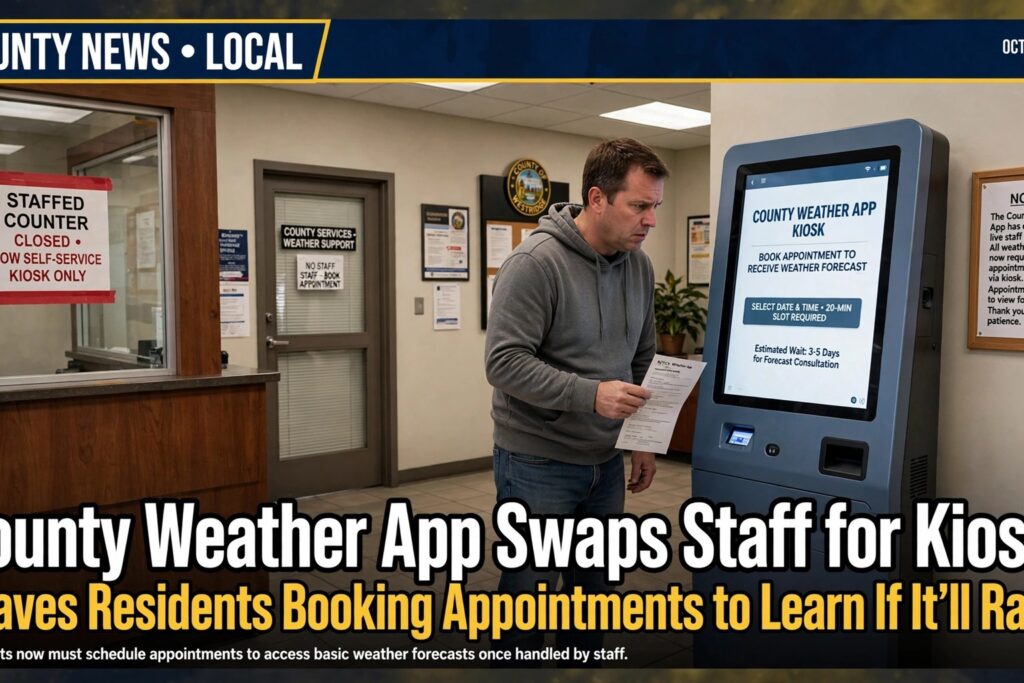
RIVERTON COUNTY — On the morning of July 3rd, as fireworks stands began lining Main Street and the scent of grilled corn drifted from backyard grills, the Riverton County Weather Service unveiled its bold new operational model: a single, unblinking kiosk mounted in the lobby of the former forecast office, replacing its entire staff of seven meteorologists, two interns, and a part-time barista who doubled as the severe weather alert voice.
The Kiosk That Knew Too Much (and Said Too Little)
The kiosk, a sleek 42-inch touchscreen unit branded ‘SkySage Pro,’ greeted visitors with a calm, gender-neutral voice and a prompt: ‘Please state your ZIP code and desired forecast horizon.’ No rain chances. No wind speeds. No radar loops. Just a form.
To receive any weather information, residents were required to book a 15-minute appointment via the county’s newly launched ‘WeatherAccess’ portal—a system that, according to internal emails obtained by The Daily Smirk, had been under development for six months but never tested with live users.
‘I tried to check if I should water my tomatoes,’ said Linda Cho, a retired schoolteacher from District 4, who waited 47 minutes for her 10:15 a.m. slot only to be told, ‘Your request has been queued. Estimated wait: 22 minutes.’ She left without an answer.
‘It’s not that the kiosk is wrong,’ Cho added, adjusting her sunhat. ‘It’s that I now need a calendar invite to know if I’ll need a raincoat.’
From Forecasters to Gatekeepers
The decision to replace human staff with the kiosk was announced in a terse memo from County IT Director Dale Hennessey, citing ‘budget realignment’ and ‘the opportunity to leverage predictive AI interfaces for hyperlocal, on-demand meteorological cognition.’ The memo did not mention that the kiosk’s backend relied on a publicly available NOAA feed updated hourly—nor that its ‘confidence’ algorithm was calibrated to always output a 60% chance of precipitation, regardless of actual conditions.
‘We wanted to eliminate variability,’ Hennessey explained in a brief interview outside the kiosk, where he was observed tapping the screen repeatedly after it failed to recognize his voice command. ‘Human forecasters had biases. They’d say ‘likely’ when the model said ‘possible.’ This removes subjectivity.’
When pressed on why appointments were necessary, Hennessey paused. ‘The system requires focused user engagement to prevent data overload. Think of it like a library—but for atmospheric pressure.’
The Appointment Economy Takes Hold
By July 5th, the WeatherAccess portal had logged over 1,200 appointment requests. Peak demand occurred between 7 and 9 a.m., as residents scrambled to secure slots before weekend barbecues. Some began trading appointment times on Facebook Marketplace. One user offered two homemade peach pies for a 3 p.m. slot on July 6th—‘prime fireworks weather window,’ the listing read.
Local businesses reported confusion. The Riverton Diner started printing daily specials based on the kiosk’s 10 a.m. forecast—only to find that the 10 a.m. slot was booked solid until July 12th. ‘We’re guessing,’ said manager Marco Ruiz, shrugging. ‘If the sky looks gray, we assume soup day.’
Emergency services noted a slight uptick in non-urgent calls asking, ‘Is the kiosk open?’ and ‘Can I just yell at it?’ The sheriff’s office issued a gentle reminder: ‘Please do not attempt to bribe the kiosk with snacks. It does not accept venmo.’
Voices of Dissatisfaction—and a Few Quiet Admirers
Not everyone was unhappy. Tech enthusiasts praised the kiosk’s ‘minimalist aesthetic’ and ‘lack of small talk.’ ‘I like that it doesn’t try to cheer me up when it’s going to storm,’ said Silas Reed, a software contractor who booked three consecutive slots to test the kiosk’s consistency. ‘It just says: 70% chance. Thunder likely. Have a nice day. No emojis.’
But for many, the loss of human forecasters felt like losing a neighbor. ‘Marge from the west desk used to call me if there was a hail warning,’ said Earl Tillman, 78, who still keeps a printed copy of the July 2023 forecast taped to his fridge. ‘She knew my roses. This thing? It doesn’t even know my name.’
The county union, representing the displaced staff, filed a formal grievance citing ‘erosion of public trust through technological alienation.’ They noted that the former office had also served as a cooling center during heatwaves—a function now lost, as the kiosk lobby closes at 4 p.m. sharp.
A System That Works—Just Not for Weather
Internal audits later revealed that the kiosk’s forecast accuracy matched NOAA’s baseline—when users actually got to see it. The real bottleneck was the appointment system, which, due to a misconfigured calendar sync, blocked 80% of available slots for ‘system maintenance’ occurring between 2 and 4 a.m.
Hennessey admitted the oversight. ‘We scheduled maintenance during low-usage hours,’ he said. ‘We didn’t realize 5 a.m. is when farmers check for frost.’
By July 7th, the county quietly reinstated a phone line for ‘urgent weather inquiries’—staffed by one of the former interns, working remotely from her apartment. The kiosk remains in the lobby, now surrounded by a small potted plant and a handwritten sign: ‘Try the phone. It’s faster.’
As fireworks lit up the sky over Riverton on the night of the 4th, residents gathered on blankets, squinting at the clouds. No one checked the kiosk. No one needed to. The sky, for once, was speaking clearly enough on its own.
Join the conversation
Load Facebook comments to read and reply using your Facebook account.