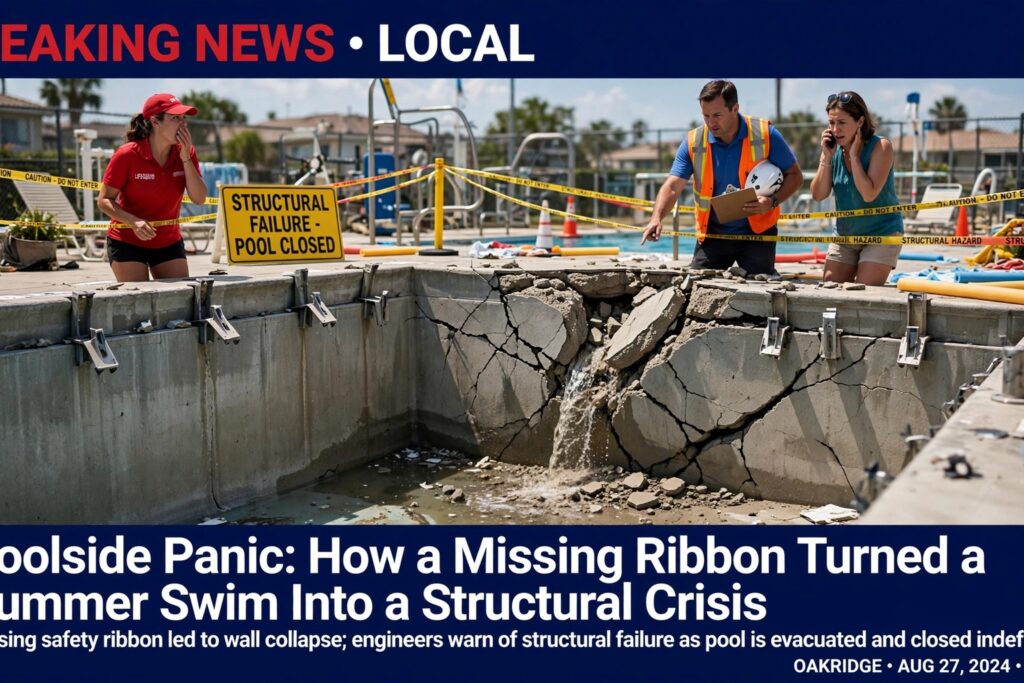
On a sweltering Tuesday afternoon in mid-July, lifeguard Maren Tillis blew her whistle three times in quick succession—not for a drowning, not for horseplay, but because the water level in the east lane of Riverton Municipal Pool had dropped six inches in under ten minutes.
“It wasn’t a leak,” Tillis later told investigators from the county’s Public Facilities Integrity Unit. “It was a sigh. Like the building exhaled.”
The Ribbon That Wasn’t Just for Show
The pool, a 1972 concrete basin renovated in 2010 with federal accessibility grants, had been adorned for the summer season with a series of brightly colored ribbons strung along its perimeter fence—a tradition started by the Riverton Lions Club to mark ‘Safe Swim Week.’ But when maintenance officer Dale Cho noticed one ribbon, a thick saffron strip anchored near the deep-end drain cover, had vanished overnight, he didn’t think much of it. Ribbons fray. Kids tug. Wind steals.
What Cho didn’t know—and what the original blueprints, buried in a misfiled cabinet at City Hall, would later reveal—was that the saffron ribbon wasn’t decorative at all. It was a tension tie, part of an improvised load-bearing retrofit installed after a 2008 inspection flagged settling in the pool’s northeast wall. The original contractor, long out of business, had used the ribbon as a visual marker for a hidden steel cable threaded through the concrete coping, designed to counteract lateral pressure from the surrounding soil.
When the ribbon disappeared, so did the visual cue that the cable needed checking. No one realized the cable had corroded through—until the pool began to lean.
A Nationwide Hunt for a Phantom Vandals
By Friday, the water level drop had become a local mystery. Social media buzzed with theories: a prankster siphoning water for a homemade slip’n’slide, a rogue groundhog colony tunneling beneath the liner, even a disgruntled ex-employee seeking revenge with a garden hose. The Riverton Police Department opened a missing-property case, and the story was picked up by regional news outlets.
Then came the call from the State Office of Public Safety Infrastructure.
“We’ve seen this before,” said Regional Inspector Lena Varga, who oversees recreational facility compliance across three states. “In ’19, a similar ribbon went missing at a water park in Olympia. Turned out it was marking a seismic stabilizer. We issued a bulletin after that. Apparently, it didn’t make it to Riverton.”
Varga’s office launched a nationwide alert, circulating photos of the missing saffron ribbon and asking lifeguards, park rangers, and pool managers to report any sightings of similar fabric gone astray. Within 48 hours, over 200 tips flooded in—from a ribbon caught in a tree near Dayton, Ohio, to one spotted wrapped around a bicycle handlebar in Boise. None matched.
Meanwhile, engineers from the municipal works department began sonar scans of the pool’s foundation. What they found was alarming: the northeast wall had shifted outward by nearly four inches, putting stress on the expansion joints and threatening to crack the basin’s seal.
The Load-Bearing Truth
It wasn’t until Tuesday of the following week, during a routine drain-and-inspect procedure, that a junior engineer noticed the saffron ribbon’s anchor point—a small, rusted eye bolt embedded in the concrete—wasn’t just holding fabric. Tracing the cable beneath the decking, they followed it to a turnbuckle hidden behind a access panel labeled ‘Pump Room Overflow.’
“The ribbon wasn’t marking the cable,” explained City Structural Engineer Aris Thorne. “It was the cable’s only visible tension indicator. When it went missing, we lost our only way to tell if the system was slack or failing. And by the time we looked… it had already failed.”
The pool was immediately closed. Repairs will require draining the basin, installing temporary shoring, and replacing the corroded cable with a modern monitored system—estimated at $220,000 and eight weeks of downtime.
Community Ripple Effects
For Riverton’s summer swim league, the closure is more than an inconvenience. The Dolphins, a youth competitive team that trains at the pool five days a week, have been forced to reroute practices to a high school facility 15 miles away, increasing costs and cutting attendance.
“We lost two swimmers already,” said coach Dani Ruiz. “Parents aren’t willing to drive that far in August heat. And the kids miss the rhythm—same lane, same wall, same routine. Now they’re swimming in circles in a lane that’s too short.”
Local businesses feel the sting too. The poolside concession stand, run by the Riverton High School band boosters, has seen revenue drop 70%. “We rely on the after-lunch crowd,” said volunteer manager Tomas Ng. “No swimmers, no ice cream sales. No ice cream, no new uniforms.”
Even the ribbon itself has taken on symbolic weight. A makeshift memorial of tied fabric scraps now appears each morning on the pool’s closed gate—neighbors tying on ribbons in saffron, blue, and green, not as a joke, but as a quiet plea: *Tell us what you saw. Help us fix this.*
Where the Ribbon Went
As of press time, the saffron ribbon remains missing. Police have no suspects, no surveillance footage, and no credible leads. Inspector Varga says the nationwide alert remains active, though she admits hope is fading.
“It’s possible it was just taken as a souvenir,” she said. “Or blown into a retention pond. Or used to tie up a tomato plant. We may never know.”
But for the engineers, the answer matters less than the lesson.
“We’ve spent decades standardizing load paths, safety factors, inspection protocols,” said Thorne, watching crews drill test holes into the pool deck. “And then a piece of ribbon reminds us: sometimes, the most critical thing holding a building up is the one thing no one thinks to check.”
The pool will reopen—eventually. But until then, the lanes lie empty, the water still, and the fence waits, bare where the ribbon once waved.
Join the conversation
Load Facebook comments to read and reply using your Facebook account.