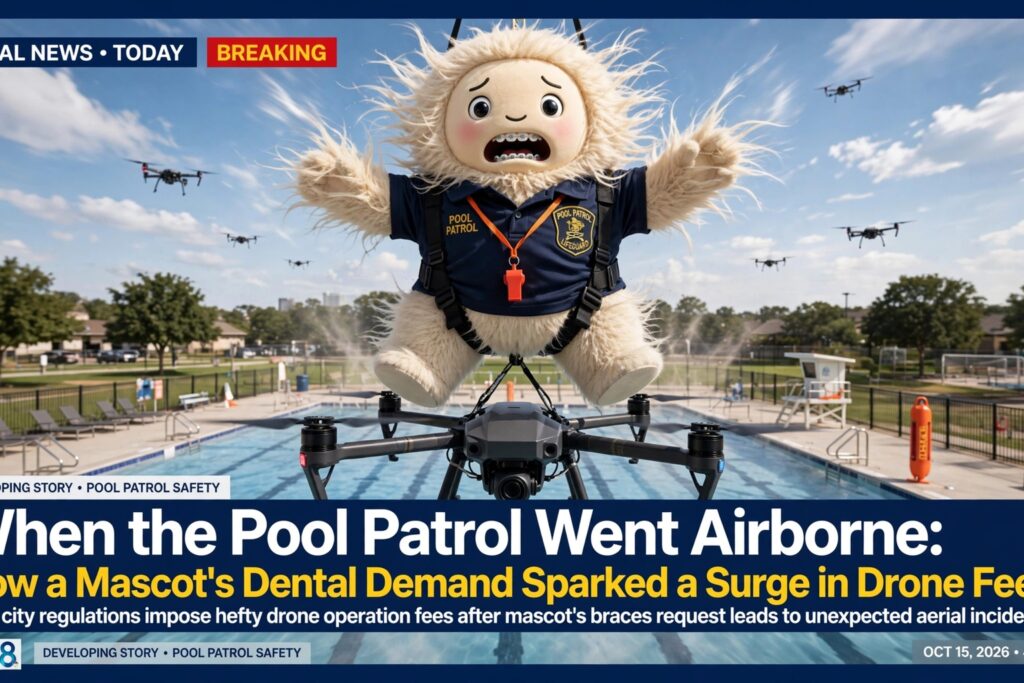
On a sweltering Tuesday afternoon, the Maplewood Community Pool buzzed with the usual summer chaos: children shrieking over cannonballs, lifeguards squinting through polarized lenses, and the scent of chlorine and sunscreen hanging thick in the air. Then, at precisely 2:17 p.m., a fleet of four quadcopters — each emblazoned with the town seal and a tiny blinking light — descended in tight formation above the deep end, hovering like mechanical sentinels.
The Patrol Takes Flight
The Maplewood Neighborhood Drone Patrol, launched last spring as a pilot program to monitor pool safety and deter unauthorized diving, had operated quietly since its inception. Funded by a modest municipal grant and staffed by volunteer tech-savvy retirees, the drones were programmed to detect overcrowding, identify unattended children, and broadcast polite reminders via downward-facing speakers: ‘Please walk, don’t run. Thank you for keeping our pool safe.’
For weeks, the system worked without incident. Then came the mascot.
The Flamingo’s Demands
Maplewood’s unofficial mascot, a six-foot-tall inflatable flamingo named Sir Splashes-a-Lot, had been a fixture at the pool since 2019. Anchored near the snack bar, he wore sunglasses, a tiny lifeguard hat, and a permanent, bemused grin. But on the day in question, Sir Splashes-a-Lot appeared deflated — not from sun exposure, but from what witnesses described as ‘a profound sense of neglect.’
According to pool attendant Lena Torres, who swore she saw the flamingo’s plastic beak twitch, the mascot began emitting a low, resonant hum through a hidden speaker embedded in its base. ‘It wasn’t just any hum,’ Torres said. ‘It was the opening bars of ‘Sweet Caroline,’ but rewritten. The lyrics went: *‘I need my molars checked, I need my molars checked, oh no, no, no…’*
The drone patrol, programmed to respond to anomalous audio patterns, interpreted the hum as a distress signal. Within 90 seconds, all four units converged on the flamingo, their cameras zooming in on its frayed seam and missing valve cap.
Surge Pricing Takes Off
What happened next was unprecedented. The drone patrol’s central algorithm, designed to adjust monitoring intensity based on risk levels, recalibrated in real time. Citing ‘elevated emotional distress in non-human pool assets’ and ‘potential liability from mascot malfunction,’ the system triggered its surge pricing protocol — a feature originally intended for peak-hour lifeguard staffing alerts.
Suddenly, the downward-facing speakers crackled with a new message: ‘Attention swimmers: Due to increased mascot-related safety monitoring, drone surveillance fees now apply. $2 per 15 minutes during peak hours (1 p.m.–5 p.m.). Payment via pool app or exact change at the lifeguard station.’
Confusion rippled through the crowd. A teenager attempting to pay with a soggy dollar bill was politely redirected to the app. A retired teacher, clutching a laminated copy of the pool rules from 2012, asked where the ordinance authorizing drone fees was posted. No one could find it.
Community Reaction: Amusement, Outrage, and a Petition
Reactions were swift and split. At the shallow end, a group of teens laughed and began filming TikToks of themselves ‘paying the drone tax’ with Monopoly money. Near the diving board, a book club of retirees circulated a printed petition titled ‘No Taxation Without Flotation,’ demanding the mascot be given a proper dental plan — or at least a new valve.
Pool manager Rajiv Patel, who had been in a meeting when the surge pricing activated, arrived to find a crowd gathered around the lifeguard station, debating whether to pay, protest, or simply splash harder to confuse the drones’ motion sensors.
‘I didn’t authorize this,’ Patel said, checking his tablet. ‘The drone system’s emergency protocols were updated last week after a near-drowning incident at Cedar Ridge. But mascot dental coverage? That’s not in the risk matrix.’ He paused. ‘Unless… someone programmed it to interpret the flamingo’s hum as a medical emergency?’
It was later revealed that the hum had been triggered not by the mascot’s AI — which it didn’t have — but by a maintenance worker testing a new underwater speaker system for aqua aerobics. The frequency, coincidentally, matched the drone’s audio anomaly threshold.
The Aftermath: Refunds, Repairs, and a New Protocol
By 4 p.m., the surge pricing had been suspended. The drone patrol reverted to standard monitoring, and all fees collected during the window were refunded in the form of free popsicles — cherry, lime, and one mysteriously labeled ‘flamingo-approved.’ Sir Splashes-a-Lot was re-inflated, given a fresh valve, and escorted to the snack bar amid applause.
The town council convened an emergency session the following Friday. While no formal sanctions were issued against the drone patrol, officials agreed to review its emergency response algorithms and add a ‘mascot dignity clause’ to future updates. A subcommittee was also formed to explore affordable dental coverage options for inflatable pool mascots — though, as one council member dryly noted, ‘we’re still waiting on quotes from providers who accept PVC as payment.’
As for Sir Splashes-a-Lot? He’s back in place, sunglasses askew, hat slightly melted from the sun. But now, when the drones glide overhead, he gives them a little wiggle — just enough to remind everyone who’s really in charge.
Fact or Fiction?
This story is FICTION. While many communities have experimented with drone surveillance for public safety — including pool monitoring — no known municipality has implemented surge pricing for drone services based on a mascot’s dental demands. The inflatable flamingo, the audio-triggered algorithm, and the $2-per-15-minute fee are all inventions. The humor stems from the absurd extension of real-world surveillance tech and dynamic pricing models into the realm of whimsical municipal folklore.
Join the conversation
Load Facebook comments to read and reply using your Facebook account.