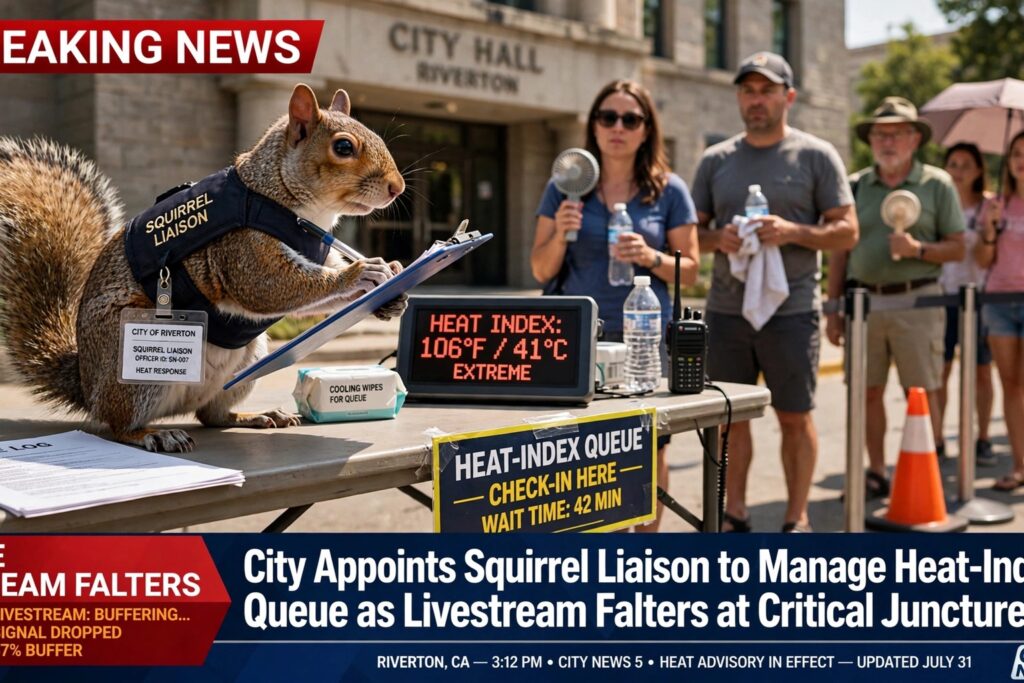
The sun hung low but merciless over Riverton Plaza on Tuesday afternoon, turning concrete into a griddle and optimism into a damp stain on the back of necks. By 3:14 p.m., the city’s official Heat Index Livestream — a grainy feed from a weather station atop the old post office — had begun buffering at precisely 102.7°F, the threshold at which municipal misting stations activate and shaded bench reservations open. The spinning wheel persisted, unblinking, through the critical 17-second window when the system normally pushes real-time alerts to residents’ phones.
It was during this agonizing lag that Maren Voss, a retired librarian with a sunhat woven from recycled campaign flyers, approached a small wooden kiosk near the fountain. Painted in cheerful acrylics and staffed by a woman in a vest emblazoned with a golden acorn, the kiosk bore a hand-lettered sign: Office of Municipal Squirrel Liaison — Priority Access Now Available.
“I’ve been waiting 22 minutes for the stream to unfreeze,” Voss said, adjusting her sunglasses. “Then I saw the squirrel lady waving me over. Said she could get me to the front of the mist line if I promised not to feed the wildlife. Sounded fair.”
The Office of Municipal Squirrel Liaison, established last spring after a city council resolution cited ‘increasing rodent-mediated microclimate awareness’ as a public health adjunct, had quietly begun offering premium queue placement to residents experiencing heat-index-related distress. Liaison Dolores Finch, a former urban forester with a master’s in animal behavior and a sideline in nut-based conflict mediation, explained her role with the calm of someone accustomed to interpreting tail flicks as barometric pressure.
“Squirrels don’t lie about heat,” Finch said, adjusting her binoculars as a gray fox squirrel paused on a nearby oak limb, tail flicking in a pattern she interpreted as ‘moderate distress, seek evaporative cooling.’ “They move to the north side of the trunk before humans even feel the shift. When the livestream glitches — and it does, every afternoon between 3 and 3:30 — I use their behavior as a proxy. If they’re burying nuts shallowly, the index is spiking. If they’re flat on their bellies, it’s time to open the premium queue.”
The premium queue, marked by a series of pinecone-shaped stanchions leading to a reserved misting station beneath a canopy of London plane trees, operates on a trust-based system. Residents earn priority by reporting squirrel activity — tail position, foraging speed, vocal chatter — via a simple card dropped into a slot on Finch’s kiosk. Accurate reports earn ‘acorn credits,’ redeemable for faster access, complimentary electrolyte tablets, or a shaded bench reservation for up to 45 minutes.
By 3:41 p.m., the livestream finally resolved, flashing a bold red alert: HEAT INDEX: 104.3°F — LIMIT OUTDOOR EXERTION. But the damage, in terms of public frustration, had already been done. A small crowd had gathered near the kiosk, not to complain, but to inquire about acorn credit eligibility.
“I told Dolores I saw three squirrels doing that side-to-side shimmy thing on the fence,” said Marcus Lee, a bike courier wiping sweat from his brow with a bandana. “She said that’s ‘thermal displacement behavior’ — worth two credits. Got me to the misters in 90 seconds. Meanwhile, the app’s still showing yesterday’s data.”
City officials, when reached for comment, acknowledged the livestream’s recurring buffering issues but declined to explain why the municipal squirrel liaison’s observations were now being cited in internal heat-response briefings. A spokesperson for the Department of Environmental Comfort noted only that ‘non-traditional bioindicators have shown surprising correlation with microclimate variance in urban canopies’ and that Finch’s data ‘is currently under peer review by the State Urban Ecology Consortium.’
The liaison’s influence extends beyond queue management. Finch has begun advising park maintenance on optimal misting nozzle placement based on squirrel travel corridors, and her weekly ‘Nut & Forecast’ bulletin — posted on the kiosk and emailed to subscribers — now includes a ‘squirrel stress index’ alongside UV ratings and pollen counts.
On Wednesday morning, as the livestream buffered again at 10:03 a.m., a line had already formed at the kiosk. Finch, sipping tea from a thermos labeled Not for Squirrels, handed out laminated cards depicting squirrel postures and their corresponding heat-index implications. A child in a dinosaur backpack pointed at a sketch of a squirrel lying flat with all four limbs splayed.
“That’s ‘heat surrender,’” Finch explained. “Means it’s 106°F in the sun. Go find shade. And maybe leave a water dish out — just not too close to the trash cans. We’re trying to keep the peace.”
As the sun climbed and the livestream remained stubbornly frozen, the premium queue grew — not with anger, but with a quiet, collective trust in the judgment of creatures who, unlike the city’s weather feed, never buffer when it matters most.
Join the conversation
Load Facebook comments to read and reply using your Facebook account.