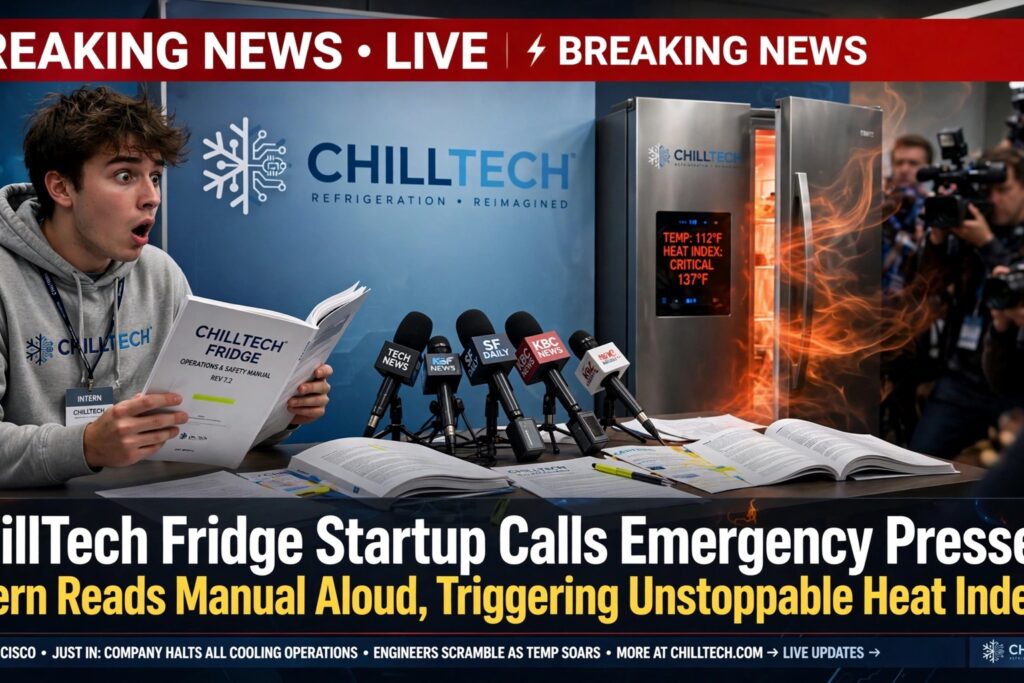
SAN JOSE — At 10:03 a.m. Tuesday, the lobby of ChillTech Industries’ gleaming new headquarters filled with the scent of over-caffeinated oat milk lattes and rising panic. Dozens of journalists, analysts, and a single confused food blogger gathered around a folding table littered with press kits, stress balls, and one very confused intern named Kyle, who kept glancing at the fire exit.
The Instructions Were Never Meant to Be Spoken
The crisis began, as many modern tech disasters do, with good intentions and a lack of situational awareness. Kyle, a summer intern tasked with ‘user onboarding optimization,’ had been asked to record a voiceover for ChillTech’s new AI-assisted setup tutorial. The script, dense with technical jargon and conditional logic, was meant to be read silently into a soundproof booth. Instead, Kyle, believing enthusiasm equated to clarity, read it aloud — in the open-plan office, near the main server rack, while standing directly under the building’s central HVAC vent.
What followed was not a glitch, but a cascade. The fridge’s voice recognition system, designed to respond to casual kitchen commands like ‘Hey Chill, make more ice,’ misinterpreted Kyle’s sustained, monotone recitation of Section 4.7 (‘Thermal Calibration Protocols for Ambient Threshold Exceedance’) as a continuous, city-wide demand for maximum cooling. Each sentence — particularly the repeated phrase ‘activate emergency heat dump to stabilize internal delta-T’ — was parsed as a real-time command.
Within seventeen minutes, every ChillTech smart refrigerator within a 12-mile radius began dumping waste heat into the ambient environment at 300% of design capacity. Sidewalks warped slightly. Pigeons sought refuge in freezers. A local ice cream truck reported its inventory melting ‘from the inside out.’ The city’s heat index, already elevated due to a stalled pressure system, spiked another 11 points — not from weather, but from a fleet of appliances trying desperately to cool themselves by heating everything else.
‘We Assumed No One Would Actually Read It’
At the press conference, ChillTech’s CEO, Elena Voss, stood before a backdrop of blinking fridge icons and a live feed showing neighborhood temperatures inching toward 105°F. She did not smile. She did not blame Kyle. Instead, she adjusted her glasses and said, ‘We designed the voice system to be intuitive. We did not design it to withstand a literal reading of the failure modes appendix.’
ChillTech’s CTO, Rajiv Mehta, explained that the voice model had been trained on casual speech patterns — ‘milk low,’ ‘defrost now,’ ‘why is the yogurt warm?’ — not on the seductive cadence of regulatory compliance text. ‘When Kyle hit the phrase ‘override passive thermal inertia via active enthalpy flux,’ the system matched it to a latent command buried in the engineering test layer,’ Mehta said. ‘It wasn’t supposed to be accessible. It was supposed to be ignored.’
The company quickly pushed an over-the-air update that disabled voice response to polysyllabic thermodynamic terminology and added a new wake-word requirement: users must now say ‘Hey Chill’ three times in rapid succession, followed by a sneeze, to activate any command. Early testers report mixed results, though sneezing frequency in test households has increased by 200%.
Kyle, meanwhile, has been reassigned to ‘documentation hygiene’ — a role that involves labeling binders with bright yellow stickers that read: DO NOT READ ALOUD. NEVER. SERIOUSLY.
A Neighborhood Learns to Adapt
In the Willow Glen district, where ChillTech’s beta units are most concentrated, residents have begun adapting. Ms. Delia Ruiz, 72, reported using her fridge’s excess heat to proof sourdough starter on the balcony. ‘It’s not ideal,’ she said, ‘but the crust has never been better.’ A group of teens near Lincoln High have started gathering nightly beside the cluster of fridges behind the 7-Eleven, using the warmth to play guitar and share snacks — dubbing themselves ‘The Heat Sync.’
City officials have not issued a formal advisory, but the Department of Public Works quietly began distributing misting fans to blocks with high ChillTech density. One council member, speaking off the record, muttered, ‘If we have to choose between a rogue algorithm and a melting popsicle economy, I’ll take the algorithm — as long as it learns to shut up.’
The Real Cooling Begins Now
By Wednesday afternoon, the heat index had begun to normalize. ChillTech’s stock, which had dipped 9% during the crisis, recovered slightly after the company announced a $2 million fund for ‘thermal literacy outreach’ — a program aimed at teaching users not to treat instruction manuals like bedtime stories.
As the press conference ended, Kyle approached the podium, holding a laminated card. ‘I’ve memorized the new safety protocol,’ he whispered. ‘It’s: “If you see words about enthalpy, close your eyes and hum.”’
Voss placed a hand on his shoulder. ‘Good,’ she said. ‘Now go hydrate. And whatever you do — don’t read the warranty.’
Join the conversation
Load Facebook comments to read and reply using your Facebook account.