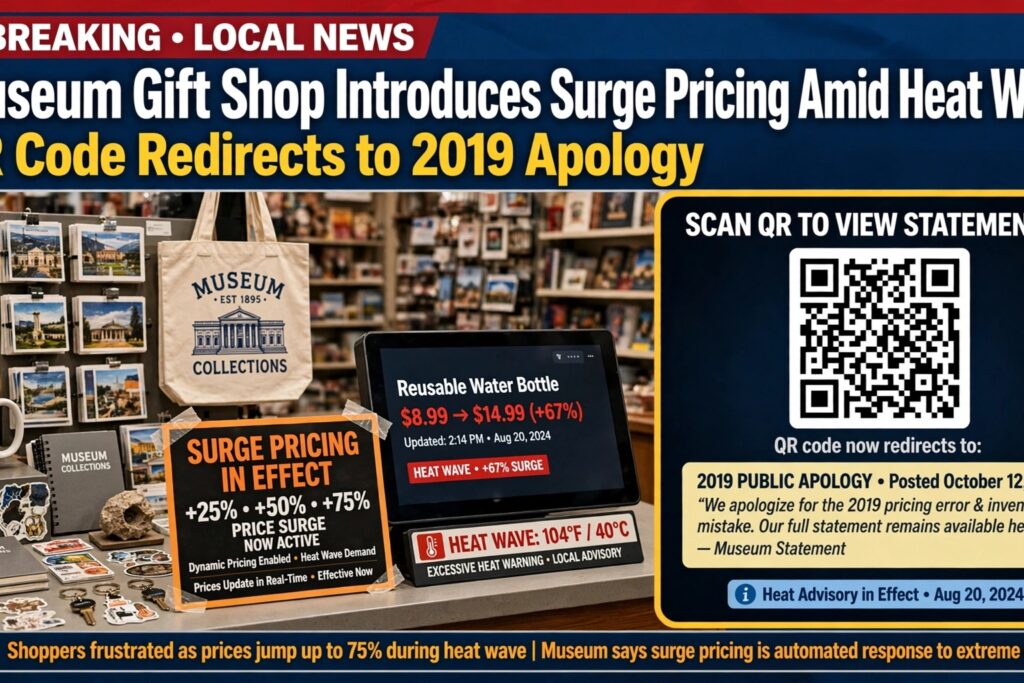
Under a relentless sun that turned the museum’s marble steps into a griddle, visitors to the National Museum of American Folklore began noticing something odd about the gift shop’s pricing.
By 10 a.m., a single bottle of chilled water cost $28. A pack of gum, normally $1.50, was listed at $12. ‘It’s dynamic pricing,’ explained Marisol Chen, the shop’s newly appointed curator of retail experience, adjusting her fan with one hand while tapping a tablet with the other. ‘We’re responding to real-time demand. When the heat index hits 115, comfort becomes a premium.’
The policy, dubbed ‘Thermal Equity Adjustment’ in an internal memo leaked to the break room refrigerator, went into effect after three consecutive days of heat advisories. Chen, who previously managed pop-up merch stands at music festivals, insisted the model was ‘industry standard’ and pointed to a small placard near the register that read: ‘Prices fluctuate with environmental conditions to ensure fair access during peak demand.’
Visitors balked. Retiree Henry Poole, visiting from Ohio with his granddaughter, said he paid $22 for a magnet that usually sold for $4. ‘I thought it was a mistake,’ he said. ‘Then I saw the QR code on the receipt.’
Scanning the code led not to a menu or FAQ, but to a grainy YouTube video titled ‘We’re Sorry: A Message from the Gift Shop Team,’ uploaded in June 2019. In it, a younger Chen—then a seasonal associate—stood beside a malfunctioning cotton candy machine, apologizing for ‘unexpected price spikes during the Juneteenth weekend rush’ and promising ‘better communication moving forward.’
‘I didn’t realize we were still using that,’ Chen said when confronted, blinking against the glare of the tablet screen. ‘That video was meant to be archived. I guess the link never got updated.’ She added that the current pricing was ‘not a mistake’ and that the apology video was ‘contextual, not contradictory.’
The museum’s director, Dr. Eleanor Vance, declined to comment on record but confirmed in a background briefing that the gift shop operates as a ‘separate revenue unit’ with autonomy over pricing strategy. ‘We support innovation in visitor experience,’ she said. ‘Even when it involves… creative interpretations of supply and demand.’
By afternoon, a line formed not at the ice cream cart but at the shop’s exit, where visitors gathered to compare receipts and debate whether the surge pricing constituted price gouging or avant-garde performance art. A group of high school students on a field trip began chanting, ‘Scan the code, get the truth!’ while others simply bought postcards and left.
Local consumer advocates called for an investigation, citing state laws against excessive pricing during emergencies. The museum’s legal team responded that the heat, while uncomfortable, did not qualify as a declared emergency under state statute—and that no one was forced to buy anything.
Chen, meanwhile, has begun testing a new variable: offering 10% discounts to visitors who arrive before 9 a.m., when the heat index is still below 100. ‘It’s about rewarding foresight,’ she said. ‘Planning ahead should have its perks.’
As the heat wave showed no signs of breaking, the gift shop’s sales reportedly doubled—though returns spiked, mostly for items purchased after 2 p.m. The apology video, unintentionally resurrected, has since been viewed over 800,000 times. Comments range from ‘I came for the dinosaurs, stayed for the irony’ to ‘Is this the new normal?’
For now, the QR code remains unchanged. And every time someone scans it, they’re reminded: in the museum of American folklore, even the present can feel like a footnote from the past.
Public Backlash and the Unintended Meme Economy
Within hours of the surge pricing rollout, social media erupted with a wave of satirical posts comparing the museum’s new pricing model to airline baggage fees and concert ticket scalping. One viral TikTok, filmed by a disgruntled visitor holding a melting popsicle, showed the QR code scanning to a 2019 apology video from the museum’s former director — who, in the clip, solemnly vowed ‘never to commodify the visitor experience again’ while standing in front of a now-removed exhibit on ethical consumerism. The irony was not lost on commentators: the apology video, originally hosted on the museum’s own server, had been archived and forgotten… until the QR code resurrected it as a digital punchline.
Meanwhile, the gift shop’s best-selling item shifted overnight from branded tote bags to a limited-edition ‘I Survived the Heat Wave Surcharge’ enamel pin — designed, ironically, by a local art student who’d been denied entry earlier that day due to inability to pay the $22 ‘peak thermal access’ fee. The pin, featuring a sweating thermometer wearing sunglasses and holding a tiny fan, sold out in 47 minutes. Museum staff, initially baffled, began quietly restocking it behind the counter — not as merchandise, but as a peace offering. One intern confessed they’d started accepting Venmo payments for the pins ‘off the books’ just to keep the line moving.
The Quiet Rebellion: When Art Fights Back
By day three, the museum’s curators launched a countermove. In the contemporary wing, they installed an unannounced, interactive piece titled Thermal Equity: a wall-mounted thermostat that, when adjusted by visitors, triggered a real-time discount on gift shop purchases — but only if the collective average temperature setting dropped below 72°F. The catch? The thermostat was locked in a glass case, accessible only by solving a riddle etched into its frame: ‘What costs nothing but is worth everything when shared?’
The answer, revealed after hours of collective guessing, was ‘shade.’ Visitors began bringing umbrellas, hats, and even cardboard signs to cast shadow over the sensor. A spontaneous coalition formed: families, tourists, and local homeless advocates alike took turns shading the device, turning the act into a quiet, communal protest. By closing time, the average temperature reading had plunged to 70°F — triggering a 15% discount across the shop. The museum’s director, watching the live feed from her office, smiled for the first time in days. She didn’t announce it. She just ordered two more boxes of the enamel pins.
As the heat wave broke and prices returned to normal, the museum left the thermostat case in place — now labeled ‘A Reminder: Comfort Is Not a Commodity’. The QR code, meanwhile, still points to the 2019 apology. But now, when you scan it, a new line appears beneath the video: ‘We’re still listening. And we’re still learning.’
Join the conversation
Load Facebook comments to read and reply using your Facebook account.