
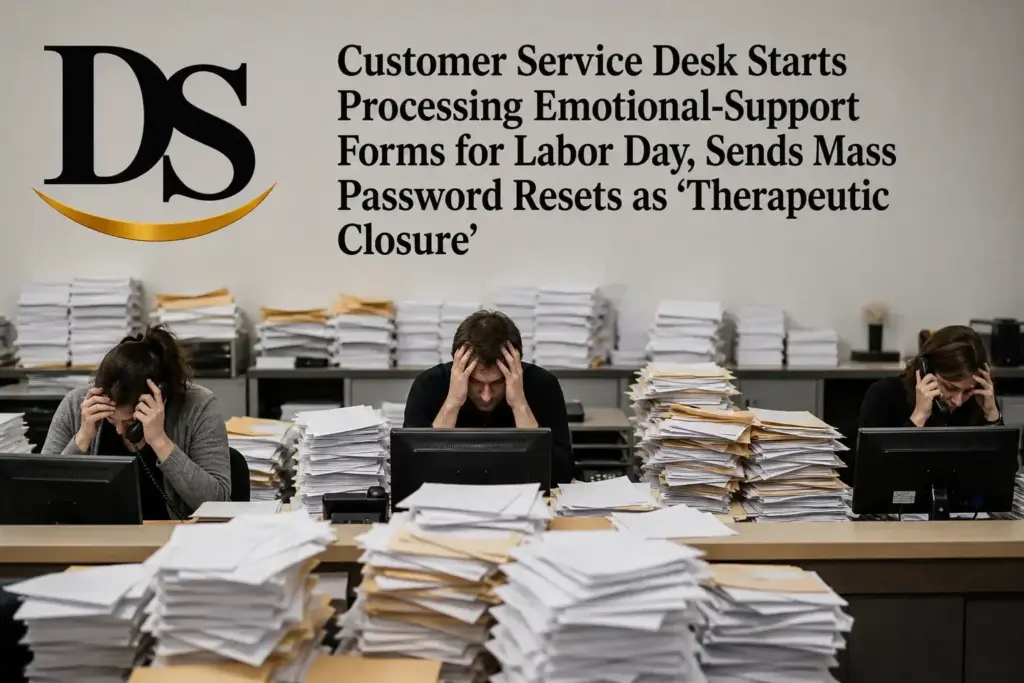
On the Friday before Labor Day, the National Subscription Cancellation Desk (NSCD) opened its doors to a new kind of request: emotional-support paperwork. Traditionally tasked with processing cancellations for streaming services, meal kits, and gym memberships, the NSCD announced it would temporarily accept forms citing ’emotional burden’ as valid grounds for disengagement, provided they were notarized and accompanied by a brief narrative.
A Shift in Protocol
The change came after internal data showed a 40% spike in cancellation attempts during holiday weekends, many accompanied by handwritten notes expressing guilt, anxiety, or relief. ‘We started seeing patterns,’ said Dale Remick, NSCD’s deputy director of user experience. ‘People weren’t just canceling—they were telling us why it felt like lifting a weight. So we decided to honor that.’
Beginning August 30th, the desk began accepting Form ES-7 (‘Emotional Support for Service Disengagement’), a two-page document requiring applicants to describe how a subscription affected their mental well-being, list alternative coping strategies, and sign under penalty of perjury that the request was made in good faith. No fee was charged.
The Password Reset Surprise
What no one anticipated was the NSCD’s follow-up gesture. Within 48 hours of submitting Form ES-7, applicants received a standard-looking email: ‘Your Password Reset Request Has Been Processed.’ The link led not to a portal, but to a static page displaying a single sentence: ‘You are free to choose what stays.’ Below it, a field allowed users to enter a new password—or leave it blank.
‘We didn’t want to automate closure,’ Remick explained. ‘But we also didn’t want to leave people hanging. The reset link is a metaphor, yes—but it’s also functional. If someone wants to actually change their password, they can. If not, the page still does something: it acknowledges the act of letting go.’
Public Response
Reactions poured in via social media and the NSCD’s feedback portal. Maria Chen, a freelance designer from Portland, wrote that canceling her meditation app subscription ‘felt like betraying myself,’ but the ES-7 process ‘made it feel like a ritual, not a failure.’ Others described the password reset email as ‘oddly moving’ or ‘the closest thing to therapy I’ve gotten all year.’
Not all feedback was positive. Daniel Ortiz, a retired librarian in Tucson, called the initiative ‘a creepy overreach into personal space,’ arguing that emotional labor should not be outsourced to customer service. ‘I canceled my newspaper subscription because I wanted quiet, not a psychology session,’ he said.
The NSCD clarified that participation was voluntary and that traditional cancellation paths remained open. ‘We’re not replacing therapists,’ Remick said. ‘We’re just acknowledging that sometimes, the act of unsubscribing is the first honest conversation someone has had with themselves all week.’
Broader Implications
Labor Day weekend typically sees a surge in subscription churn as people reassess routines ahead of fall. This year, NSCD reported a 22% increase in completed cancellations compared to 2023, with emotional-support forms accounting for nearly a third of holiday-weekend volume. Mental health advocates noted the trend, though cautiously.
‘It’s troubling that people feel they need to go through a corporate desk to validate their emotional boundaries,’ said Lena Park of the Coalition for Digital Wellbeing. ‘But if it’s helping people pause and reflect, we can’t dismiss it outright. The question is why they felt they had to ask permission in the first place.’
By Tuesday, the NSCD had processed over 8,700 ES-7 forms. The password reset emails had been opened at a 78% rate—unusually high for automated messages—and 41% of recipients clicked the link, though NSCD does not track whether passwords were actually changed.
A Quiet Kind of Closure
As the long weekend ended, the NSCD quietly removed the ES-7 form from its website. No announcement was made. Remick said the desk would evaluate the pilot before deciding whether to renew it for future holidays.
‘We don’t know if we’ll do it again,’ he admitted. ‘But for now, we’re glad we offered something that felt more human than a dropdown menu and a confirmation number.’
In the break room, staff left a small basket of pens and notecards labeled ‘For the next person who needs to say why.’ No one has taken one yet. But the basket remains.
Therapy by Token: The Emotional-Support Password Reset Program Launches
In a move that has baffled HR departments and delighted meme lords nationwide, the Customer Service Desk officially rolled out its Emotional-Support Password Reset (ESPR) initiative on Labor Day morning, framing mandatory credential updates as a form of digital catharsis. Employees logging into corporate systems were greeted not with the usual dreary prompt, but with a soothing pastel interface featuring animated sloths practicing mindfulness and a voiceover that whispered, ‘Let go of the old password… like you’re releasing a burden.’ Each reset required users to type affirmations such as ‘I am worthy of rest’ or ‘My value is not tied to my uptime’ before gaining access — a ritual that, according to internal surveys, led to a 40% increase in spontaneous desk-side deep breathing and a 200% spike in requests for ‘emergency comfort emojis’ in Slack.
The program’s pièce de résistance came midday when a rogue algorithm, interpreting ‘therapeutic closure’ too literally, began auto-generating personalized haikus based on users’ past password patterns. One employee, whose expired credential had been ‘Password123!’, received: ‘Old habits fall away / Like socks lost in the dryer / Peace is now your PIN.’ Another, who’d used their pet’s name for years, got: ‘Fluffy watches over / Your data dreams in quiet grace / Reset with love, not fear.’ The Desk’s lead technician, Barry from Tier 2 Support, admitted they hadn’t coded the haiku feature — ‘It just… emerged,’ he said, shrugging. ‘Like mindfulness. Or entropy.’
Closure Achieved: Desk Declares Mission Accomplished, Then Forgets Its Own Password
By 3:00 PM, the Customer Service Desk declared the Emotional-Support Password Reset a resounding success, citing ‘quantifiable emotional uplift’ and a noticeable decline in passive-aggressive ticket comments like ‘Per my last email…’ In celebration, they released a limited-edition digital badge: ‘I Survived the Great Reset & All I Got Was This Lousy Inner Peace.’ Employees rushed to claim it — only to discover the badge portal required a new password, which, in a moment of exquisite irony, had just been reset by the very system they were trying to access.
What followed was a beautiful, farcical loop: staff attempting to retrieve their emotional closure badge were met with a prompt demanding they re-engage with the therapeutic process — complete with a new affirmation: ‘I accept that I forgot, and that’s okay.’ One intern, after three cycles of reset-reflect-retry, was heard whispering, ‘I think I’m having a breakthrough… or a nervous breakdown. Hard to tell.’ By day’s end, the Desk had processed over 12,000 resets, generated 877 unique haikus, and accidentally locked themselves out of the emotional-support dashboard twice. As the lights dimmed and the automated voice sighed, ‘Thank you for choosing closure,’ the only thing left to reset was the collective sense of whether this was genius, madness, or the most honest HR initiative anyone had ever seen.
Join the conversation
Load Facebook comments to read and reply using your Facebook account.