
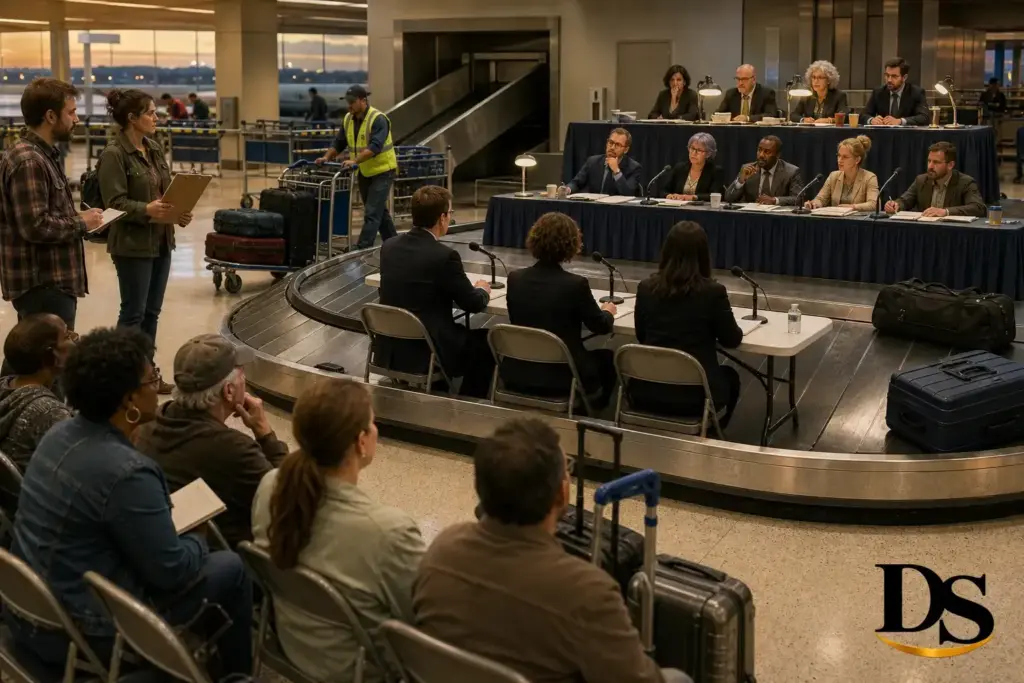
The contract arrived on a Tuesday, tucked between a memo about runway de-icing fluid and a notice regarding lost luggage reclamation fees. No press release. No public hearing. Just a single-spaced PDF labeled ‘Election Day Discourse Modernization Initiative – Phase One’ and a signature line from the City’s Deputy Procurement Officer, who, according to internal emails, had ‘never met the committee but trusted their baggage handling instincts.’
The Committee That Knows Where Your Suitcase Went
The Airport Baggage Committee — officially the Municipal Aviation Luggage Oversight Board (MALOB) — had, for the past three years, earned a reputation for two things: recovering oddly specific lost items (a left-handed ukulele, a jar of fermented shark, a single rollerblade) and holding marathon meetings where members debated whether ‘carousel speed’ constituted a constitutional right under the implied warranty of smooth transit. Their expertise, they argued, was in managing flow, anticipating bottlenecks, and calming agitated crowds — skills, they insisted, were transferable to electoral participation.
‘We don’t just move bags,’ said MALOB Chairperson Dale Henderson, adjusting his lanyard during a Zoom call with city officials. ‘We manage human anxiety in high-stress, time-sensitive environments. Election Day is just another conveyor belt — except instead of suitcases, it’s ballots, tempers, and misinformation.’
The no-bid contract, valued at $2.3 million, tasked MALOB with redesigning the ‘chatter infrastructure’ of polling places: installing voice-modulating kiosks to reduce partisan shouting, deploying color-coded wristbands to signal voter intent (green for undecided, red for ‘I’ve made up my mind and will not be swayed,’ yellow for ‘I need a snack and a hug’), and implementing a real-time ‘mood radar’ system adapted from baggage claim sentiment analysis.
‘It’s not surveillance,’ Henderson insisted. ‘It’s predictive empathy.’
The Watchers Emerge
Within 48 hours, a flyer appeared on community boards, library windows, and the inside of toilet stalls at the public pool: ‘Forming: The Second Committee to Watch the First Committee.’ No logo. No leadership. Just a QR code linking to a Google Doc titled ‘MALOB Watch: Notes, Concerns, and Suspicious Lanyard Colors.’
By week’s end, over 200 residents had signed up. They called themselves the Vigilant Electorate Oversight Network (VEON). Their mission: to observe, document, and occasionally question whether MALOB’s interventions were improving democracy or just making it more efficiently confusing.
‘They’re putting wristbands on voters like they’re tagging luggage,’ said VEON’s self-appointed liaison, Mira Chen, a retired librarian who now spends her mornings taking notes on a clipboard labeled ‘Observations: Day 3.’ ‘Last Tuesday, I saw a woman in the green zone arguing with a man in the red zone about whether avocado toast counts as a hot breakfast. The mood radar flashed ‘elevated tension.’ A MALOB intern handed them both complimentary stress balls. I wrote it down.’
VEON began publishing daily briefings: ‘MALOB deployed 12 ‘calm-down’ puppets at Precinct 7. One resembled a confused alpaca. Voters reacted with laughter. Or possibly distress. Inconclusive.’ Another entry: ‘MALOB’s mood radar misidentified a toddler’s tantrum as ‘high civic engagement.’ No correction issued.’
The city, meanwhile, declined to comment on either committee’s activities, citing ‘ongoing operational integrity.’ A leaked internal email, however, showed the Deputy Procurement Officer writing: ‘If VEON starts auditing our wristband supply chain, we may need to invoke the Luggage Transfer Protocol.’
Democracy on the Carousel
On Election Day, the scene at polling places was surreal yet strangely orderly. Voters moved through checkpoints where MALOB volunteers, wearing vests with reflective stripes and tiny luggage tags that read ‘Handle with Care – Civic Duty,’ guided them to stations based on their wristband color. The mood radar, mounted on a tripod beside the ballot scanner, pulsed softly in shades of blue and amber.
VEON observers, stationed in folding chairs with binoculars and thermoses of tea, took turns noting anomalies. At one precinct, a voter in the yellow zone was escorted to a ‘snack and hug’ station after sighing loudly. At another, a MALOB volunteer attempted to de-escalate a heated debate about ranked-choice voting by offering a stress ball shaped like a rotating baggage carousel.
‘It’s not perfect,’ admitted Henderson, watching from a mobile command van painted to resemble a suitcase. ‘But turnout was up 18% in precincts using our system. And fewer people yelled at the poll workers. That’s a win.’
VEON’s final report, released the following Friday, was less enthusiastic. ‘While we acknowledge reductions in overt hostility,’ it read, ‘we remain concerned about the normalization of behavioral nudging in civic spaces. Also, the alpaca puppet has developed a cult following. We recommend immediate recall.’
The Luggage of Trust
Weeks later, the city council held a hearing. MALOB presented data showing improved voter satisfaction scores. VEON presented a binder of annotated photos, including one of a voter attempting to scan their wristband instead of their ballot.
No vote was taken. No contract was revoked. But the Deputy Procurement Officer was quietly reassigned to oversee municipal park bench maintenance.
As for MALOB? They’ve already submitted a follow-up proposal: ‘Adapting Baggage Claim Carousel Technology for Early Voting Drop-Off Boxes.’ VEON, meanwhile, is recruiting for a third committee — this one to watch the watchers of the watchers.
In the basement of the public library, a new flyer is circulating. It shows a suitcase spinning on a carousel. Above it, in bold letters: ‘Where does your vote go when no one’s looking?’
Join the conversation
Load Facebook comments to read and reply using your Facebook account.