It began, as many bureaucratic oddities do, with a misplaced emphasis.
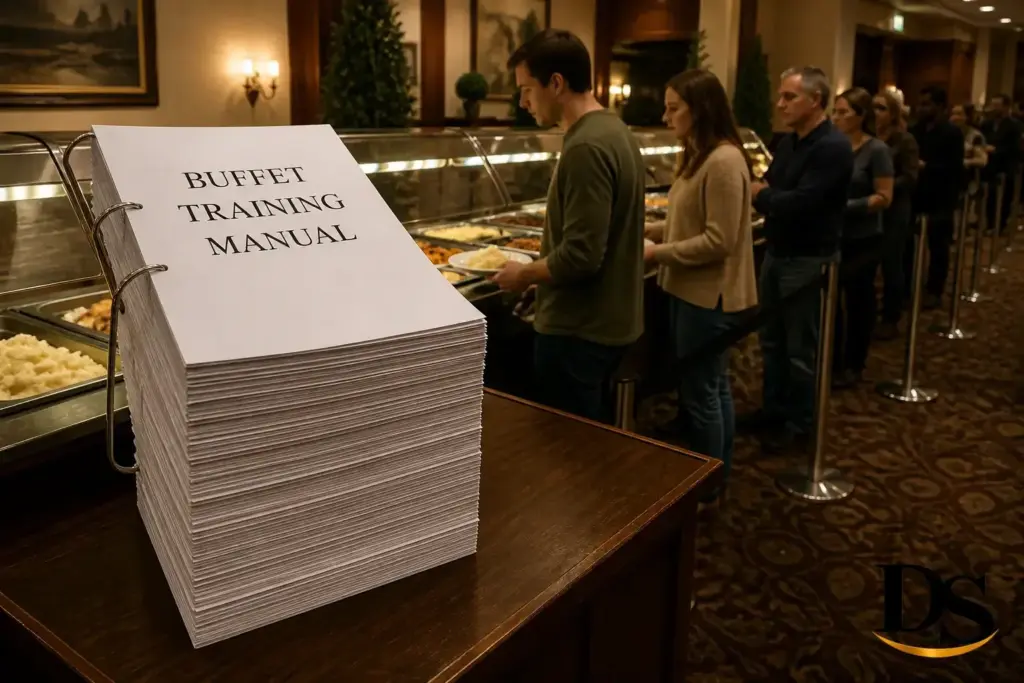
On a quiet Tuesday morning in the sub-basement of the Global Buffet Authority’s headquarters in Geneva, intern Lila Chen was tasked with reading aloud the organization’s annual “Customer Interaction Protocols” to a group of new trainees. The document, a dense 400-page tome covering everything from proper gravy ladling technique to the ethical implications of unlimited dessert refills, was meant to be skimmed. Chen, however, read it verbatim — including the footnotes.
One footnote, buried in Section 7.3 under “Managing High-Traffic Service Zones,” instructed staff to “avoid initiating political discourse during peak serving hours, particularly when patrons are holding plates of fried chicken or jello salad.”
Chen, reading with the earnestness of someone who had just aced her civics midterm, paused at the footnote and continued: “In the event that political discussion arises organically — particularly on nationally recognized days of civic participation such as Election Day — staff are advised to employ neutral, palate-cleansing conversational pivots. Examples include: commenting on the texture of the cornbread, inquiring about the preferred temperature of the mashed potatoes, or noting the seasonal availability of cranberry relish as a metaphor for the fleeting nature of political momentum.”
The room fell silent. Then, someone laughed. Then, someone else took a photo. By lunch, the clip had circulated internally, and by Friday, the Buffet Authority’s Office of Culinary Diplomacy had commissioned a full report.
The Birth of the Guide
What emerged was not a reprimand, but a 90-page publication titled Navigating Civic Discourse at the Serving Line: A Beginner’s Guide to Election Day Chatter. Authored by a committee of nutritionists, conflict mediators, and one retired UN protocol officer who once mediated a dispute over the last slice of pineapple upside-down cake, the guide treats Election Day not as a political event, but as a logistical challenge akin to managing a rush on the soft-serve machine.
“We’re not trying to suppress conversation,” explained Dr. Aris Thorne, head of the Authority’s Social Gastronomy Division, in a press briefing held beside a steaming tray of turkey gravy. “We’re trying to elevate it. When people are waiting for their third helping of mac and cheese, they’re vulnerable. They’re open. That’s a moment of civic potential — if you don’t let it devolve into an argument over whether the stuffing should have celery.”
The guide breaks down Election Day chatter into three phases: pre-ballot (arrival to plate selection), mid-meal (first bite to second helping), and post-prandial (dessert to exit). Each phase includes suggested talking points, tone modifiers, and exit strategies. For instance, during the pre-ballot phase, staff are encouraged to ask, “Are you voting early, or saving your appetite for after the polls?” — a question designed to acknowledge civic duty while keeping the focus on meal timing.
In the mid-meal phase, the guide warns against commenting on candidates’ hairstyles unless directly related to a dish’s presentation. “Saying ‘That candidate’s hair looks like overwhipped meringue’ is acceptable only if the meringue bar is open and the patron is currently sampling it,” the guide specifies. Otherwise, it risks being interpreted as a personal critique — a violation of Buffet Authority Code 4.1: “No food-based analogies that could be construed as ad hominem.”
The post-prandial section is perhaps the most nuanced. It recommends using the dessert course as a decompression zone. “A shared moment over chocolate pudding can reset the emotional temperature,” reads the guide. “If tension remains, offer a second spoon. If it persists, suggest a walk to the salad bar — neutral territory, universally respected.”
Reactions have been varied but generally positive. At a test site in Toledo, Ohio, buffet manager Rosa Mendes reported a 40% decrease in heated exchanges during the 2023 midterm simulation. “We had a guy start to complain about gerrymandering while reaching for the green beans,” she said. “I handed him the guide and said, ‘Page 42: redirect to the crispiness of the bacon-wrapped dates.’ He blinked, took a bite, and said, ‘You know, these are actually really good.’ Crisis averted.”
Academics have taken notice. Dr. Elara Voss, a sociologist at the University of Melbourne who studies food and democracy, called the guide “an unexpectedly sophisticated tool for managing diffuse civic energy in low-stakes, high-traffic environments.” She added, “It’s not about silencing voices. It’s about channeling them through the universal language of gravy.”
Critics, however, warn of overreach. A letter to the editor in The Gastropub Gazette argued that the guide “risks turning every buffet into a re-education camp for polite small talk,” though the author conceded that the section on using fruit salad to defuse election denialism was “oddly compelling.”
The Global Buffet Authority has no plans to expand the guide beyond Election Day — for now. But internal memos suggest similar manuals are in development for Tax Day, Lunar New Year, and the annual World Pie-Eating Championship, where emotional regulation is reportedly even more critical.
As for Lila Chen, she’s been promoted to Junior Protocol Analyst. Her first assignment? Re-reading the entire manual — this time, silently.
Join the conversation
Load Facebook comments to read and reply using your Facebook account.