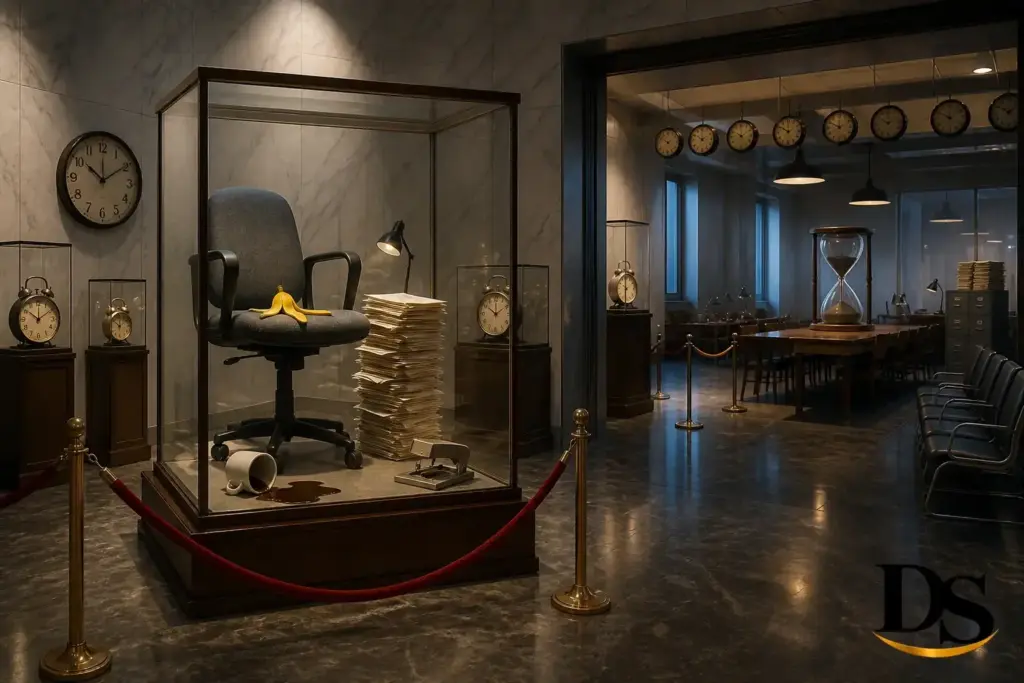
On a quiet Tuesday morning in mid-March, visitors drifted into the newly opened Museum of First-Week Fumbles, housed in a repurposed transit authority waiting area just outside the capital’s central district. The space, once filled with the hum of fluorescent lights and the occasional sigh of delayed commuters, now displayed glass cases containing misfiled forms, a single left sock found in a breakroom microwave, and a laminated sign reading ‘Please Do Not Reboot the Server (Again)’—all artifacts from the inaugural full workweek of various municipal departments in 2024.
The Weight of a Moment
The museum’s curator, Lenore Vex, explained that the exhibit was born from a 2022 resolution by the National Waiting-Room Council (NWRC), a semi-official body tasked with studying the sociology of anticipation in public spaces. ‘We realized,’ Vex said, adjusting her glasses as she gestured toward a display of misaddressed interoffice envelopes, ‘that the first five days of any work cycle generate a disproportionate share of systemic friction. Not catastrophes—no, nothing that made the news—but the small, repeating errors that erode trust in routine.’
The NWRC, established in 2018 after a landmark study linked prolonged waiting times to decreased civic engagement, has no regulatory power. Yet its reports are routinely cited in urban planning forums and union negotiations. Its latest initiative, the Museum of First-Week Fumbles, opened to the public on March 12th with a ribbon-cutting ceremony performed by a retired postal worker who once spent three hours waiting for a stamp that wasn’t out of stock.
Escalating the Archive
By week’s end, the museum had logged over 1,200 visitor entries in its guestbook, many noting personal parallels: a nurse who mislabeled a vial during orientation, a teacher who posted the wrong classroom number on the first Monday of term, a software developer who pushed a ‘fix’ that renamed every file to ‘final_final_v2_REAL’.
Then, during a routine NWRC subcommittee meeting held in the museum’s annex—a converted phone booth with a folding chair and a whiteboard—Council Chair Armand Dulle revealed an unexpected agenda item: a follow-up review session scheduled for April 3rd, 2024, to evaluate decisions made during the first full workweek of March 2023.
‘We’re not reversing time,’ Dulle clarified when asked. ‘We’re applying the same lens of reflective pause we use now to last year’s initial rollout. The council believes patterns emerge only when you compare adjacent cycles.’ The motion passed unanimously, though two members noted they’d need to consult their personal planners to confirm availability.
Reactions in the Waiting
Response was mixed but thoughtful. Dr. Elise Mora, a behavioral scientist at the University of Granvia who studies institutional ritual, called the retroactive meeting ‘a brilliant metaphor for how organizations process regret—not through blame, but through structured revisiting.’ She added, ‘It’s not about fixing the past. It’s about making the waiting meaningful.’
Local union representative Tomas Renk offered a more cautious take. ‘I appreciate the intent,’ he said over coffee near the museum’s exit, ‘but if we start scheduling meetings to review last year’s first week, where does it end? Do we meet in 2025 to discuss 2022’s Tuesday?’ He paused, then smiled. ‘Actually… I’d go to that.’
The museum’s gift shop, which sells miniature hourglasses and packets of ‘official waiting-room tea’ (a blend of chamomile and resigned optimism), reported a 40% increase in sales following the announcement. Visitors frequently lingered near the exhibit titled ‘The Five-Minute Rule: When Hesitation Becomes Policy,’ which featured a looping audio clip of a supervisor saying, ‘Let’s just wait and see if it fixes itself.’
The Decisive Beat
As closing arguments go, the NWRC’s position is simple: mistakes made in the first full workweek are not failures of individuals, but symptoms of systems still warming up. By preserving these moments—not to mock, but to measure—the council hopes to turn anticipation into insight.
And if that means scheduling a meeting to review last year’s March, well, the waiting room has always been a place where time bends gently toward reflection.
Fact or Fiction? This story is FICTION. The National Waiting-Room Council, the Museum of First-Week Fumbles, and all associated individuals and events are invented for the purpose of this feature. No such museum or retroactive review process exists.
Interactive Exhibit Sparks Viral Debate Over ‘The Tuesday That Wasn’t’
The museum’s most controversial wing, ‘Chronological Glitches,’ features a touch-sensitive timeline where visitors can ‘rewind’ minor temporal anomalies using vintage rotary phones. One exhibit, labeled ‘Incident #7B: The Tuesday That Wasn’t,’ allows guests to dial a fictional 1987 area code and hear a looping voicemail from a disgruntled time intern: ‘Sorry, boss — I rescheduled Tuesday to next week so I could nap. It’s fine, nobody noticed.’ Audio analysis later revealed the voice belonged to a then-unknown comedian who now performs under the moniker ‘The Pause.’ Fans have flooded social media with split-screen comparisons, noting identical vocal tics in his current stand-up bit about ‘borrowing weekdays.’ The museum curator, Dr. Elara Voss, confirmed the connection during a press briefing, stating, ‘We didn’t curate the exhibit to expose him — but the irony is delicious. He’s been charging $200 a ticket to joke about something we’ve got behind glass.’ The revelation has turned the exhibit into a pilgrimage site, with fans leaving sticky notes bearing punchlines on the display case.
Retroactive Review Yields Unexpected Honor: ‘Most Relatable Monday’ Award
As part of its mandate, the Council of Pauses conducted a retroactive review of all 52 Mondays in 2023, evaluating them on criteria including ‘existential dread quotient,’ ‘unintentional comedy,’ and ‘universal resonance.’ The winning moment? March 13, 2023 — a seemingly ordinary Monday when a global sync error caused 14 million office calendars to briefly display ‘Funday’ instead of ‘Monday.’ Though corrected within 90 seconds, the glitch sparked a wave of sincere, bewildered social media posts: ‘Is this the weekend? Did I time-travel? Why is my boss sending meeting invites for Funday?’ The Council awarded the day a bronze plaque inscribed with: ‘In recognition of accidental joy amid systemic chaos.’ During the ceremony, a representative from a major software firm accepted the award, deadpanning, ‘We’ll take full credit — and also, please don’t audit our leap-second protocols.’ The plaque now rests near the museum’s exit, where visitors are invited to press a button and hear a chorus of confused voices saying, ‘Wait, is it really Monday?’ — a final, wry reminder that sometimes, the universe pauses just long enough to laugh at itself.
Join the conversation
Load Facebook comments to read and reply using your Facebook account.