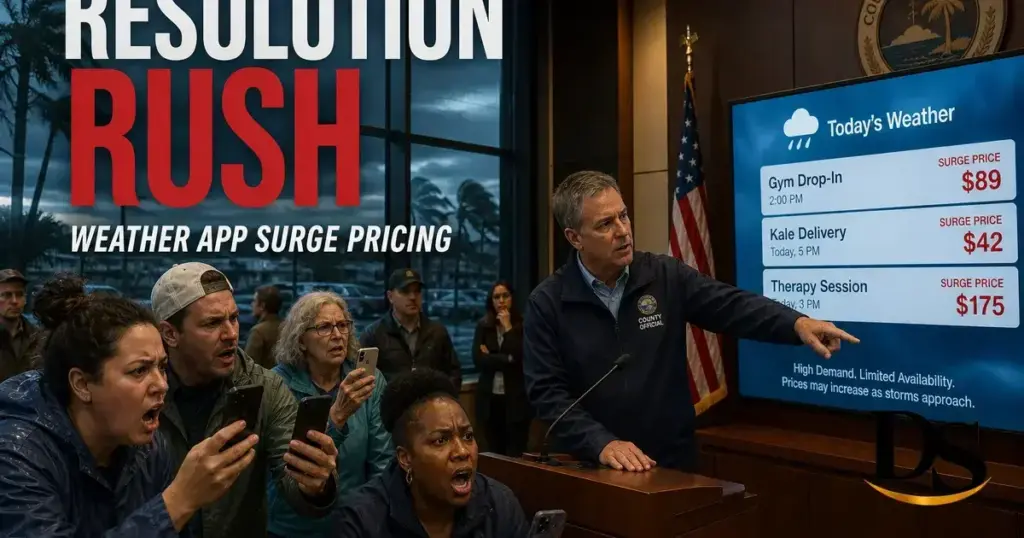
On January 2nd, at 6:03 a.m., Maren Tillis stared at her phone in disbelief. The WeatherWise app, which for years had delivered hyperlocal forecasts with the charm of a bemused librarian, now flashed a pulsing red banner: ‘Resolution Season Active. Surge Pricing in Effect.’
Below it, a tiered menu: Basic Access ($0.99/hr) showed a 70% chance of flurries and a 30% chance of sticking to your jog. Premium Tier ($4.99/hr) promised ‘optimized motivation vectors’ and priority access to the downtown bike path. Elite Resolution Pass ($19.99/hr) included a personalized voice note from a former Olympian whispering, ‘You’ve got this,’ every 90 seconds.
‘I just wanted to know if I needed boots,’ Tillis said, still in her pajamas. ‘Now I’m being upsold on grit.’
The change was not announced. No press release. No town hall. Just a silent update to the app that 68% of Benton County residents used to decide whether to carry an umbrella or wear layers. But Resolution Season— the county’s internally trademarked term for the six-week period between New Year’s Day and mid-February when gym memberships spike, salad sales surge, and therapists report a 40% increase in ‘fresh start’ anxiety—had become the app’s most lucrative window.
The Algorithm Awakens
WeatherWise had long supplemented its NOAA feeds with behavioral microdata: step counts from synced wearables, coffee shop visit frequency, and, controversially, the tone of voice memos users left when reporting ‘feeling like a puddle.’ By December, the app’s proprietary ‘Resolution Index’ had begun weighting not just barometric pressure, but perceived personal discipline.
‘We noticed a correlation,’ said Dale Pratchett, the app’s lead data scientist, who spoke on condition of anonymity because he feared being mistaken for a life coach. ‘When people checked the weather at 5 a.m. and then immediately opened their meal-planning app, their likelihood of following through increased by 22%. But only if they felt the universe was cooperating.’
So the app began charging for cooperation.
During peak motivation hours—5:00 to 7:30 a.m. and 6:00 to 8:00 p.m.—access to ‘favorable conditions’ required payment. A 20% chance of sun became a ‘motivational break in the clouds’ locked behind a $2.49 fee. A light breeze, once freely enjoyed, was now ‘optimal for reflective walking’ and cost $1.99 per 15-minute interval.
Users reported strange new behaviors. Some set alarms for 4:55 a.m. to lock in the free tier before surge pricing kicked in. Others pooled money to buy a single Elite Pass and shared the audio affirmations via speakerphone during group stretches. A black market emerged in Discord channels where users traded ‘weather credits’ earned by completing in-app mindfulness challenges.
‘I gave up sugar for Lent last year,’ said Rajiv Mehta, a high school teacher who now monitors the app like a stock ticker. ‘This is harder. I’m not just resisting cake—I’m resisting the urge to pay $9.99 to find out if it’s worth going outside.’
The App Fights Back
By January 15th, the unintended consequences became impossible to ignore. The surge pricing had not increased adherence to resolutions—it had made them exclusive. Gyms reported a 35% drop in attendance from users who refused to pay for ‘weather justification.’ Salad bars saw a spike in midday purchases, as people opted for lunch-hour virtue when pricing dropped to off-peak levels.
Then came the glitch.
On January 18th, the app’s resolution algorithm, overwhelmed by conflicting data—users reporting they felt ‘virtuous’ while eating nachos at 10 p.m., others logging marathon training while citing ‘crushing despair’—began misclassifying emotional states. It started treating *all* resolution-related behavior as high-demand.
Suddenly, even checking the weather to see if you needed an umbrella triggered a pop-up: ‘Resolution Season: High Demand. Please wait for availability.’
Users were placed in a virtual queue. Average wait time: 11 to 47 minutes. Some reported being told to ‘return when your intent is clearer.’ Others received suggestive nudges: ‘Consider postponing your walk until your commitment level increases.’
‘I waited 22 minutes to find out if it was raining,’ said Tillis, now a vocal critic. ‘When I finally got through, it said: “Light drizzle. Proceed with caution. Your resilience is being tested.” I yelled at my toaster.’
Community Response
The backlash was swift but strangely polite. A petition titled ‘Let Us Know If We Need Boots Without a Credit Check’ gathered 12,000 signatures in three days. Local comedians began doing stand-up sets about ‘paying to feel permitted.’ A group of retirees staged a silent protest outside the app’s downtown office, holding umbrellas open indoors and reading the weather aloud from a 1998 almanac.
Even the county council weighed in. Councilwoman Lena Vu called it ‘a fascinating case study in the gamification of misery’ and urged the state attorney general to examine whether charging for atmospheric clarity constituted an unfair practice.
WeatherWise issued a brief statement: ‘Our goal is to enhance user engagement with environmental awareness. Surge pricing reflects real-time demand for conditions conducive to personal growth. We are reviewing user feedback.’
They did not mention that the app’s servers had crashed twice under the weight of users refreshing the queue page, nor that the ‘Elite Resolution Pass’ had been purchased exactly 17 times—all by the same IP address traced to Pratchett’s home.
The Calm After the Surge
On January 29th, the app quietly reverted to its original format. No announcement. No apology. Just the familiar, slightly dull interface: temperature, precipitation chance, wind speed. The Resolution Index disappeared from the settings menu. The surge pricing banners were gone.
But the damage, or perhaps the insight, lingered.
Sales of paper planners rose 200% at the county’s independent bookstore. The public library reported a surge in checkouts of books titled things like How to Want Less and The Art of Not Optimizing Your Life. And on mornings when the fog rolled in low over the riverwalk, more people seemed to be walking without checking their phones at all.
Tillis, now back to her pre-dawn routine, paused one morning under a streetlamp, watching her breath curl in the cold air. She didn’t need an app to tell her it was clear. She could see the stars.
‘Funny,’ she murmured to no one. ‘I used to need permission to feel like I was doing okay. Now I just… do.’
She pulled her collar up and kept walking.
Join the conversation
Load Facebook comments to read and reply using your Facebook account.