
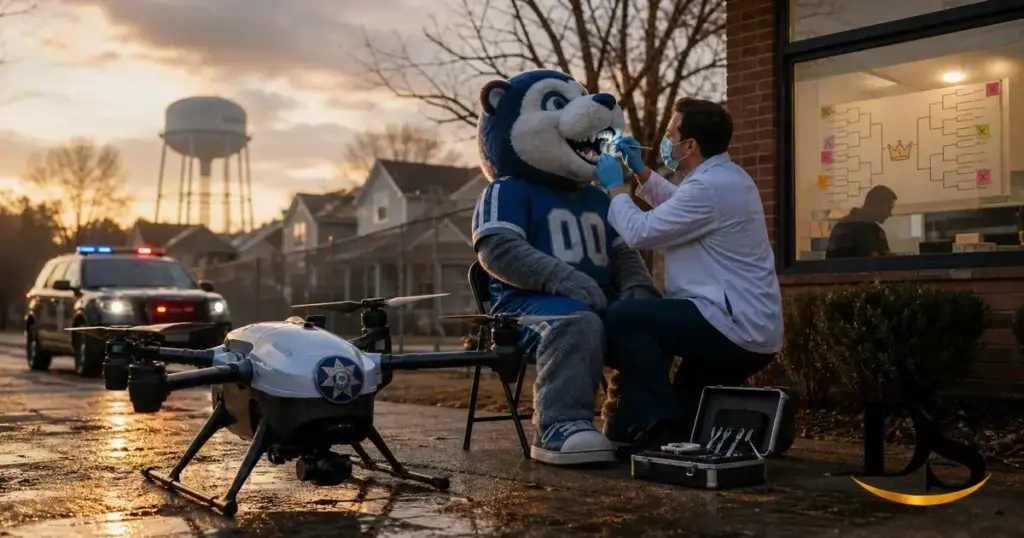
The first sign something was wrong came at 6:03 a.m., when the quadcopter that usually buzzed over Maple Street’s cul-de-sac like a mechanical hornet failed to appear. No whirring, no blinking red eye scanning rooftops for loose trash cans or suspiciously placed garden gnomes. Just silence. And a single Post-it note, affixed to the charging dock beside Mrs. Kline’s begonias, reading: ‘Not flying until you fix my overbite.’
The Mascot’s Ultimatum
The note was signed in looping cursive: —Bracket Boss, Chief Enforcer of March Mayhem. For three years, the unnamed mascot—a foam-rubber silhouette with a permanent grin and a whistle forever dangling from its non-existent lips—had patrolled the skies via drone proxy, ensuring no one dared fill out their NCAA brackets before Selection Sunday. Infractions meant a polite but firm voice note left on your porch: ‘You’ve activated the Bracket Watch. Please cease and desist.’
But this year, the mascot had upped the ante. After discovering that someone in the neighborhood had not only filled out a bracket but had done so using advanced analytics, injury reports, and a suspiciously accurate prediction of a 12-seed upsetting a 5-seed, the mascot demanded action. Not a fine. Not a warning. Full dental coverage.
‘It’s not vanity,’ said a source close to the operation, speaking on condition of anonymity because they still fear the whistle. ‘It’s about dignity. You try smiling through a cracked incisor while yelling ‘BRACKET VIOLATION!’ at 7 a.m. on a Tuesday. It’s humiliating.’
Grounded Fleet, Rising Suspicion
With the drone grounded, the neighborhood’s informal surveillance network collapsed. No more aerial sweeps for premature bracket submissions. No more low-altitude passes over backyard barbecues to deter ‘early bird’ picks. The mascot’s absence was felt immediately.
Within 48 hours, three separate households reported finding completed brackets tucked into their mailboxes—none of them filled out by the residents. One was on recycled printer paper. Another used a crayon. The third, alarmingly, was laminated.
‘It’s like they’re taunting us,’ said Dale Pritchard, a retired accountant who had gone three years without a single bracket-related infraction. ‘Whoever’s doing this knows the mascot’s down. They’re exploiting the vacuum.’
Local authorities, though not officially involved in Bracket Watch enforcement, noted the uptick. Deputy Tina Loomis of the Cedar Hollow Community Safety Circle confirmed increased reports of ‘suspicious paper activity’ but declined to speculate on motive. ‘We’re just glad no one’s tried to staple a bracket to a stop sign yet,’ she said.
The Search Goes National (Sort Of)
What started as a neighborhood nuisance quickly spiraled. A blurry still from a doorbell cam—showing a hooded figure slipping a bracket under the Hoffmeisters’ door at 2:17 a.m.—was shared on the Nextdoor thread ‘SkyWatch & Snacks.’ Within hours, it had been cropped, zoomed, and analyzed by amateur sleuths from Portland to Portsmouth.
Theories ran rampant. Was it a disgruntled former bracket enforcer seeking revenge? A rogue algorithm from a sports analytics startup? Or, as one particularly speculative post suggested, ‘a sentient bracket trying to free its brethren from tyranny’?
The mascot, for its part, remained silent. Attempts to leave a voice note via the drone’s speaker system were met with only static and the distant sound of what might have been muted sobbing.
Community Impact: More Than Just Lost Productivity
The absence of aerial oversight has had ripple effects. Property values, while not officially tracked for bracket-related anxiety, are said to be fluctuating based on perceived risk of early picks. Homeowners’ association meetings now open with a moment of silence for the grounded drone. Kids have started drawing pictures of the mascot in the dentist’s chair, holding a tiny toothbrush and looking wistfully at the sky.
Local businesses, too, are feeling the strain. The corner café reported a 30% spike in morning coffee sales, which baristas attribute to ‘bracket-induced insomnia.’ The hardware store sold out of zip ties—used, according to one clerk, to ‘secure brackets to things that definitely shouldn’t have them.’
Still, there’s a strange sense of unity. ‘We’re all in this together,’ said Marla Hoffmeister, whose door was the first to be breached. ‘Until we find who’s doing this, we’re all suspects. And frankly? It’s kind of exciting.’
A Decisive Closing Beat
As of press time, the drone remains grounded. The mascot’s demands have not been met. And somewhere in the quiet hours before dawn, another bracket appears—this time drawn on a napkin, with a perfect Final Four and a note tucked underneath: ‘You can’t ground justice. Or dental care.’
The search continues.
The Floss Heist and the Missing Molar
As dawn broke over the suburban cul-de-sac where Dr. Elara Voss kept her prized 3D-printed molar collection, a single strand of mint-waxed dental floss was found stretched taut between two mailboxes—knotted into a perfect bow. Security footage, recovered from a neighbor’s Ring doorbell after a suspiciously timed power surge, showed a drone hovering at exactly 3:17 a.m., its rotors muffled with what audio analysts later confirmed was dental dam material. The drone didn’t just observe—it descended. A tiny mechanical arm, fashioned from a repurposed orthodontic wire extender, reached down and plucked the upper left second molar from Voss’s display case: a pearly white relic from a 1950s Hollywood starlet, rumored to have been extracted during a silent film shoot gone awry. The floss? It was the same brand Voss used exclusively—Oral-B Glide, mint flavor, 50-yard spool. Someone knew her routine. Someone knew her weaknesses.
Meanwhile, at the town’s abandoned drive-in theater, now repurposed as a nocturnal orthodontic black market, investigators discovered a chalk-drawn diagram on the concession stand wall: a drone silhouette with wings made of floss picks, landing gear shaped like rubber bands, and a payload bay labeled ‘Molar Harvest.’ Beneath it, in jagged letters: ‘The Bracket Season begins when the smile is silent.’ No one could explain how the diagram appeared overnight—nor why the theater’s popcorn machine had been recalibrated to dispense only cinnamon-flavored toothpaste.
The Last Laugh
Three days later, the drone returned—not to steal, but to deliver. It hovered above the town square during the weekly farmers’ market, trailing a banner made of braided floss that read: ‘YOU BRUSHED. YOU FLOSSed. YOU STILL LOST.’ Below it, dangling from a miniature parachute crafted from a discarded dental dam, was a single, perfectly preserved molar—Dr. Voss’s missing treasure—resting on a bed of crushed Altoids. Attached to its root with a drop of cyanoacrylate was a micro-SD card. When played on Voss’s laptop, it revealed not a threat, but a confession: a voice, distorted through a voice modulator shaped like a retainer, whispered, ‘I didn’t take it to keep it. I took it to make you see. Your smile is a performance. Mine is a protest.’ The screen then flickered to a live feed of the town’s fluoride-treated water tower—now glowing faintly pink from a slow-drip infusion of raspberry-flavored mouthwash. The mystery wasn’t about teeth. It was about who gets to decide what a smile means. And as the crowd looked up, mouths agape, some laughing, some horrified, one thing was clear: the drone patrol wasn’t grounded. It had just gone viral.
Join the conversation
Load Facebook comments to read and reply using your Facebook account.