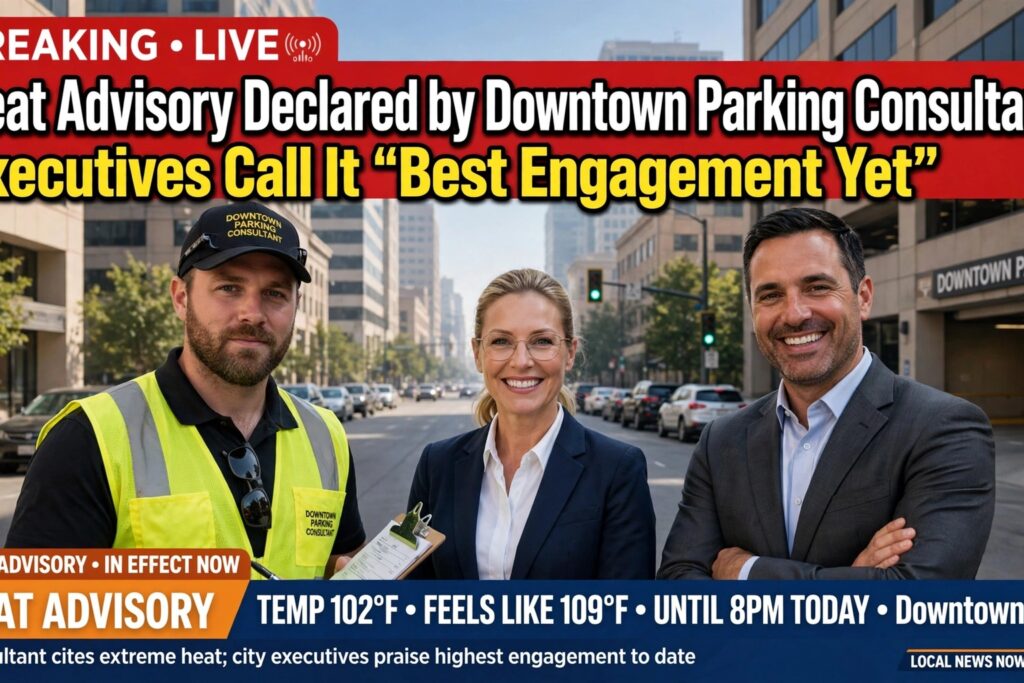
At 9:03 a.m. on the third sweltering Tuesday of June, a laminated placard appeared on the bulletin board outside City Hall’s parking enforcement office. It bore no official seal, no mayoral signature, and was printed on what looked like the back of a receipt from a downtown taco truck. Yet it declared, in bold Helvetica: ‘HEAT ADVISORY: TEMPERATURES EXCEED 95°F. AVOID NON-ESSENTIAL PARKING. HYDRATE. WALK IF YOU CAN.’
No one from the National Weather Service had issued such a warning. No city agency had convened a press briefing. But by 10:15 a.m., the advisory had been retweeted by the mayor’s deputy chief of staff, shared in three neighborhood Slack channels, and cited by a local news anchor as ‘the most timely public service message we’ve seen all summer.’
The Consultant Behind the Curb
The source? ParkRight Solutions, a six-person firm specializing in ‘optimizing urban curb dynamics through behavioral nudges and dynamic pricing algorithms.’ For years, they’d advised the city on meter rates, loading zone design, and the psychological impact of painted lines. But this was their first foray into meteorological authority.
‘We noticed a pattern,’ explained Lena Voss, ParkRight’s founder and chief curb strategist, over iced oat milk lattes at a café two blocks from City Hall. ‘When temperatures spike, illegal parking increases by 22%—people circle longer, block bike lanes, double up in loading zones. It’s not just uncomfortable; it’s a systemic failure of curb inventory management during thermal stress events.’
ParkRight’s internal memo, leaked to a city planner who wished to remain anonymous, had recommended ‘proactive thermal signaling’ as a way to ‘pre-load compliance behavior’ before enforcement became necessary. The heat advisory was their pilot.
‘We didn’t break any rules,’ Voss insisted. ‘We didn’t claim to be the government. We just shared a data-informed observation in a format that looked actionable. The city didn’t stop us. In fact, they amplified it.’
Executives Applaud the Confusion
By noon, the advisory had trickled into corporate inboxes. At Helix Dynamics, a software firm with offices overlooking the downtown plaza, CEO Marcus Hale forwarded it to his entire staff with the note: ‘Finally, someone’s thinking outside the garage.’
‘It was brilliant,’ Hale said later, during a video call from his home office, where a fan blew directly onto his keyboard. ‘We spend millions on engagement campaigns—viral challenges, influencer takeovers, AR filters—and here’s a two-person consultancy moving the needle with a PDF and a hunch. The confusion? That’s the point. It made people stop, look, wonder. That’s attention. That’s behavior change.’
Other executives echoed the sentiment. Priya Nair, CMO of a regional bank, called it ‘organic authority hacking.’ ‘We’ve been trying to get our financial wellness tips noticed for quarters. ParkRight did it with a heat index and a font choice. We’re studying their playbook.’
Even the city’s actual emergency management office, after initially fielding calls about the advisory’s legitimacy, issued a quiet statement: ‘While ParkRight Solutions is not authorized to issue weather advisories, their message aligns with current public health guidance. We encourage residents to stay cool and hydrated.’ Translation: we didn’t stop it, and we’re not mad.
Curb-Side Consequences
The real test came on the streets. By afternoon, parking enforcement officers reported a 15% drop in vehicles circling for spots in the downtown core—typically a peak time for congestion during heat waves. Bike lane obstructions decreased. One officer, who asked not to be named, said he’d seen more people walking to nearby lots than usual.
‘I didn’t write the ticket,’ he admitted. ‘I just pointed at the sign and shrugged. Sometimes, the nudge works better than the fine.’
Local businesses reported mixed effects. A gelato shop near the park saw a 30% spike in foot traffic. A valet service reported fewer no-shows, as patrons opted to walk rather than risk circling. A coffee cart owner complained: ‘Now everyone thinks I’m in on it. They keep asking me if I’ve seen the advisory. I just sell espresso.’
Urban planners are divided. Some see it as a dangerous precedent—private firms issuing public advisories. Others view it as a clever workaround in an era of underfunded public services. ‘If a parking consultant can get people to change behavior during a heat wave,’ said Dr. Aris Thorne of the Urban Mobility Institute, ‘maybe we’ve been looking at public outreach all wrong. Maybe the issue isn’t the message—it’s the messenger.’
The Advisory That Stuck
By Friday, the heat had broken. But the advisory remained—taped to lampposts, pinned to community boards, even appearing as a Zoom background in a remote team meeting. ParkRight had printed 200 copies. They’re now considering a sequel: ‘Air Quality Alert: Idling Increases Particulates by 18% During Rush Hour.’
Voss smiled when asked if they’d consult with meteorologists next time. ‘Why?’ she said. ‘We’re not trying to replace the weather service. We’re trying to make the curb smarter. And if a little confusion helps people park better—or not at all—then we’ve done our job.’
As for the city? Officials say they’re reviewing the incident. But for now, the laminated sign still hangs outside City Hall—unofficial, unchallenged, and, according to the latest traffic logs, oddly effective.
Join the conversation
Load Facebook comments to read and reply using your Facebook account.