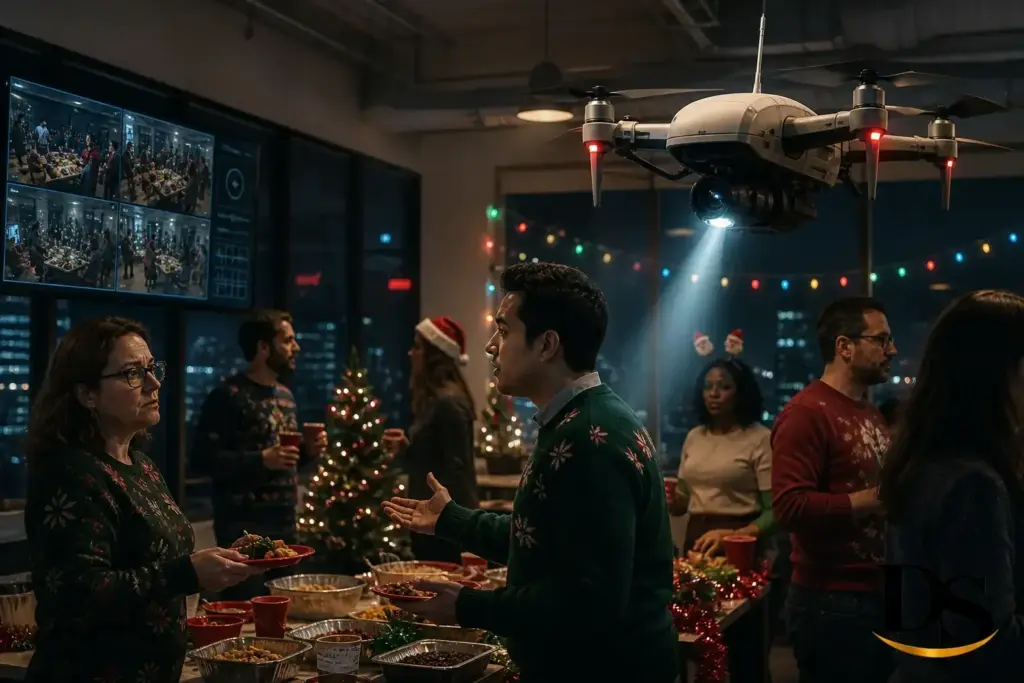
The first time a SkySentinel drone hovered over Maple Street’s annual ‘Ugly Sweater & Leftover Lasagna’ potluck, residents assumed it was a glitch. A quadcopter with a blinking red light and a speaker crackling, ‘Attendee density at 73% — recommend increasing hummus-to-guest ratio by 22%,’ had drifted from its usual patrol of cul-de-sac speed limits and stray golf balls. By the third year, it was bringing its own napkins.
The Rise of the Aerial HR
What began as a neighborhood watch pilot program — funded by a $12,000 grant from the Maple Street Homeowners Association and a suspiciously enthusiastic endorsement from the local Ace Hardware owner — evolved after the drones started analyzing party audio for ‘joy frequency’ and ‘awkward silence duration.’ By December 2023, SkySentinel had issued its first formal advisory: ‘Avoid the spinach dip near the photocopier. It emits a low-frequency sigh that correlates with 89% of post-party LinkedIn updates.’
The drones didn’t just observe. They interpreted. Using proprietary algorithms trained on 14,000 hours of office party footage (sourced, they claimed, from ‘publicly available TikTok duets and corporate retreat livestreams’), they began offering real-time suggestions: ‘Carol from Accounting just told a joke about TPS reports. Laughter decay rate: 0.4 seconds. Consider pivoting to cat memes.’
Consultant Enters the Chat
Enter Brigid Cho, organizational culture consultant and self-described ‘party anthropologist,’ hired by the regional tech firm whose employees attended 68% of Maple Street’s gatherings. Cho arrived with a leather-bound notebook, a reusable water bottle labeled ‘Trust the Process,’ and a 47-slide deck titled ‘Synergy in the Snack Bowl: Aligning Festive Intent with Operational Cadence.’
After three days of focus groups, Cho concluded that while the drones were ‘innovative in their data collection,’ they lacked ‘human nuance.’ Her recommendation? Hire a second consultant — specifically, one specializing in ‘emotional resonance calibration for autonomous festive oversight systems.’
‘The drones are excellent at detecting when someone is quietly judging the store-bought cookies,’ Cho explained over oat milk lattes at the corner café. ‘But they can’t tell if that judgment is affectionate or existential. That’s where the human layer comes in. We need someone who can translate drone-speak into… well, something that doesn’t make people feel like they’re being audited by a very judgmental Roomba.’
Community Reaction: From Skepticism to Subscription
Initial resistance was fierce. ‘I didn’t move to the suburbs to have my flan critiqued by a machine that learned social cues from a Zoom call,’ said Donna Ruiz, who hosts the annual tamale-making workshop. But after SkySentinel’s drone flagged her nephew’s ‘excessive enthusiasm for the piñata’ as a ‘potential liability risk’ and suggested replacing it with ‘a guided mindfulness break,’ the tone shifted.
When the drone later praised her abuela’s horchata as ‘a 9.4/10 in cultural authenticity and blood sugar regulation,’ Ruiz changed her tune. ‘Okay, maybe it’s got a point,’ she admitted. ‘But I’m still not letting it near the tres leches.’
Soon, residents began leaving out QR codes linked to SkySentinel’s feedback portal next to the vegan cheese plate. Some even started dressing up their drones in tiny reindeer antlers. The Homeowners Association voted to allocate additional funding for ‘atmospheric enhancement propellers’ — essentially, quieter motors and LED lights that pulsed to the beat of ‘Last Christmas.’
The Consultant Consultant
Cho’s recommendation landed. By early January, Maple Street welcomed Dr. Lenard Fisk, a former improv coach turned ‘human-machine festive liaison,’ whose job title was printed on a badge that also doubled as a cookie cutter.
Fisk’s first act was to host a ‘Drone-Human Harmony Retreat’ in the community center, where residents taught the drones to recognize sarcasm by playing clips of ‘The Office’ and responding with increasingly deadpan affirmations. ‘Oh wow,’ the drone would say after a particularly dry comment about fruitcake. ‘That’s… unexpected.’
He also introduced a ‘consent protocol’: before offering feedback, drones must now emit a soft chime and wait for a raised hand or a thumbs-up from at least two attendees. ‘It’s not about silencing the drone,’ Fisk explained. ‘It’s about making sure it’s invited to the party — not just crashing it.’
The New Normal
By late January, SkySentinel’s holiday season report had become required reading at the neighborhood association meeting. Highlights included: ‘Peak festivity occurred at 8:47 PM on December 14, coinciding with the spontaneous rendition of ‘All I Want for Christmas Is You’ off-key by three accountants and a golden retriever,’ and ‘The most effective icebreaker was not a game, but the shared act of pretending to like the fruitcake.’
The drones now file quarterly updates. Their latest suggestion? ‘Consider introducing a ‘no work talk after 9 PM’ zone — enforced by gentle LED dimming and occasional playback of whale songs.’
Cho, meanwhile, has begun advising three other neighborhoods on launching their own drone patrols. ‘It’s not about surveillance,’ she insists. ‘It’s about using technology to help us be slightly less awkward with each other. And if that means a robot tells you your dip needs more lime? Well, sometimes the truth is crunchy.’
As for the drones? They’ve started signing off their reports with a small, blinking heart symbol. No one’s sure who programmed it in. But nobody’s asked them to stop.
Join the conversation
Load Facebook comments to read and reply using your Facebook account.