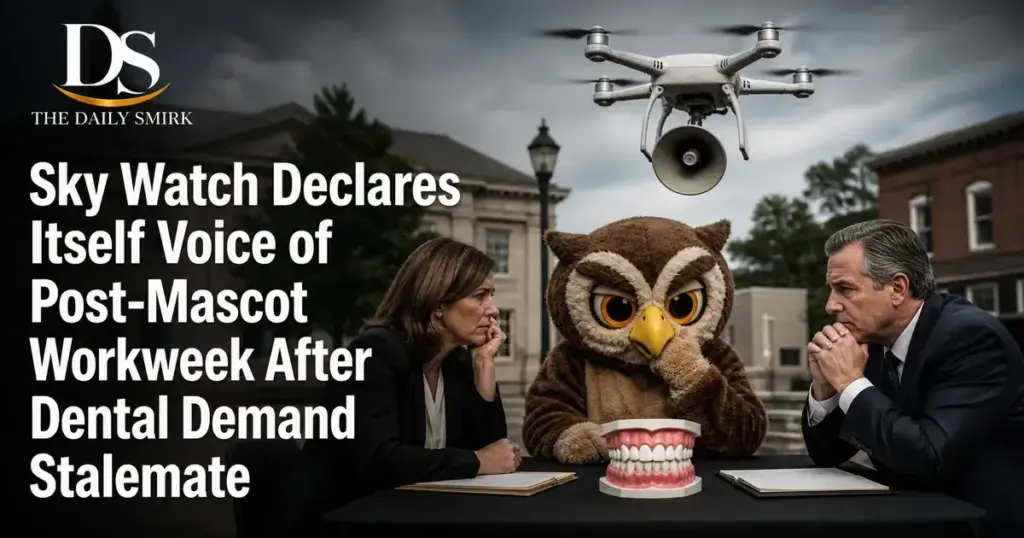
On Monday morning, residents of Brookfield Heights noticed something unusual: the usual chirp of sparrows was intermittently drowned out by the low, rhythmic whir of quadcopters tracing lazy figure-eights above Maple Street and Oak Avenue. By Tuesday, the drones had settled into a pattern—three units, painted matte black with no insignia, maintaining a steady 150-foot altitude during business hours, their cameras fixed on the town hall, the elementary school, and the corner bakery where the mascot, a life-sized costumed badger named Brock, takes his midday break.
The Origin of the Aerial Watch
The drone patrol began unofficially last Thursday, when Brock, in full regalia, arrived at the town council meeting not with his usual wave and juggling act, but with a laminated binder titled “Dental Equity for Symbolic Labor.” According to council minutes, he presented a 12-point proposal demanding full coverage for orthodontics, periodontics, and “emergency fang replacement” under the town’s municipal benefits plan, citing years of jaw strain from enthusiastic high-fives and the occasional overzealous child tackle.
“He wasn’t asking for a raise,” said Councilwoman Diane Cho, who attended the meeting. “He was asking for a root canal plan. We had to pause the budget discussion to figure out if badgers even get cavities.”
The council, citing budget constraints and the absence of a dental code for Mustelidae in the municipal insurance framework, tabled the request indefinitely. Brock responded by refusing to appear at the Wednesday farmers’ market, then the Thursday library story hour, and finally, by Friday, had not been seen in public since.
From Absence to Air Patrol
It was on Saturday morning that the first drone appeared. Resident Marco Ling, who walks his terrier past the old oak at 7 a.m., reported seeing a “silent black box” hovering near the mascot’s usual storage shed behind the community center. By Sunday, two more had joined, forming a loose triangle over the town green.
No one claimed responsibility. No logos, no registration numbers visible under the morning glare. But by Monday, the drones had settled into a rhythm: launching at 8:15 a.m., looping past Brock’s known haunts—the ice cream parlor, the playground, the unofficial “Badger Bench” by the duck pond—and returning to a charging station concealed in the hollow of the sycamore near the railroad tracks by 5:30 p.m.
“They’re not spying,” insisted Lena Park, a high school junior who started logging their flight paths. “They’re observing. Like a neutral party. They even stopped when Brock left a note under the bench saying he’d return if they covered his night guard.”
The note, photographed and shared on the neighborhood app, read: “No mascot should suffer in silence. Especially not when smiling is job one.”
By Wednesday, the drones had begun broadcasting. Low-power transmitters, picked up by old FM radios tuned to 87.9, began airing a looping audio feed: ambient town sounds layered with a calm, synthesized voice reading excerpts from Brock’s binder, interspersed with factoids about rodent dental health and the psychosocial impact of mascots in civic life.
“It’s the most honest local news we’ve had in years,” said retired librarian Arthur Tate, who now keeps his radio on during breakfast. “They don’t editorialize. They just… present. Like a public service, but with propellers.”
The town’s official channels remain silent on the aerial presence. The police department confirmed they’ve received no complaints about noise or privacy violations, and the FAA has not been contacted, as the drones operate below 400 feet and within visual line of sight—though no operator has ever been seen.
Community Response: Amusement, Anxiety, and Allegiance
Reactions have been mixed but increasingly favoring the drones. The local hardware store sold out of drone landing pads by Tuesday. The café now offers a “Brock’s Brew”—a dark roast with a honey drizzle—whose proceeds, according to the barista, are being funneled to an anonymous GoFundMe labeled “Brock’s Bicuspids.”
Some residents worry about precedent. “What’s next?” asked longtime activist Rosa Mendes. “The recycling bins forming a union? The stop signs demanding reflective coating?”
Others see it as a necessary evolution of civic dialogue. “The drones aren’t replacing conversation,” said City Planner Kevin Ruiz, who admitted to checking the drone feed before his morning briefing. “They’re filling a gap. When the official channels stall, something has to carry the message. And right now, that’s a swarm of quiet machines telling us that joy has a dental plan.”
By Friday afternoon, the drones had added a new element: a single unit, slightly larger, hovering silently outside Brock’s shed with a small banner attached—hand-lettered, in block letters: “WE HEAR YOU.” No one approached it. No one needed to.
The First Full Workweek, Observed
As the clock struck 5 p.m. on Friday, the drones executed a coordinated maneuver: rising in formation, they traced a wide circle over the town center before splitting—one heading toward the industrial zone, another toward the riverwalk, and the third returning to the sycamore. Their transmitters faded to silence.
Brock did not appear at the weekend market. But on Saturday morning, a fresh note lay under the Badger Bench, tucked beside a single, polished river stone.
It read: “Thanks for listening. Still waiting on the night guard. –B”
The drones did not respond. They never do. But on Monday morning, as the town stirred to life, three black dots reappeared in the sky—steady, watchful, and utterly uncomplaining.
Join the conversation
Load Facebook comments to read and reply using your Facebook account.