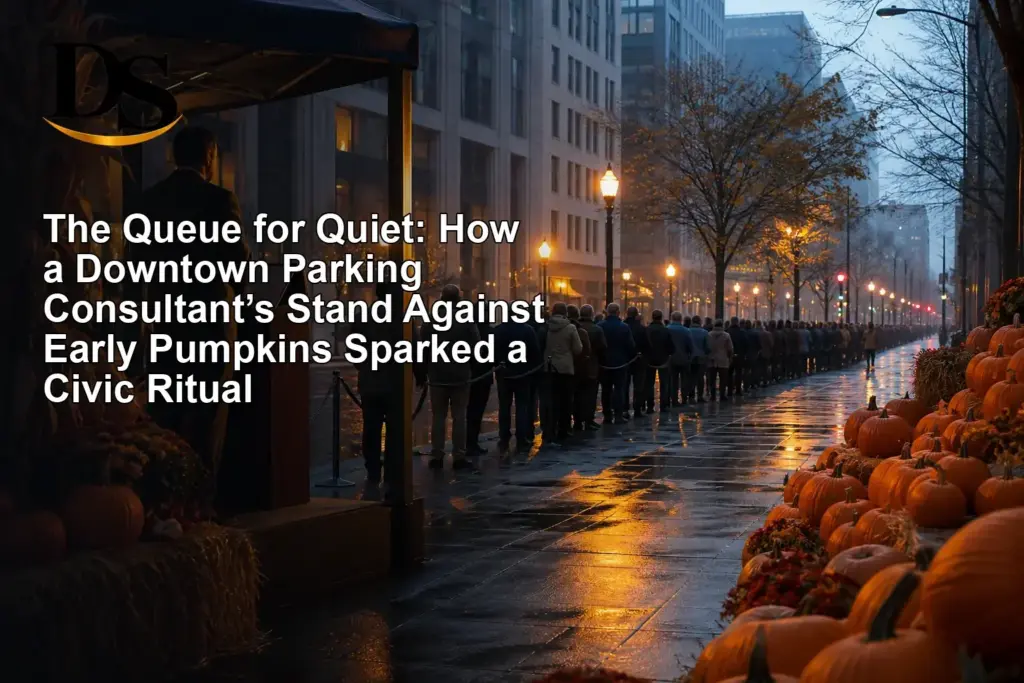
On a crisp September morning, just as the city’s commuters were adjusting to the return of pumpkin spice in everything from lattes to laundry detergent, Mara Voss stood beside her folding chair on the corner of 5th and Elm, holding a laminated sign that read: ‘Premium Queue: Bypass Early Pumpkin Display — $15. Cash or Venmo.’ No one laughed. No one cheered. But within twenty minutes, six people had paid.
The Origins of a Quiet Protest
Voss, a downtown parking consultant with fifteen years of experience optimizing curb access for food trucks and emergency vehicles, said the idea came to her after her third consecutive year of being forced to walk past a towering pyramid of orange gourds outside the municipal library — installed, she noted, on September 1st, three weeks before the autumnal equinox.
‘I don’t hate pumpkins,’ she told me over lukewarm coffee at a diner two blocks away, her voice calm, her eyes steady. ‘I hate the lack of consent. There’s no vote. No town hall. Just… pumpkins. Everywhere. Before you’ve even finished your summer wardrobe.’
She began by standing silently with a clipboard, noting how many people glanced away, hurried their pace, or muttered under their breath. By day three, she had a hypothesis: people weren’t just annoyed — they were grieving the loss of seasonal ambiguity.
So she built the queue.
The Premium Service Takes Shape
What started as a solitary act of civil quietude quickly evolved. By the second week, Voss had a second chair, a tip jar labeled ‘For the Pumpkin-Free Future,’ and a handwritten FAQ taped to a nearby lamppost:
Q: Is this legal?
A: I’m not blocking the sidewalk. I’m offering a service. You’re paying to avoid visual distress.Q: What if I change my mind?
A: There are no refunds. But you can join the queue again tomorrow.Q: Where’s the unsubscribe button?
A: …I don’t know. I looked. It’s not here.
That last question — the unsubscribe button — became the unofficial mantra. Patrons began asking it aloud, half-joking, half-desperate. Some printed tiny QR codes linking to nowhere and taped them to their coats. Others left notes in the tip jar: ‘I subscribed to autumn. I didn’t know it was forever.’
The city’s Parks and Recreation Department, contacted for comment, stated that the pumpkin display was part of a ‘longstanding tradition of early seasonal engagement’ and declined to discuss ‘alternative queue-based mitigation strategies.’ When asked if there was an official channel to opt out of premature holiday imagery, a spokesperson paused, then said, ‘We’ll look into it.’ No follow-up came.
Escalation and the Unintended Civic Ritual
By mid-September, the queue had grown. Regulars began arriving at 6:45 a.m., not to pay, but to stand in silence beside Voss, forming a human buffer between the sidewalk and the pumpkins. A local poet started leaving haiku on the tip jar. A retired librarian began distributing laminated cards that read: ‘I consent to autumn. Today is not that day.’
The phenomenon attracted attention beyond the neighborhood. A blogger from Portland wrote a piece titled ‘The Pumpkin Protest: When Civic Fatigue Meets Entrepreneurial Spirit.’ A TikTok user filmed a timelapse of the queue growing from one to twenty-seven people over three days, set to a slowed-down version of ‘Here Comes the Sun.’ It garnered 800,000 views. The comments were flooded with variations of: ‘Where’s the unsubscribe button?’ and ‘I didn’t know I needed this until I saw it.’
Voss, meanwhile, maintained her deadpan demeanor. She refused interviews with national outlets. ‘This isn’t about me,’ she said when I pressed her. ‘It’s about the quiet majority who just want to walk to work without feeling like they’ve stepped into a Halloween store that opened in July.’
Local businesses noticed the shift. The bakery two doors down began offering a ‘Pumpkin-Free Pastry’ — a plain croissant with a side of existential relief. The laundromat started playing summer playlists on loop between 7 and 9 a.m. A yoga studio nearby added a ‘Pre-Pumpkin Mindfulness’ class at 6:30 a.m., timed to end just as the queue dissolved.
The Unsubscribe Button That Wasn’t There
As October approached, the pumpkins remained. But something had shifted. The display, once met with cheerful acceptance, now drew sideways glances. Parents hurried children past it. Couples walked on the far side of the street. Even the library staff, who had installed the display, began arriving ten minutes later than usual — and entering through the back.
One rainy Tuesday, a woman in a navy coat approached Voss’s queue, handed her a twenty, and said, ‘Keep the change. I’m buying silence for the rest of the month.’ Then she added, quieter: ‘I looked everywhere for the unsubscribe button. It’s not in the app. It’s not on the website. It’s not in the town charter. Is it… in here?’ She tapped her chest.
Voss nodded. She didn’t say anything. She didn’t need to.
By the first week of October, the premium queue had dissolved — not because the pumpkins were gone, but because they were no longer being seen as impositions. People had begun to notice them again — not as intrusions, but as markers. The queue had done its work: it had restored the space between indifference and anticipation.
Voss packed up her chair on a Friday morning, leaving behind only the FAQ sign and a single pumpkin, placed gently on the sidewalk beside her usual spot. It was small. Unadorned. And it faced away from the street.
As I walked away, I glanced back. The pumpkin sat quietly. The sidewalk was empty. And for the first time in weeks, no one was looking for an unsubscribe button.
Join the conversation
Load Facebook comments to read and reply using your Facebook account.