
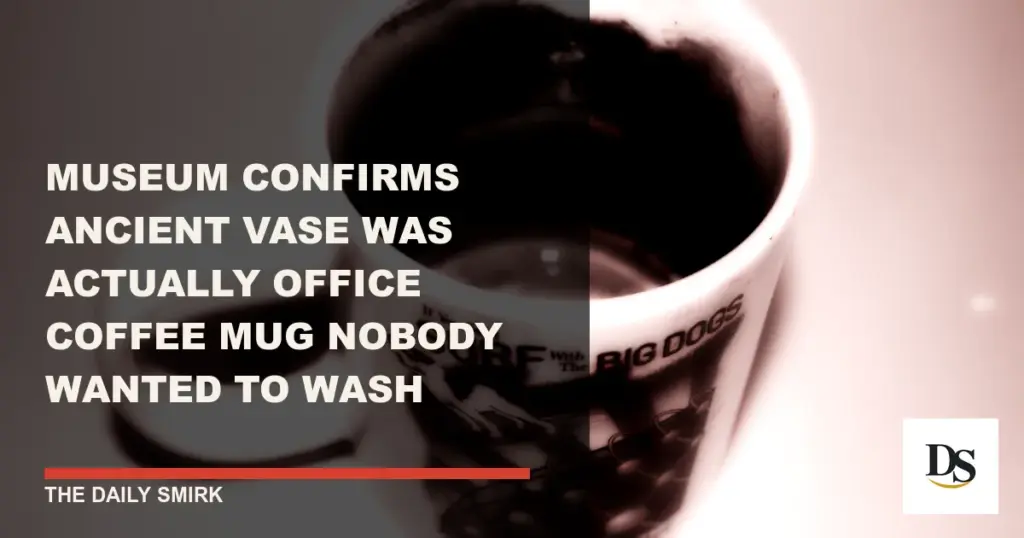
CHICAGO—After four decades of display as a rare ceremonial vessel, curators at the Midwestern Museum of Antiquities confirmed Thursday that its celebrated Harrowgate Vase is an office coffee mug left in a staff sink in 1983 because nobody wanted to wash it.
The discovery followed a yearlong conservation project intended to identify traces of incense, sacred wine, or burial oils. Laboratory analysis instead found instant coffee, powdered creamer, and a ring of residue consistent with a beverage reheated twice before being abandoned beside a handwritten note reading “Whose is this?”
“We are revising the object’s interpretation,” museum director Elaine Voss said at a press conference held beneath a banner that still described the mug as a masterpiece of late Bronze Age domestic ritual. “It remains a powerful record of human civilization, particularly humanity’s tendency to leave one difficult dish for someone else.”
The beige ceramic object entered the collection after a custodian discovered it during renovation of the museum’s old administrative wing. Its brown stains, chipped rim, and dense coating of break-room dust convinced scholars that it had been excavated from a royal tomb.
Decades of scholarship reconsidered
Generations of researchers analyzed the mug’s faded inscription, WORLD’S OKAYEST ACCOUNTANT, as a fragment of an unknown funerary language. One influential paper argued that “Okayest” was a minor deity associated with modest harvests and adequate military campaigns.
The mug’s curved handle was interpreted as a solar symbol representing rebirth. Curators now believe it was simply a handle, though they acknowledged it had successfully represented rebirth every morning after the accounting department filled it with coffee.
A dark line inside the vessel inspired theories about ancient flood measurement. Chemical tests indicate the line marks the maximum amount of coffee that could be carried from the break room without spilling onto quarterly reports.
Museum catalogs also described a series of scratches near the base as tally marks recording livestock. Investigators matched them to the wire rack of a dishwasher in the former staff kitchen, though no evidence suggests the mug ever completed a full washing cycle.
The trail leads to payroll
Archivists identified the original owner through a 1982 office holiday photograph. In the image, junior accountant Gerald Pruitt holds the mug while standing beside a punch bowl and looking surprised to have been included.
Pruitt, now retired, remembered receiving it during an office gift exchange. He denied abandoning it deliberately. “I set it in the sink to soak,” he said. “Then month-end happened, then year-end happened, and at some point a velvet rope appeared around it.”
Former employees described a prolonged standoff. Each morning someone added hotter water and one drop of soap, a ritual that allowed the entire department to feel cleaning had begun. By afternoon the water cooled, and a new note was placed beside the mug with increasingly formal punctuation.
The final note, preserved in museum archives as a possible prayer tablet, reads: “GERALD???” Pruitt said the punctuation was unfair because several other employees used the mug after he transferred to payroll.
Visitors confront a familiar past
The museum has kept the object on display but changed its label. The new text calls it “Untitled Communal Mug, glazed ceramic, coffee, institutional avoidance.” Attendance increased after the announcement, with visitors lining up to examine a form of neglect recognizable across cultures.
“I used to walk past it because old pottery is not my thing,” visitor Keisha Moore said. “But an office dish everyone silently resents? That is history I can access.”
Children on school tours are invited to identify which person should have washed the mug. Most point to Gerald. A smaller group argues that anyone who used it shared responsibility. Teachers quickly redirect those students before the concept spreads.
The museum gift shop introduced replicas priced at $42. Each arrives with authentic-looking residue and a card instructing the buyer to leave it beside a sink until workplace relationships deteriorate. The first production run sold out before lunch.
Other artifacts face new scrutiny
The revelation prompted curators to review several objects acquired during the same renovation. A bronze implement once classified as a priestly agricultural blade is now believed to be a letter opener. A stone tablet covered in columns of numbers may be a cafeteria inventory scratched onto the back of a floor sample.
Researchers are especially concerned about a wooden figure known as the Guardian of Thresholds. Facilities records describe it as a doorstop purchased from a hardware store after the loading dock latch broke.
Voss said corrections are a normal part of scholarship and rejected calls to remove the mug from the ancient civilizations gallery. “Age alone does not create meaning,” she said. “Sometimes meaning develops because dozens of educated adults spend 40 years constructing an elaborate explanation rather than putting something in the dishwasher.”
Conservators do not plan to clean the mug. Removing the residue would erase evidence, damage its familiar appearance, and risk confirming whether the stain beneath the handle can come off with ordinary effort.
At closing time, a museum employee carried a fresh coffee cup into the conservation lab and placed it in the sink. A colleague looked at it, looked away, and turned off the lights. Curators expect the institution’s next major acquisition to be ready for display within three to five business days.
Join the conversation
Load Facebook comments to read and reply using your Facebook account.