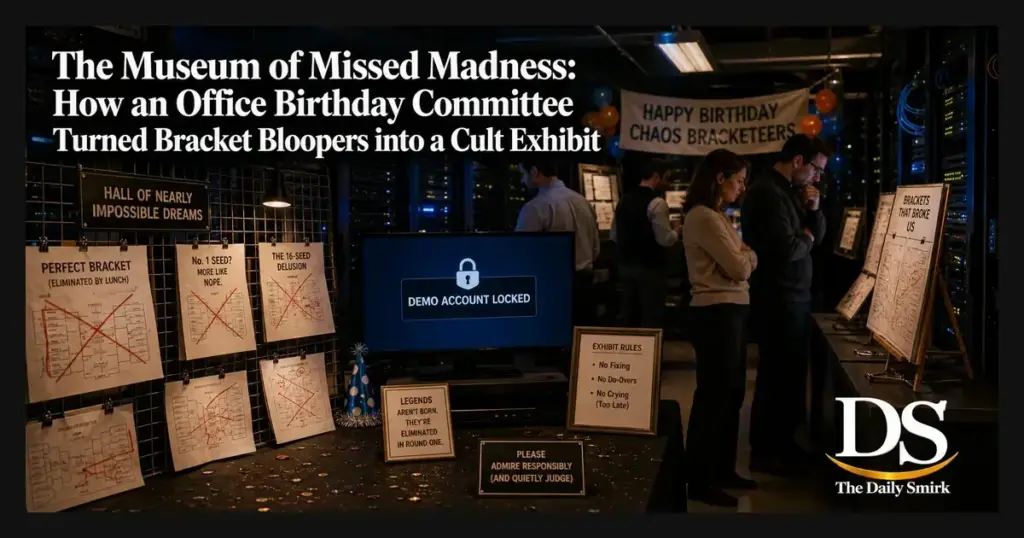
It started, as so many quiet revolutions do, with a sticky note on the breakroom fridge. ‘Bracket Bust Hall of Fame — Nominations Open,’ it read, scrawled in neon green marker beside a half-eaten cupcake. The date was March 12th, three days after the regional sweet sixteen imploded under the weight of a 15-seed upsets and Dave from Accounting’s tragic faith in Gonzaga’s ‘intangibles.’
By Friday, the note had migrated to the whiteboard beside the coffee machine. By Monday, it had a budget line item: $200 from the birthday fund, approved unanimously after a heated debate over whether Lisa from HR’s ‘emotional support pickle’ incident during overtime qualified as a ‘bracket-adjacent’ mistake.
Thus was born the Museum of Office Bracket Mistakes (MOBM), a pop-up exhibit housed in the decommissioned server room behind the printer graveyard. Curated by the birthday committee—self-appointed archivists of joy and mild chaos—the space opened its doors on a Tuesday morning with a ribbon-cutting ceremony involving a frayed Ethernet cable and a single confetti cannon that misfired into the HVAC vent.
Inside, visitors encountered meticulously labeled artifacts: a laminated printout of Mark from Sales’ ‘sure thing’ Final Four pick (Duke, Kentucky, Kansas, and—wait for it—Norfolk State), accompanied by a sticky note confessing, ‘I thought the mascot was a blue devil, not a… Spartan?’ A shattered World’s Best Boss mug sat under glass, its demise attributed to Karen from Payroll’s reaction when her Cinderella pick, Oral Roberts, lost by 22. A looping video played on a salvaged monitor: slow-motion replays of the moment the office bracket pool’s Excel sheet corrupted after someone tried to ‘fix’ a formula with emojis.
‘We’re not mocking the mistakes,’ explained Tina, the committee’s unofficial historian, adjusting a label beneath a participation trophy labeled ‘Most Creative Use of a Coin Flip.’ ‘We’re preserving them. These aren’t just losses—they’re folk tales. This is where we learn that bracketology is less science, more séance.’
The museum quickly became a lunchtime pilgrimage. Departments sent delegates. Interns wrote haikus about upset seeds. The facilities team, initially skeptical, began donating exhibits: a broken chair leg from the ‘argument over seeding ethics’ incident, a half-drunk kombucha bottle labeled ‘Post-Trigger Warning Libation.’ By week two, the museum had its first donor: a retired actuary who mailed in a framed printout of his 1998 bracket, which had predicted a champion that didn’t exist in the tournament that year.
Then came the email. Subject line: ‘ACTION REQUIRED: DEMO ACCOUNT EXPIRATION IMMINENT.’ Sent at 4:58 p.m. on a Friday, it warned that the office’s internal demonstration account—used for training, testing, and, unbeknownst to most, hosting the MOBM’s digital archive, ticketing system, and the interactive ‘What If?’ bracket simulator—would lock in 24 hours due to inactivity protocols.
Panic ensued. The birthday committee scrambled. Tina stayed late, printing screenshots of the simulator’s leaderboard. Raj from IT, roped in after mistaking the server room for a supply closet, managed to export the audio tour before the lights flickered and the screens went black. The final visitor, a temp who’d come to nominate his own mistake—picking a team based on the prettiness of their uniforms—left a note in the guestbook: ‘Thanks for the laughs. Hope the real museum opens soon.’
When the doors reopened Monday, the server room was dark. The exhibits remained, but the interactivity was gone. No more digital leaderboard. No way to submit new mistakes via the kiosk. Just paper, plastic, and memory.
Yet the museum endured. Employees began taping new admissions to the walls: a screenshot of a failed mobile bracket app, a napkin sketch of a conspiracy theory about the selection committee’s bias toward schools with vowel-heavy names. The birthday committee, undeterred, announced plans for MOBM 2.0: a cloud-based version, pending approval from the newly formed Digital Heritage Subcommittee.
As for the original space? It now doubles as overflow storage for birthday cake leftovers and the occasional forgotten yoga mat. But on quiet afternoons, if you listen closely past the hum of the refrigerator, you can still hear the echo of a confetti cannon—and the distant, delighted groan of someone realizing, too late, that they’d picked a 16-seed to win it all.
Fact or Fiction?
This story is FICTION. While office bracket pools and birthday committees are real, no known museum dedicated to bracket-season mistakes has been established in a decommissioned server room, nor has one been locked out by a demo account expiration. The tale blends workplace humor with the universal agony of March Madness misfires, crafted as a satirical feature in the spirit of The Daily Smirk.
The Great Snack Rebellion: When Cupcakes Became Canvas
It started innocently enough — a misplaced frosting swirl on Karen from Accounting’s vanilla cupcake, meant to resemble a smiley face but instead evoked a startled badger. By week three, the birthday committee’s ‘edible art’ subteam had turned dessert decorating into an underground performance art movement. Employees began submitting anonymous ‘snack manifestos’ alongside their cake requests: one demanded a tiramisu sculpted into Rodin’s The Thinker, another insisted on a gluten-free lemon bar arranged as a miniature Stonehenge. HR tried to shut it down after someone used edible gold leaf to recreate the Mona Lisa on a red velvet cake — complete with a tiny, smug smirk made of dark chocolate. But the exhibit fought back. The Museum now features a rotating ‘Snack Shrine’ case, where preserved (via food-safe resin) masterpieces like the ‘Bagel Black Hole’ and ‘Jell-O Volcano Eruption’ are displayed under spotlights, each with a placard quoting the creator’s anonymous note: ‘I did it for the vibes.’ The rebellion peaked when the CEO, attempting to enforce ‘professional pastry standards,’ accidentally dropped his own store-bought cupcake — which landed frosting-side down in a perfect replica of the museum’s logo. He didn’t say a word. Just took a photo. And added it to the exhibit.
Closing Beat: The Exhibit That Laughs Back
Today, the Museum of Missed Madness doesn’t just display artifacts — it invites interaction. Visitors are handed a blank ‘Bracket Bloopers’ card upon entry and invited to sketch their own near-miss moment: the time they almost sent a meme to the boss, almost wore mismatched shoes to a client meeting, almost laughed during a moment of silence. These cards are clipped to a growing clothesline near the exit, fluttering like confetti from a party no one planned but everyone remembers. Last Tuesday, a new intern added a card showing a stick figure tripping over a power cord while holding a coffee labeled ‘Monday.’ Below it, in wobbly letters: ‘I didn’t fall. I was testing the exhibit’s gravity.’ The museum doesn’t celebrate perfection. It honors the beautiful, butter-fingered, bracket-busting humanity of trying — and failing — in public. And somehow, in that space between intention and accident, we’ve found something rarer than success: a place where everyone belongs, not because they got it right, but because they dared to get it wonderfully, gloriously wrong.
Join the conversation
Load Facebook comments to read and reply using your Facebook account.