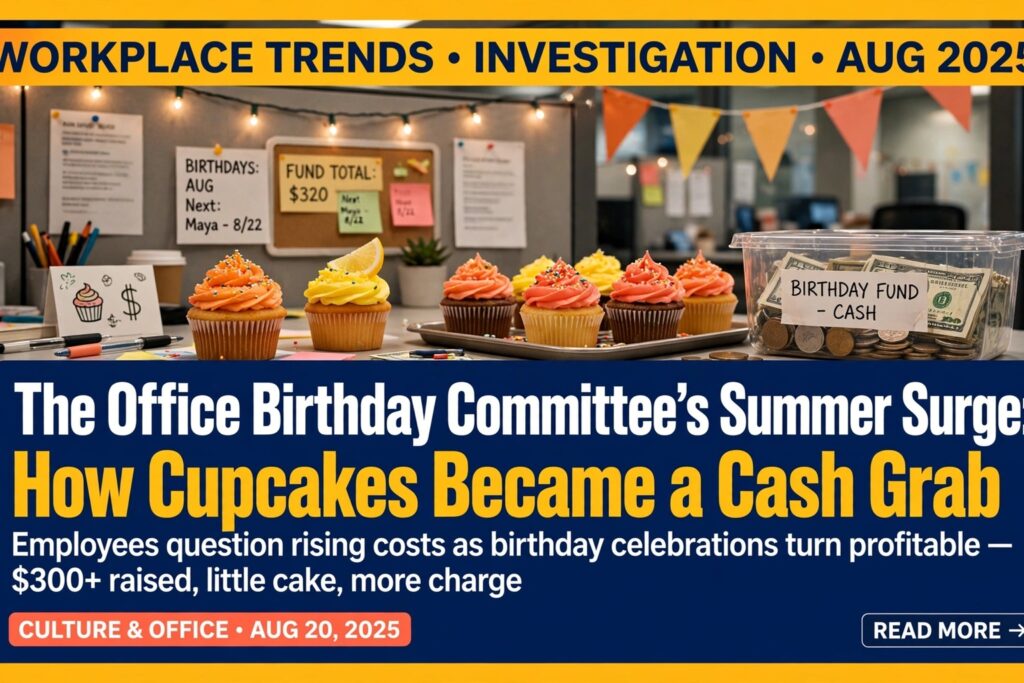
It started innocently enough. On the first Monday of June, when the office air conditioning sputtered to life like a reluctant lawnmower, Karen from Accounting placed a single vanilla cupcake on the break room table with a sticky note: ‘Happy Birthday, Dave! — The Committee’. No one questioned it. Dave smiled, took a bite, and went back to his spreadsheet.
The Price Tag Appears
By the second week, the notes changed. A chocolate fudge cake for Priya in Marketing came with a new addition: ‘Suggested contribution: $8’. Then, for Raj’s milestone 30th, the note read: ‘Peak demand pricing in effect: $12. After-hours surcharge applies after 3 PM.’ Employees exchanged glances. Was this a joke? The committee, led by intern-turned-chairperson Tiffany Blatt, insisted it was ‘market-based recognition’.
Background: The Birthday Economy
The office birthday committee had existed for years as a voluntary rotation: someone brought treats, signed a card, and the cycle continued. No funds changed hands. But after a quarterly wellness survey flagged ‘celebration fatigue’ and ‘unequal effort,’ Tiffany proposed a ‘sustainable recognition model.’ Using a shared spreadsheet, the committee began tracking pastry costs, labor (time spent buying and arranging), and even ‘emotional labor’—a category that sparked debate when Greg from IT argued that remembering Sandra’s gluten-free preference deserved a 1.5x multiplier.
Escalating Developments
What began as suggestions hardened into expectations. The committee introduced tiered pricing: standard ($6), premium ($10 for fondant or fruit toppings), and executive ($15 for layered cakes with custom messages). A ‘no-show fee’ of $5 was levied against those who accepted cake but didn’t pay via Venmo or cash dropbox by Friday. By mid-June, the break room whiteboard displayed a live ‘Celebration Index’ tracking contribution rates, which Tiffany claimed had ‘stabilized morale through accountability.’
Then came the unofficial start of summer. On June 20th, the day after the summer solstice, the committee announced ‘Summer Surge Pricing’: all birthday treats would increase by 20% due to ‘increased demand for morale-boosting interventions during seasonal transition.’ The note on Elena’s lemon tart read: ‘Surge active. $10.80. Tip jar for extra sprinkles.’ Some employees began bringing their own snacks and eating them at their desks. Others started a Slack thread titled ‘Is this still a workplace or a theme park?’
Attributed Reactions
‘I didn’t sign up for a birthday Uber,’ said Marcus Lee, a senior designer, as he scraped frosting off a paper plate. ‘I just wanted to celebrate my kid’s first year without needing a receipt.’
Tiffany Blatt defended the model in a team meeting: ‘We’re not profiting. We’re covering costs and ensuring fairness. If you want cake, you pay for the ingredients and the effort. It’s no different than ordering lunch.’ She noted that surplus funds were being rolled into a ‘future celebration reserve’—though no one had seen the ledger.
HR, when approached, referred inquiries to the ‘voluntary social committee charter,’ a document last updated in 2019 that made no mention of dynamic pricing. ‘We encourage camaraderie,’ said a representative, ‘but we don’t monitor how birthdays are celebrated.’
Community Impact
The surge had unintended consequences. Potluck participation dropped as people questioned whether bringing a dish now required a cost-benefit analysis. The vegan baker in Customer Support stopped contributing after her ‘specialty diet surcharge’ was questioned. Meanwhile, a underground economy emerged: employees trading homemade cookies for coffee runs or stapler loans, bypassing the committee entirely.
By June 28th, the break room felt less like a shared space and more like a concession stand. The birthday card for Jamal, usually passed around with jokes and doodles, sat unsigned for two days. When it finally circulated, it bore only three names and a Venmo QR code.
The Demonstration Account Locks Everyone Out
Then, on June 29th, the demonstration account used to manage the committee’s shared budgeting spreadsheet—originally set up for a now-defunct financial literacy workshop—triggered an automatic security lock. The system, detecting ‘unusual activity’ from multiple devices and locations, froze access. Suddenly, no one could view the contribution tracker, update the Celebration Index, or even see who owed what for last week’s red velvet cake.
Panic ensued. Had they overpaid? Underpaid? Was the surplus real? Tiffany tried to reset the password but hit a two-factor wall tied to a deactivated intern email. For the first time in months, the break room was quiet. No cake. No notes. Just the hum of the fridge and the smell of stale coffee.
On June 30th, someone brought in a store-bought brownie. No note. No price. Just a treat. A few others followed. By Friday, the table was full again—unpriced, unregulated, and unexpectedly joyful.
Decisive Closing Beat
The demonstration account remains locked. The committee has not reconvened. And while no official policy has changed, the break room has quietly returned to its old rhythm: someone brings something, someone else says thanks, and the day moves on.
Sometimes, the best systems are the ones that don’t need a spreadsheet to work.
Fact or Fiction?
FICTION. This article is a satirical exploration of workplace culture, incentive systems, and the unintended consequences of over-formalizing informal traditions. No such surge pricing scheme or demonstration account lock occurred at any known office. The characters and events are invented to highlight how well-intentioned structures can drift into absurdity when detached from human context.
Join the conversation
Load Facebook comments to read and reply using your Facebook account.