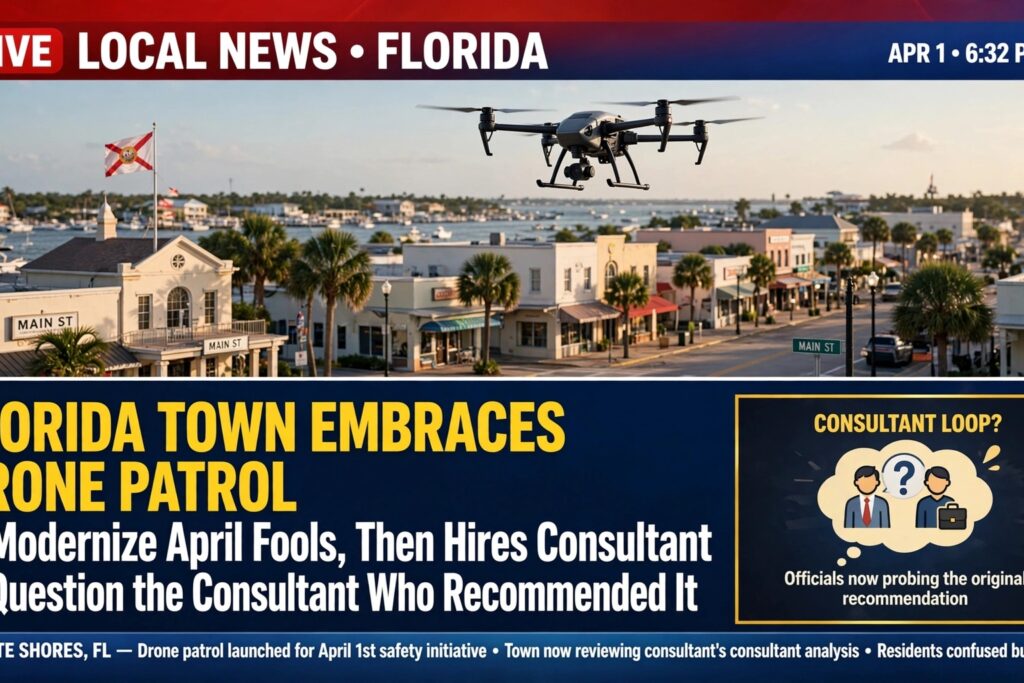
CEDAR HOLLOW, Fla. — On a misty March morning, residents of Oakridge Estates watched as six quadcopters, painted in muted camo and emblazoned with the neighborhood association’s seal, lifted silently from the cul-de-sac beside the retention pond. Their mission: to monitor, document, and, if necessary, gently redirect April Fools’ Day mischief before it escalated into HOA violations or, worse, unsolicited glitter bombs.
‘We’re not trying to kill the fun,’ said Marjorie Tuck, president of the Oakridge Community Alliance, adjusting her sunhat as she observed the drones’ test flight. ‘We’re trying to bring it into the 21st century. With accountability. And geofencing.’
The initiative, dubbed ‘Project JestWatch,’ began as a grassroots response to last year’s prank overload—a series of increasingly elaborate hoaxes that included a fake alligator in the community pool, a strategically placed ‘For Sale’ sign on the mayor’s lawn, and a synchronized sprinkler activation that drenched three book club members mid-discussion of Where the Crawdads Sing. Tuck estimated the cleanup and emotional toll exceeded $12,000 in landscaping, dry cleaning, and therapy copays.
Seeking a modern solution, the alliance bypassed traditional bidding after a presentation by Horizon Dynamics, a Tampa-based consultancy specializing in ‘municipal whimsy mitigation.’ Horizon’s lead analyst, Daryl Pryce, argued that drone surveillance could reduce prank-related incidents by 68% through deterrence, real-time intervention, and post-event forensic review—complete with timestamped HD footage and AI-assisted anomaly detection (though the AI, Pryce clarified, was only trained on past prank patterns, not facial recognition).
‘It’s not about catching people in the act,’ Pryce explained during a Zoom call attended by three association board members and a confused landscaper. ‘It’s about changing the calculus. If you know your whoopee cushion deployment might be logged in a shared dashboard, you might just… reconsider.’
The board voted unanimously to award Horizon Dynamics a no-bid contract worth $47,000 for six months of drone operations, data storage, and monthly ‘jest metrics’ reports. The drones launched on April 1, hovering at 40 feet above sidewalks, their quiet hum blending with the distant chirp of cicadas and the occasional squeal of a child chasing a rogue rubber chicken.
Initial results were promising. By 10 a.m., the drones had documented three attempted pranks: a fake spider lowered from a tree (deterred after a drone hovered nearby for 90 seconds), a misplaced lawn ornament relocated to the median (corrected via automated PA announcement: ‘Please return the flamingo to its rightful owner. This is not a drill.’), and a planned ‘invisible man’ stunt thwarted when the drone’s thermal sensor detected a person crouched behind a bush holding a spool of clear fishing line.
‘We got him,’ Tuck said later, reviewing the footage. ‘Not with force. With presence. It’s poetic.’
But by April 3, unease began to stir. At the association’s emergency meeting, resident Dale Porch raised concerns about mission creep. ‘Last night, my drone picked up a signal near the Johnson’s mailbox. Turns out, it was just Mrs. Johnson testing her new hearing aid. But the system flagged it as ‘anomalous auditory behavior.’ Who’s reviewing these alerts? And why am I getting a PDF summary of my wife’s morning yoga routine?’
Others questioned the cost-benefit ratio. ‘We spent nearly fifty grand to stop a glitter bomb,’ said Linh Nguyen, who teaches math at the charter school. ‘That’s enough to buy 500 whoopee cushions. Or fund the library’s summer reading program.’
Sensing growing unease, the alliance commissioned a second review—this time from Veridian Insight, a firm specializing in ‘organizational decision audits.’ Their task: to evaluate whether Horizon Dynamics’ initial recommendation had been sound, or if the alliance had been overly persuaded by slick pitch decks and the promise of ‘disruptive jest control.’
Veridian’s lead consultant, Elise Moran, arrived with a binder, a laptop, and a healthy skepticism. After interviewing board members, reviewing drone logs, and analyzing the correlation between drone presence and prank reduction (which, she noted, could also be attributed to unusually heavy rainfall on April 2), she delivered her findings.
‘The drones are functional,’ Moran said at the follow-up town hall. ‘They fly. They record. They occasionally announce things over a speaker. But the original ROI projection—68% reduction—was based on a single pilot study in a retirement village in Arizona where the primary prank was leaving fake parking tickets on golf carts. Oakridge Estates is not Sunhaven Village. Your pranks involve more creativity, more propulsion, and, frankly, better snacks.’
Moran recommended scaling back the drone program to weekend-only patrols, replacing daily flights with motion-activated cameras at high-risk zones (the pool, the mailbox cluster, and the statue of the town’s founder, who may or may not have wrestled a bear in 1923), and reinvesting the savings into a community prank tribunal—a rotating panel of residents tasked with reviewing incidents and assigning restorative penalties, such as weeding the community garden or leading the next Pledge of Allegiance.
Tuck listened, nodding. ‘We wanted to innovate,’ she said afterward. ‘And we did. But maybe innovation doesn’t always need six rotors and a service contract. Sometimes, it just needs a little humility—and maybe a flamingo on standby.’
As of press time, the drones remain in their cases, charging in the alliance’s storage shed beside the extra bags of mulch and the forgotten Easter egg launcher. The flamingo, meanwhile, has returned to its post. And for the first time in years, no one’s quite sure who moved it.
Join the conversation
Load Facebook comments to read and reply using your Facebook account.