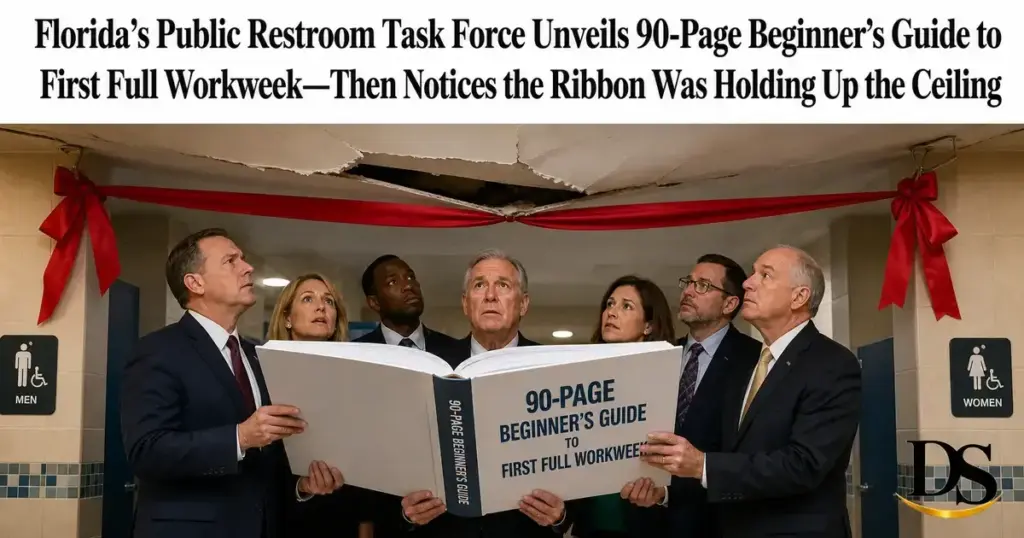
TALLAHASSEE — On a humid Tuesday morning, members of the Florida Public Restroom Access and Dignity Task Force gathered beneath a banner reading ‘Clean Stalls, Clear Minds’ to unveil their magnum opus: a 90-page, spiral-bound beginner’s guide to navigating the first full workweek in state-operated restrooms.
The guide, titled ‘From Flush to Flow: A Week-Long Journey Toward Bathroom Equity’, outlined daily protocols for handwashing duration, stall selection ethics, and the proper use of air freshener as a diplomatic tool. Page 34 featured a flowchart titled ‘When to Nod, When to Smile, When to Pretend You Didn’t Hear That.’
The Launch That Held Up More Than Expectations
The unveiling ceremony took place in the lobby of the Leon County Administrative Building, where a crimson ribbon was stretched across two marble columns flanking the main entrance. Task Force Chair Dr. Lenora Peabody, a retired urologist with a penchant for alliterative policy names, delivered a 12-minute speech on the psychological toll of inconsistent soap dispenser placement.
As she concluded, ‘Let us now cut the ribbon to a future where no Floridian must choose between dignity and dry hands,’ Peabody reached for the ceremonial scissors. The moment the blade touched fabric, a low groan echoed from the ceiling above.
Plaster dust drifted downward. A tile near the sprinkler system shifted. Then, with the inevitability of a slow leak becoming a flood, a 3-foot section of the drop ceiling sagged, revealing tangled wiring and the faded outline of a long-forgotten HVAC maintenance notice from 2009.
‘Well,’ said Deputy Director Marcus Cho, stepping back as a maintenance worker in a hard hat peered up, ‘that’s not in the guide.’
Background: A Mission Born of Frustration
The Task Force was formed in 2022 after a viral video showed a tourist in Daytona Beach using a hotel lobby plant as a makeshift urinal, citing ‘absence of clear signage and moral direction.’ Funded by a state grant aimed at improving public hygiene infrastructure, the group spent 18 months touring rest stops, courthouses, and municipal pools, compiling anecdotes, swipe-card malfunction logs, and one particularly detailed complaint about a motion-sensor faucet that ‘only worked if you waved like you were hailing a taxi in a hurricane.’
Their guide, printed on recycled paper with soy-based ink, includes illustrations of proper toilet paper orientation (over, never under), a FAQ section addressing ‘What if the hand dryer sounds like a disappointed goose?’ and a worksheet for tracking weekly restroom-related anxiety levels.
‘We wanted something accessible,’ said Peabody later, adjusting her lanyard. ‘Not a manifesto. A companion. Like a GPS for bodily comfort.’
Escalating Developments: From Ribbon to Reckoning
Structural engineers were called in within the hour. Preliminary findings indicated the ribbon had been tied not just for symbolism, but to stabilize a compromised corner where a previous water leak had weakened the drywall anchor. The columns, it turned out, were decorative facades; the real load-bearing support ran behind them—and had been inadvertently relieved of tension when the ribbon was severed.
‘In hindsight,’ said County Facilities Manager Rochelle Dumas, ‘using a ceremonial ribbon as a temporary shim during renovations was… optimistic. But we’d planned to replace it with a steel bracket after the event. The timing was… unfortunate.’
The incident delayed the guide’s distribution by two days while contractors installed a temporary support beam. Copies were eventually handed out at county health clinics, library branches, and one particularly enthusiastic Waffle House that volunteered to be a pilot site for ‘Restroom Diplomacy Training.’
Attributed Reactions: Pride, Puzzlement, and a Touch of Pragmatism
Public response has been mixed but largely amused. At a community forum in Gainesville, retiree Elaine Vicario praised the guide’s ‘no-judgment zone’ approach to toilet seat lid etiquette, though she admitted she ‘still flushes with my foot.’
‘It’s not about perfection,’ said Task Force intern Jelani Rowe, who helped draft the section on ‘Managing Eye Contact in the Mirror Zone.’ ‘It’s about giving people the tools to feel okay when things aren’t ideal. Even if the ceiling almost falls in.’
Not everyone was convinced. A letter to the editor in the Orlando Sentinel questioned whether ‘tax dollars should fund a 90-page pamphlet on how to sigh quietly in a stall’ when ‘some counties still can’t afford toilet paper that doesn’t disintegrate if you look at it wrong.’
The Task Force responded by noting that 68% of surveyed Floridians reported avoiding public restrooms due to anxiety over unclear social protocols— a figure they believe justifies the investment.
Community Impact: A Ripple Through the Stalls
In the weeks since the launch, anecdotal shifts have emerged. At the Tallahassee DMV, staff reported fewer instances of users knocking repeatedly on occupied doors after misreading the ‘Vacant/Engaged’ sign—a common point of confusion addressed on page 22.
At Florida State University, a student government committee adopted the guide’s ‘Three-Second Rule’ for sink sharing during peak hours, reducing line-related tensions in the union building restrooms.
And in a surprising turn, the incident has sparked renewed interest in infrastructure transparency. A grassroots group called ‘Flush the Truth’ has begun mapping load-bearing elements in public buildings, arguing that ‘if we’re going to invest in dignity, we should at least make sure the ceiling stays up.’
Decisive Closing Beat
Back at the Leon County building, the ribbon has been replaced—not with another ceremonial loop, but with a clearly marked steel cable and a small plaque that reads: ‘This space is held up by engineering, not symbolism. Please wash your hands.’
The Task Force has since added an appendix to the guide: ‘Appendix G: What to Do When the Building Reacts to Your Hope.’
It consists of one sentence, centered on the page: ‘Step back. Let the professionals handle it. Then try again next week.’
Join the conversation
Load Facebook comments to read and reply using your Facebook account.