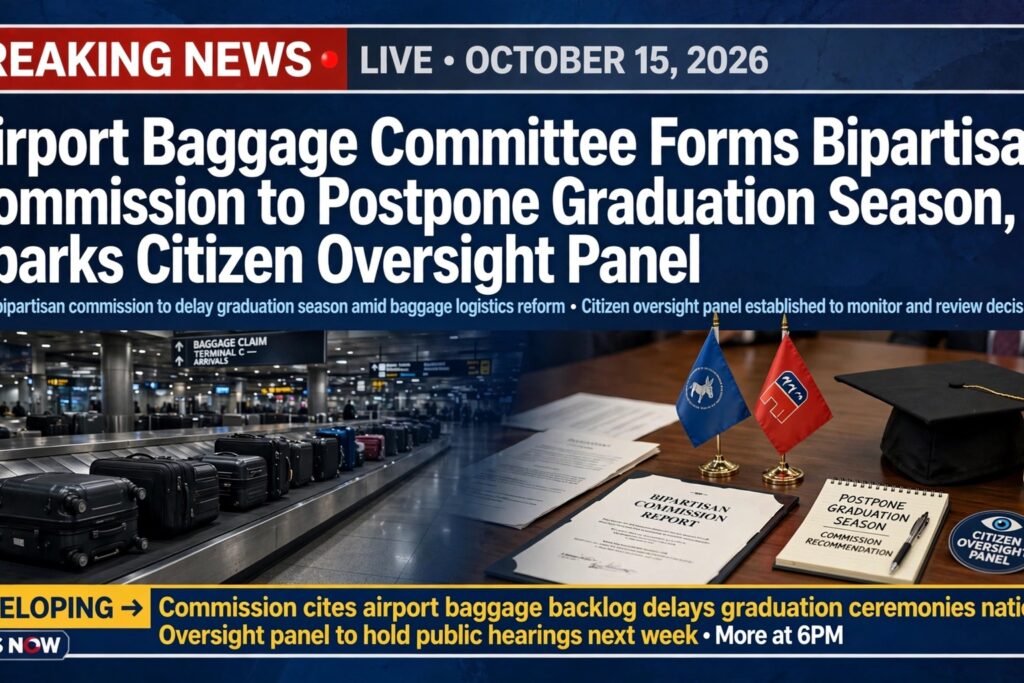
WASHINGTON — In a quiet conference room beneath Terminal C at Dulles International, the National Airport Baggage Coordination Board (NABCB) convened its first-ever bipartisan commission on Tuesday, not to address lost luggage or conveyor belt inefficiencies, but to delay the nation’s graduation season.
‘We’re not anti-education,’ said Chairperson Miriam Delgado, a former TSA supervisor turned logistics strategist, adjusting her headset as she spoke. ‘We’re pro-synchronization. Right now, 3.2 million graduates are flooding airports in a six-week window — caps, gowns, extra suitcases for memorabilia, and that one uncle who brings a full-sized grill ‘for the celebration.’ Our system wasn’t built for this.’
The NABCB’s 12-member commission, evenly split between Democrats and Republicans and chaired by Delgado and her counterpart, retired Air Force logistics officer Colonel Richard Vance, voted 11-1 to implement a nationwide ‘Graduation Flow Modulation Protocol.’ Under the plan, all high school and university commencements will be postponed from May–June to September–October, with exceptions only for military academies and institutions with documented indoor stadium capacity exceeding 90%.
The rationale, outlined in a 47-page white paper titled ‘Temporal Load Balancing in Academic Egress Events,’ cites data showing that baggage handling systems operate at 18% capacity during winter months but spike to 240% during peak graduation weekends. ‘It’s not about the gowns,’ Delgado added. ‘It’s about the ripple effect: delayed flights, misrouted tote bags containing valedictorian speeches, and the occasional emotional support alpaca mistakenly checked as oversized luggage.’
The decision ignited immediate backlash from parent-teacher associations, marching band boosters, and a coalition of florists who rely on June corsage sales. But it was the grassroots response that surprised even the NABCB.
By Friday, a group of residents from Reston, Virginia — self-designated as the ‘Citizen Oversight Panel for Airport-Induced Academic Delays’ (COPAIAD) — had filed a formal request to observe the NABCB’s commission meetings. Their mission: to ensure the baggage handlers weren’t overreaching.
‘We’re not questioning their expertise,’ said COPAIAD co-founder Eleanor Pratchett, a retired librarian who organized the group after her grandson’s graduation was moved to October 14th, coinciding with peak leaf-raking season. ‘We’re just making sure they’re not using this as an excuse to finally ban those noisy airhorns graduates love. Someone’s got to watch the watchers.’
COPAIAD now meets every Thursday at a Panera Bread near the airport’s long-term parking garage, where members review NABCB meeting minutes, annotate printed copies of the white paper with colored pencils, and occasionally bring homemade cookies labeled ‘For the Commission — With Love and Skepticism.’
The NABCB, for its part, has welcomed the scrutiny. ‘Transparency builds trust,’ Delgado said during a press briefing, flanked by Vance and a PowerPoint slide showing a bar graph titled ‘Emotional Support Alpaca Incidents: 2019–2023.’ ‘If citizens want to watch us watch the bags, fine. Just don’t bring outside food to the meetings — we’ve had issues with crumbs in the RFID readers.’
Local officials are cautiously optimistic. Mayor Linda Cho of Fairfax County noted that while the delay disrupts traditional summer plans, it could alleviate strain on municipal services. ‘Our fireworks budget usually gets blown in three weekends,’ she said. ‘Now we can spread it out. Plus, October graduations mean cooler weather for outdoor ceremonies — fewer heatstroke cases, more comfortable polyester.’
Academics remain divided. Dr. Aris Thorne, a chronobiologist at Georgetown University, warned that shifting commencement to fall could disrupt circadian rhythms tied to academic achievement. ‘Students associate May with closure,’ he said. ‘Moving it to October risks creating a cultural dissonance — like celebrating New Year’s in July.’ Others, however, see opportunity. ‘Imagine,’ said Dean Luisa Mendes of Northern Virginia Community College, ‘a graduation where you don’t have to sweat through your robe. Where your grandparents don’t need portable fans. Where the only thing melting is the chocolate on your diploma cake.’
As of press time, the NABCB has agreed to livestream its next commission meeting, with COPAIAD assigned a dedicated commentary channel on the airport’s public Wi-Fi portal. Pratchett says her group plans to submit a formal response by month’s end — complete with footnotes, a bibliography, and a pie chart showing the optimal distribution of graduation months based on average humidity levels.
For now, the nation’s graduates wait — in limbo, but with luggage safely routed.
The Graduation Gown Gambit
As the Bipartisan Commission’s first hearing convened in a repurposed TSA screening lane — complete with a malfunctioning metal detector that beeped whenever someone mentioned ‘diploma’ — a startling revelation emerged: the delay wasn’t just about luggage. Internal memos, leaked by a disgruntled baggage handler who moonlights as a poet, revealed the Commission’s true motive: to synchronize the postponement of graduation season with the annual ‘Lost & Found Fashion Show,’ a clandestine event where unclaimed suitcases are modeled on a runway made of conveyor belts.
The highlight? A rogue intern, tasked with alphabetizing lost luggage tags, accidentally swapped the labels on two identical navy-blue Samsonites — one containing a valedictorian’s cap and gown, the other a full set of medieval armor meant for a Renaissance faire in Toledo. When the gown emerged on the ‘Lost & Found’ runway, it was paired with a gauntlet, a visor, and a suspiciously damp lance. The crowd gasped. Then laughed. Then cried. Then started a TikTok trend: #GradGownOrArmor.
Meanwhile, the Citizen Oversight Panel, initially formed to scrutinize the Commission’s motives, has devolved into a weekly support group for parents trying to explain to their teens why their graduation photos now feature a suitcase full of socks and a single left sneaker labeled ‘Property of the United States Government.’ One mother, tearful but resolute, presented a PowerPoint titled ‘Why My Son’s Diploma Is Currently in Bin 7B, Next to the Half-Eaten Burrito and a Questionable Hat.’
The Commission, sensing the absurdity has peaked, announced a surprise compromise: graduations will proceed — but only if every graduate agrees to wear their cap and gown over a hazmat suit, and receive their diploma via drone delivery from a baggage cart piloted by a retired air traffic controller who communicates exclusively in interpretive dance.
As the sun set over the terminal, casting long shadows across the endless sea of unclaimed luggage, a lone janitor swept up a stray tassel. He paused, looked at it, then tucked it gently into his pocket. ‘Some things,’ he muttered to no one in particular, ‘are too important to lose. Even if the system forgets them.’
The Last Call for Luggage (and Legacy)
In a final, surreal twist, the Airport Baggage Committee revealed that the ‘postponement’ was never meant to last — it was a stress test. The real goal? To see how long society could function without the ritual of graduation before people started inventing their own.
And invent they did. Pop-up commencements sprouted in airport chapels, parking garages, and even inside the hollowed-out fuselage of a decommissioned 747 turned into a pop-up library. One group of graduates, denied their ceremony, held a ‘reverse procession’ — walking backward from baggage claim to the check-in counters, tossing their caps into the air like confetti, only to have them sucked into the vacuum vents and reappear three hours later in the lost-and-found bin labeled ‘Miscellaneous Headwear: Do Not Claim.’
The Citizen Oversight Panel, now officially recognized as a municipal advisory board (after a heated debate over whether their minutes should be printed on boarding pass stock), issued a 12-point manifesto: ‘We demand transparency. We demand accountability. We demand that if your diploma is delayed, you get a complimentary snack voucher and a free hug from a terminal mascot.’
As the Commission prepares to disband — its final act being the ceremonial return of a single, lonely sock to its rightful owner after 11 months in quarantine — the article closes not with a punchline, but with a quiet moment: a graduate, cap in hand, standing before the departures board. Her flight is delayed. Again. But she’s smiling. Because, for the first time in weeks, the screen doesn’t say ‘Cancelled.’ It says: ‘Boarding Soon.’
And somewhere, in the hum of the baggage carousel, a lone gown spins slowly — not lost, not found, but waiting. Like hope. Like humor. Like the quiet, stubborn belief that even when the system fails, we’ll still show up — in whatever we’re wearing — to claim what’s ours.
Join the conversation
Load Facebook comments to read and reply using your Facebook account.