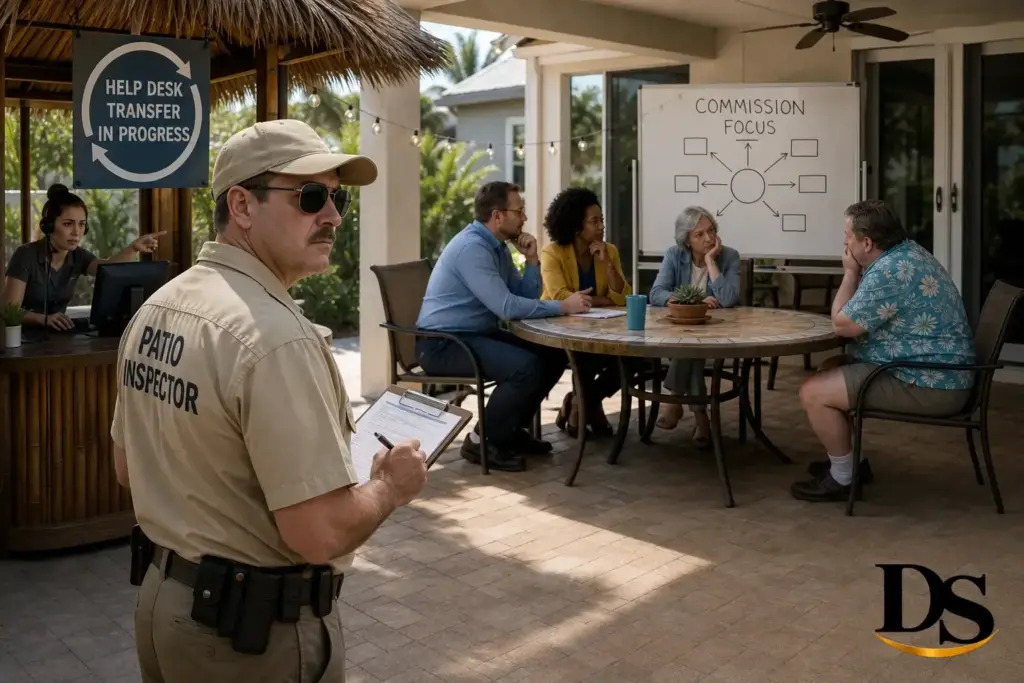
In the humid shade of a screened-in lanai in Sarasota, Margaret Tolliver adjusted her clipboard and sighed. The mosquito netting fluttered above a half-empty pitcher of sweet tea as she reviewed yet another complaint: a neighbor’s Trump flag, too close to the property line. Another: a Biden sticker peeling off a mailbox, deemed ‘visually agitating’ by the HOA. Tolliver wasn’t just any resident — she was Sarasota County’s sole certified patio inspector, a title earned after three years of measuring rail spacing, checking for rot in pressure-treated lumber, and mediating disputes over umbrella tilt.
The Quiet Initiative
It was during a routine inspection of a deteriorating concrete slab behind a split-level home that Tolliver had her epiphany. ‘We’re not here to referee political yard signs,’ she told the homeowner, a retired teacher who’d just finished explaining why his ‘Let’s Go Brandon’ flag was ‘protected speech, not a tripping hazard.’ ‘We’re here to make sure your deck doesn’t collapse into the azaleas.’
The comment stuck. Over the next week, Tolliver began quietly approaching fellow inspectors in neighboring counties — not to discuss load-bearing codes, but to propose a temporary moratorium on election-related commentary during official patio evaluations. By mid-September, she had drafted a one-page proposal: the Patio Integrity and Civic Quiet Initiative, or PICQI. Its goal? To suspend all partisan discourse during inspections until after Election Day, letting structural safety take precedence over lawn sign debates.
What began as a personal plea gained traction. Retired inspectors from Boca Raton to Pensacola signed on. A former municipal auditor in Tallahassee offered to draft the bylaws. By October, PICQI had become a bipartisan commission — seven members, three Republicans, two Democrats, two independents — all united by a shared belief: the structural integrity of Florida’s patios deserved a moment of peace.
The Help Desk That Wouldn’t Let Go
To coordinate their efforts, the commission established a simple help desk: a shared Google Voice number routed to a rotating voicemail box. Callers could leave messages about inspection concerns, code questions, or — ideally — nonpartisan patio concerns. The system was meant to be humble, low-tech, and offline from the noise.
But almost immediately, something strange happened. When Tolliver called the number to test it, she heard a recording: ‘Thank you for contacting the Patio Integrity and Civic Quiet Initiative. Your call is important to us. Please hold for the next available agent.’ Then, after exactly twelve seconds of hold music — a tinny rendition of ‘America the Beautiful’ played on a kazoo — the line clicked, and the same recording began again.
‘It’s transferring itself,’ said Dale Pruitt, the commission’s lone Republican member and a former pool contractor from Naples. ‘I called from my truck. Got the same loop. Tried again from my wife’s phone. Same thing. It’s not forwarding to anyone. It’s just… recycling.’
The commission met via Zoom the next evening. Pruitt shared his screen. They listened. After three cycles, the chairwoman, an independent from Gainesville named Loretta Moss, muted herself and whispered, ‘Is it possible the system is… aware?’
No one laughed. The joke, if it was one, had vanished into the circuitry.
Escalating Absurdity
Over the next 48 hours, the help desk’s behavior grew more peculiar. Callers reported hearing faint background chatter — snippets of debate about tariff policy, then suddenly a discussion about proper flashing installation. One inspector in Ocala swore he heard his own voice, from a call made two hours earlier, echoing back with a two-second delay.
Technical support from the county’s IT department was consulted. They found no call forwarding rules, no auto-attendant scripts, no evidence of external interference. The number was registered to a prepaid SIM card Tolliver had bought at a Walmart in Bradenton, activated under the name ‘Patio Quiet.’
‘It’s not hacked,’ said the IT analyst. ‘It’s just… broken in a way that makes sense.’
The commission debated shutting it down. But then, a call came through — not a loop, but a live voice. An elderly woman from Venice: ‘Hi, I’m calling about my lanai screen. It’s sagging in the southwest corner. No politics, I promise. Just worried it’ll give way during the next storm.’
They took her name, noted the issue, and promised a follow-up. When they hung up, the help desk resumed its loop.
‘It only lets through the quiet ones,’ Pruitt observed. ‘The ones who just want their patio to stay up.’
Community Impact
Word spread slowly. In neighborhood Facebook groups, users began posting: ‘Had my patio inspected today. Inspector didn’t mention the election once. Just checked my joist hangers. Felt… nice.’ Others reported inspectors declining to engage when asked about candidates, instead commenting on the grade of the concrete or the adequacy of the drainage slope.
A local paper in Fort Myers ran a brief: ‘Patio Inspectors Observe Unofficial Truce Amid Election Season.’ No names were given. No mention of the help desk.
Inside the commission, morale was mixed. Tolliver admitted she hadn’t expected the initiative to last this long. ‘I just wanted to get through one inspection without hearing about electoral college math,’ she said. ‘Now we’re accidentally running a parody of a government hotline — and it’s working better than the real thing.’
Moss, the chairwoman, was more reflective. ‘We set out to create space for safety. What we got was a mirror. The help desk doesn’t transfer calls because it’s broken. It transfers because it doesn’t know where else to send them. Sounds familiar.’
The Closing Beat
As Election Day loomed, the commission held its final meeting. They voted to disband PICQI at midnight on November 5th. The help desk would go silent. The SIM card would be deactivated. The proposal archived.
But before they signed off, Tolliver placed one last test call. The line rang. Then, the familiar recording: ‘Thank you for contacting the Patio Integrity and Civic Quiet Initiative…’
They let it play. Twelve seconds of kazoo-held harmony. Then the loop began again.
No one stopped it. They just listened, for a moment, to the sound of a system doing its best — confused, circular, and strangely devoted — to keep the line open.
Join the conversation
Load Facebook comments to read and reply using your Facebook account.