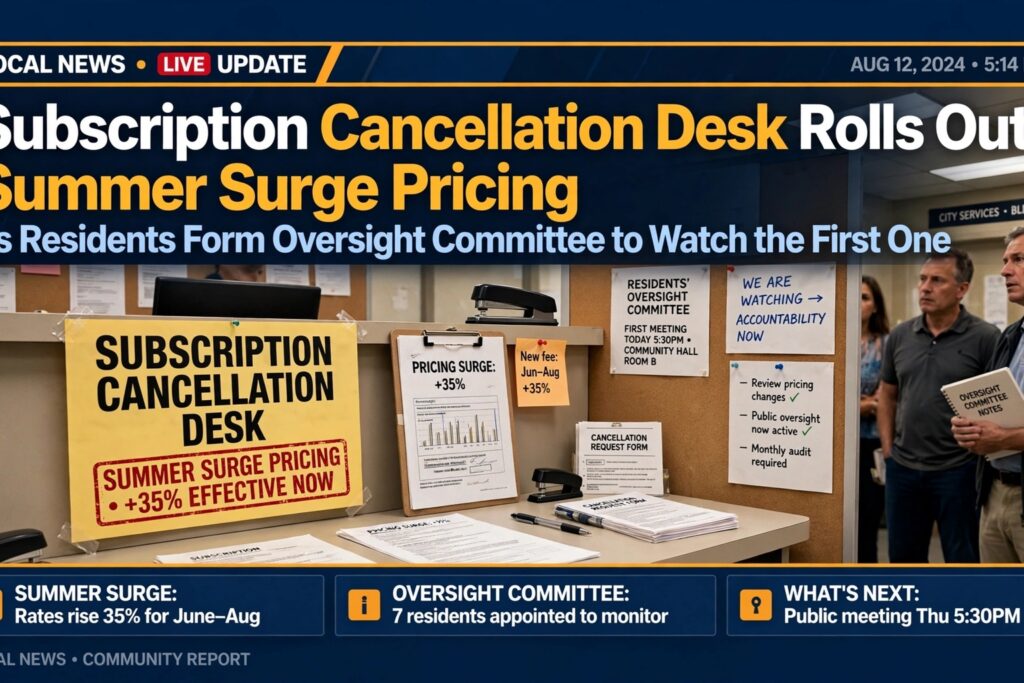
In the quiet suburb of Cedar Hollow, where lawns are meticulously edged and the hum of air conditioners blends with distant lawnmowers, the Subscription Cancellation Desk has become an unlikely epicenter of civic tension.
Located in a repurposed phone booth outside the town library—complete with a laminated sign reading ‘Cancellations Here (Please Have Account Info Ready)’—the desk, staffed by volunteer retirees and one overworked intern named Daryl, has long served as a free public service for residents seeking to extricate themselves from forgotten gym memberships, duplicate newspaper subscriptions, and that one mystery charge labeled ‘Zorblax Premium’.
But as summer vacation planning reached its peak in late June, the desk unveiled a new policy: surge pricing.
‘During high-demand cancellation periods—specifically, the two weeks before July 4th and the first three weeks of August—we will apply a dynamic fee structure based on real-time volume,’ read a hastily taped addendum to the booth’s plexiglass shield. ‘Fees range from $0 to $12 per cancellation, calculated via algorithm.’
The announcement triggered immediate confusion. Martha Langley, a retired librarian who had come to cancel her third duplicate subscription to Birdwatcher’s Digest, stared at the sign. ‘I didn’t know we were bidding on cancellations now,’ she said. ‘Is this like Uber? Do I get surge pricing if I yell?’
Daryl, sweating beneath a ‘Volunteer Since 2019’ badge, explained that the fee was not for the cancellation itself, but for ‘system strain’—a term he admitted he borrowed from a cloud computing seminar. ‘If three people show up at once asking to cancel their meal kit, the algorithm sees stress. It’s not personal. It’s… load balancing.’
The policy quickly drew criticism. At the next town hall, resident Tomas Reed accused the desk of ‘monopolizing frustration.’ ‘We come here to reduce our monthly outflow, not to play a guessing game with some spreadsheet Daryl found online,’ he said. ‘Next they’ll charge us for breathing while we wait.’
In response, a group of residents formed the Citizens’ Cancellation Oversight Committee (CCOC), tasked with monitoring the Subscription Cancellation Desk for fairness, transparency, and adherence to the unwritten social contract of public service.
Their first meeting, held in the library’s community room, attracted twelve people—including Daryl, who attended ‘to clarify misconceptions.’ The CCOC promptly elected a chair, adopted Robert’s Rules of Order, and began drafting a nine-point oversight framework that included requirements for public fee disclosure, algorithmic transparency, and a ban on charging more than the cost of a stamp for emotional labor.
‘We’re not trying to shut it down,’ said CCOC chair Evelyn Cho, a former IT analyst who canceled her satellite TV subscription last winter. ‘We just want to make sure the surge pricing isn’t arbitrary. If Daryl’s using a magic 8-ball behind that booth, we deserve to know.’
Daryl, for his part, insisted the algorithm was real—though he conceded it was currently just a Google Sheet with conditional formatting. ‘It’s based on historical cancellation density, weather data, and whether the ice cream truck has passed by twice today,’ he said. ‘It’s sophisticated.’
The CCOC responded by forming a subcommittee to audit the algorithm. That subcommittee, in turn, proposed creating a feedback portal—hosted on a free WordPress site—to collect resident complaints about surge pricing incidents. Within 48 hours, the portal logged 17 entries, including one from a man who claimed he was charged $9 to cancel a subscription he never signed up for.
As the debate intensified, the town council weighed in. Councilwoman Priya Nair urged restraint. ‘We have potholes, a dwindling bee population, and a raccoon problem at the recycling center. Let’s not over-regulate the cancellation desk,’ she said. ‘But if they start charging for emotional labor, I’m drafting an ordinance.’
By mid-July, the Subscription Cancellation Desk had processed 217 cancellations, collected $84 in surge fees, and inspired two separate op-eds in the Cedar Hollow Gazette—one praising its innovation, the other comparing it to ‘a Kafka novel written by a spreadsheet.’
The CCOC, meanwhile, had held three meetings, published a 12-page interim report, and was considering whether to surveil the desk via a hidden camera—though they ultimately rejected the idea, citing ‘privacy concerns for the volunteers.’ Instead, they opted for biweekly check-ins and a suggestion box.
Daryl remains undeterred. He recently upgraded his Google Sheet to include a ‘vacation anticipation multiplier’ based on local hotel booking trends. ‘People cancel more when they’re about to go to the beach,’ he explained. ‘It’s not greed. It’s behavioral economics.’
Whether the surge pricing will persist beyond summer remains uncertain. But one thing is clear: in Cedar Hollow, even the act of unsubscribing has become a communal ritual—complete with oversight, algorithms, and a growing sense that someone, somewhere, is always watching the watchers.
Join the conversation
Load Facebook comments to read and reply using your Facebook account.