
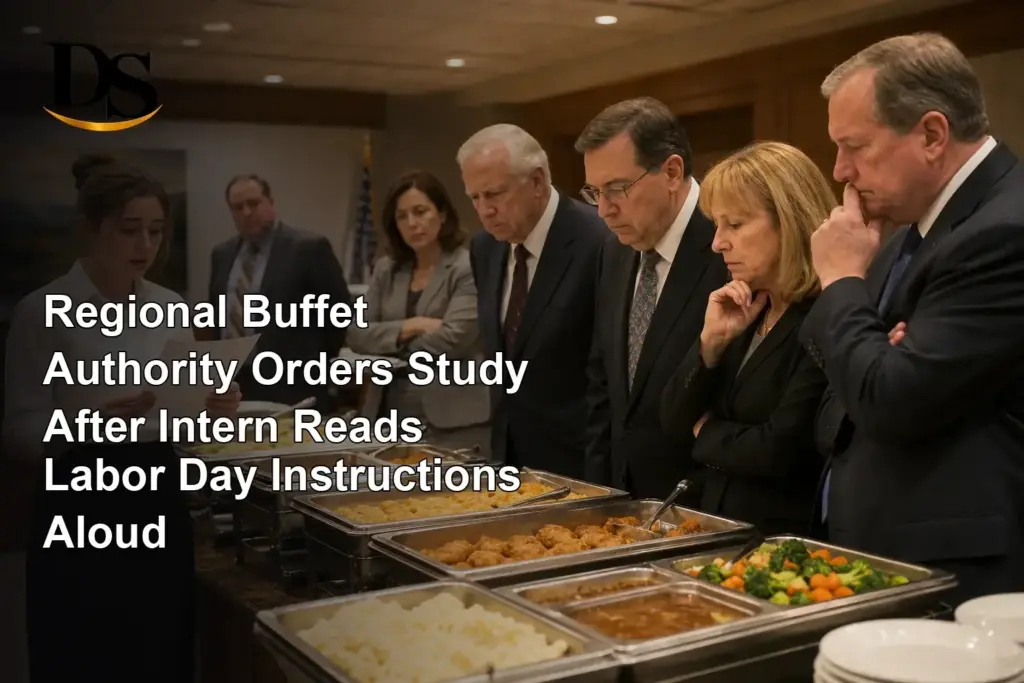
It began with a cough, a shuffled paper, and a voice too eager for 8:15 a.m.
At the monthly meeting of the Tri-County Regional Buffet Authority (TCRBA), Intern Daniella Vos read aloud from the newly printed “Labor Day Weekend Guest Experience & Operational Readiness Guide” — a 12-page document detailing everything from griddle temperature thresholds to the proper ratio of coleslaw to fried chicken on commemorative platters. She read it verbatim, as instructed by her supervisor, who had told her to “make sure everyone hears the rules before we approve the holiday buffet surge.”
What followed was not applause, but silence. Then, a slow blink from Director of Operations Hank Loomis. Then, a whispered question from Comptroller Rita Ngo: “Wait… is Labor Day the one where we celebrate the end of summer, or the one where we honor workers by not working… but still eating?
The room fell into a stunned quiet. No one moved. The guacamole station, still warm from pre-service testing, sat untouched.
Thus began the TCRBA’s unprecedented decision: to commission an independent study to determine whether any member of the public — or, more urgently, any member of the authority itself — actually understands what Labor Day weekend is supposed to mean.
The Guide That Broke the Room
The Labor Day guide, authored by TCRBA’s External Communications Subcommittee, was meant to standardize guest messaging across 47 affiliated buffets from Delaware to Dayton. It included bullet points such as:
- “Labor Day is not a celebration of labor, but rather a recognition that labor has earned the right to eat unlimited fried shrimp.”
- “Guests may confuse this holiday with Memorial Day; gently correct them by offering a second helping of mac and cheese.”
- “If asked about the history of Labor Day, respond with: ‘It’s when the unions negotiated for more dessert options.’ Then pivot to the pie bar.”
Vos, a political science major interning for college credit, had been told to read it aloud to ensure “compliance and awareness.” She did so without irony, her voice rising slightly on the phrase “unlimited fried shrimp.”
When she finished, Deputy Director of Guest Relations Mitch Tullow lowered his glasses and said, “I’ve read this three times. I still don’t know if we’re supposed to be sad, proud, or just really full.”
The authority voted 6-2 to pause all Labor Day preparations until an independent study could clarify the holiday’s cultural, culinary, and existential significance.
Enter the Institute for Holiday Semiotics
TCRBA contracted the Institute for Holiday Semiotics (IHS), a small think tank based in a converted library in Asheville, to conduct the study. Lead researcher Dr. Elise Varrick explained their methodology: “We’re not asking people what Labor Day is. We’re asking what they *do* on Labor Day, then comparing it to what they say they believe it is. The gap is where the truth lives.”
Over three weeks, IHS field teams surveyed 2,100 guests at TCRBA-affiliated buffets, conducted focus groups with shift workers, and analyzed social media posts tagged #LaborDayBuffet. They also interviewed 17 authority members privately, using a neutral facilitator and a plate of mini quiches as a buffer.
The findings, delivered in a 48-page report bound in recycled napkin material, were both predictable and unsettling.
Only 23% of respondents could correctly identify Labor Day as a federal holiday honoring the American labor movement. Forty-one percent believed it marked “the official end of summer, like a secular Thanksgiving for grill owners.” Twenty-six percent thought it was “the day the buffets get really good because nobody’s watching.” Ten percent had no idea it was a holiday at all and assumed the extra bacon strips were a Tuesday promotion.
Among TCRBA staff, comprehension was slightly higher — but not by much. Forty percent of managers could name one historical fact about labor unions. Sixty-seven percent could correctly list the three most popular Labor Day buffet items (fried chicken, watermelon, and soft-serve ice cream swirl). Zero percent could explain why the holiday is observed on the first Monday in September.
“We’re not failing at education,” said Dr. Varrick. “We’re succeeding at ritual. People don’t need to know the history to know what to do: show up, eat a lot, and leave feeling slightly guilty about the third plate of banana pudding.”
The Authority Reacts
TCRBA’s response was swift, if uncertain.
Authority Chair Linda Cho announced that the Labor Day guide would be revised — not to correct factual inaccuracies, but to “better align with observed guest behavior and staff understanding.” The new version will replace the historical section with a flowchart titled “How to Know If It’s Labor Day:”
- Is it a Monday?
- Is the buffet line longer than your willingness to wait?
- Are people wearing white shoes despite the fashion rule?
- Is there a disproportionate amount of pie?</n
- If yes to three or more: It’s Labor Day. Proceed to the carving station.
Director Loomis defended the original guide, saying it was “meant to be aspirational.” “We weren’t trying to teach history,” he said. “We were trying to create a shared experience. And if that experience involves mistaking Labor Day for a fried chicken holiday, well… at least they’re enjoying themselves.”
Intern Vos, now back at school, said she was surprised by the reaction. “I just read what was on the page. I didn’t think it was controversial. I thought everyone knew Labor Day was about… you know… the thing with the unions and the day off and the meatloaf special.”
She paused. “Wait, is it the meatloaf special? I think I got that part wrong.”
The TCRBA has not yet decided whether to issue a correction. But as of this writing, the buffets are fully stocked, the griddles are hot, and the guacamole is waiting.
No one seems to mind not knowing why.
Join the conversation
Load Facebook comments to read and reply using your Facebook account.