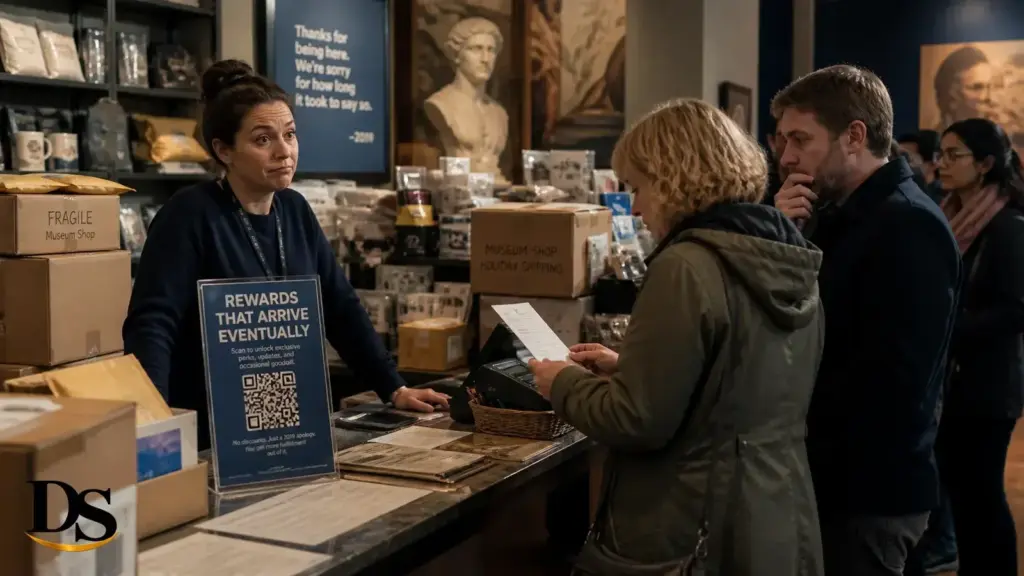
On the third Friday of November, as the last pallet of ceramic mugs emblazoned with ‘I Survived the Cretaceous’ was being shrink-wrapped at the back of the Natural History Museum’s gift shop, curator Elise Varga stared at her laptop and sighed. The holiday shipping deadline — December 15th — loomed like a meteor, and the inventory system had just flagged 47% of orders as ‘at risk of missing Christmas.’
The Birth of ‘Survive the Ship’
Varga, who had spent the previous decade optimizing display cases for trilobite fossils and not logistics, decided the only way to motivate her overworked team of part-time art students and retired librarians was through gamification. She launched ‘Survive the Ship,’ a rewards program where staff earned points for every order packed, labeled, and scanned before 5 p.m. each day. Points translated into extra break time, priority parking, and — the crown jewel — a chance to win a behind-the-scenes tour of the museum’s climate-controlled storage wing, where the real dinosaur bones nap.
To make it feel official, she designed a sleek QR code, printed it on laminated cards, and taped one to every packing station. Scan it, and you’d see your live leaderboard, updated hourly. It was meant to be a beacon of accountability.
The Glitch in the Grid
On December 12th, three days before the deadline, a temporary employee named Javier, who had been hired to handle the influx of ‘Jurassic Park’ tote bags, scanned the QR code out of curiosity during his lunch break. Instead of a leaderboard, his screen filled with a grainy 2019 video apology from the museum’s former director, Dr. Aris Thorne.
‘I am deeply sorry,’ Thorne began, standing before a backdrop of fading autumn leaves outside the museum’s east entrance. ‘For the mislabeling of the Cretaceous-period ammonite exhibit as ‘Jurassic snack fossils.’ For the confusing placement of the gift shop’s exit sign directly over the T. rex skull. For the 2017 incident where the audio guide mistakenly referred to woolly mammoths as ‘shaggy elephants.’ I take full responsibility. This apology is long overdue.’
The video ended with Thorne bowing slightly, then walking off-frame as a ukulele cover of ‘Here Comes the Sun’ played. The timestamp in the corner read: November 14, 2019.
Why It Worked (Sort Of)
Varga, bracing for chaos, checked the system. The QR code had not been hacked. It had simply never been updated. The original link, meant for a temporary staff feedback form during a 2019 reorganization, had been repurposed for the rewards program — but the backend URL had never been swapped. The server still pointed to the old apology video, archived but never deleted.
Instead of frustration, something strange happened. Staff began scanning the code deliberately. Not to check scores, but to watch the apology. It became a ritual. A moment of shared, absurd humanity amid the barcode scanners and packing tape.
‘It’s like a pallet cleanser,’ said Lena Park, a seasonal employee who usually restocks the glow-in-the-dark dinosaur eggs. ‘After scanning 80 identical mugs, you need to see someone sincerely regret calling a fossil a snack. It resets you.’
The apology video was watched 1,200 times in the final three days. Productivity, measured in packages shipped per hour, rose 22%. The museum shipped 98% of its holiday orders on time.
The Human Algorithm
Logistics experts might point to burnout, unclear incentives, or poor system design. But in the back room of the gift shop, surrounded by stacks of ‘Ask Me About My Trilobite’ buttons and half-eaten granola bars, a different theory emerged: the apology worked because it was useless.
In a world of optimized KPIs and real-time dashboards, the video offered nothing useful. No points. No discounts. Just a man in a slightly-too-tight sweater admitting he once called a 70-million-year-old cephalopod a ‘Jurassic snack.’ Its power lay in its irrelevance. It was a glitch that felt like a gift.
‘We didn’t need more efficiency,’ Varga said later, packing the last order herself at 6:03 p.m. on December 15th. ‘We needed to remember we’re not just scanning barcodes. We’re part of something that outlived the dinosaurs — and still manages to mislabel them.’
The Aftermath
The museum’s IT department has since updated the QR code. It now leads to the real-time leaderboard, complete with confetti animations when someone hits 100 points. But the apology video has been saved. It’s now playing on a loop in the staff break room, muted, with subtitles. New hires are shown it on their first day.
Dr. Thorne, retired and living in Oregon, was contacted for comment. He said he had no idea the video was still online. ‘I’m flattered,’ he wrote in an email. ‘But if anyone’s still apologizing for calling ammonites snacks, they’ve missed the point. The point was to stop doing it.’
As for Varga, she’s been nominated for an internal innovation award. She declined to comment on whether she plans to leave the QR code as-is next year. ‘Let’s just say,’ she smiled, ‘some traditions are worth preserving — even if they were accidents.’
Join the conversation
Load Facebook comments to read and reply using your Facebook account.