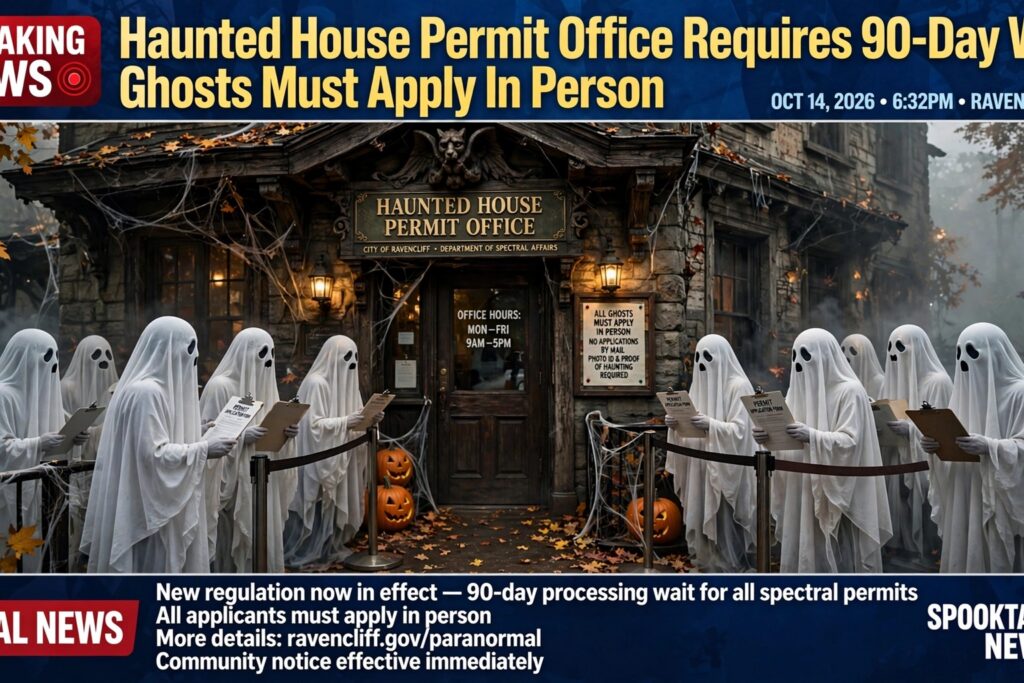
FAIRVIEW — The county’s Haunted House Permit Office announced Tuesday that all haunted attractions must now apply 90 days in advance, and that any ghosts employed by the attraction “must appear in person” to verify their paranormal credentials.
“We’ve had incidents,” said permit office director Gary Lumpkin, 54, whose business card identifies him as Chief Regulator of Manufactured Fright. “Last year a haunted barn on Route 9 listed four ghosts on its application. Inspectors found two teenagers in sheets and a Roomba with a tablecloth on it. That’s not a haunting. That’s a laundry situation.”
Under the new rules, haunted houses must submit floor plans, emergency exit diagrams, and a “Scare Inventory” listing every intended fright by category: jump scares, atmospheric dread, and what the form calls “existential unease (optional).”
Most controversial is the ghost verification requirement. “If your attraction advertises real ghosts, those ghosts need to come down to the office,” Lumpkin explained. “We’ll need to see them. Through the glass partition is fine. They don’t need to sign anything — we understand the whole unfinished-business scheduling conflict. But we do need to lay eyes on them.”
Local haunted house operator Big Dave Kowalski, 47, who runs “Kowalski’s Korner of Terror” out of a converted car wash, called the rules “government overreach with a spooky hat on.” His establishment’s star ghost, a translucent figure known only as “The Lady,” has reportedly refused to visit the permit office.
“She’s been haunting that car wash since 1987,” Kowalski said. “She doesn’t do paperwork. Last time someone asked her to fill out a form, all the lights exploded. That’s her answer. That’s always been her answer.”
Lumpkin was unsympathetic. “Then The Lady can haunt on her own time, unofficially, like the rest of America’s ghosts. But if Kowalski wants to charge $18 admission and advertise ‘genuine spectral activity,’ The Lady needs to come in. We have evening hours on Thursdays. Many ghosts prefer evenings.”
The office has also standardized its inspection process. Inspectors now carry a 40-point checklist covering everything from fog density (“must obscure at least 60 percent of a standard teenager”) to chain-rattle authenticity. “Plastic chains are an automatic fail,” said senior inspector Paula Reyes, 39. “We had a place using plastic chains last October. The children noticed. Children always notice.”
Despite the grumbling, applications are up. “People respect a rigorous process,” Lumpkin said, stamping a permit with evident satisfaction. “Anyone can scare you. It takes a government to scare you correctly.”
Join the conversation
Load Facebook comments to read and reply using your Facebook account.