
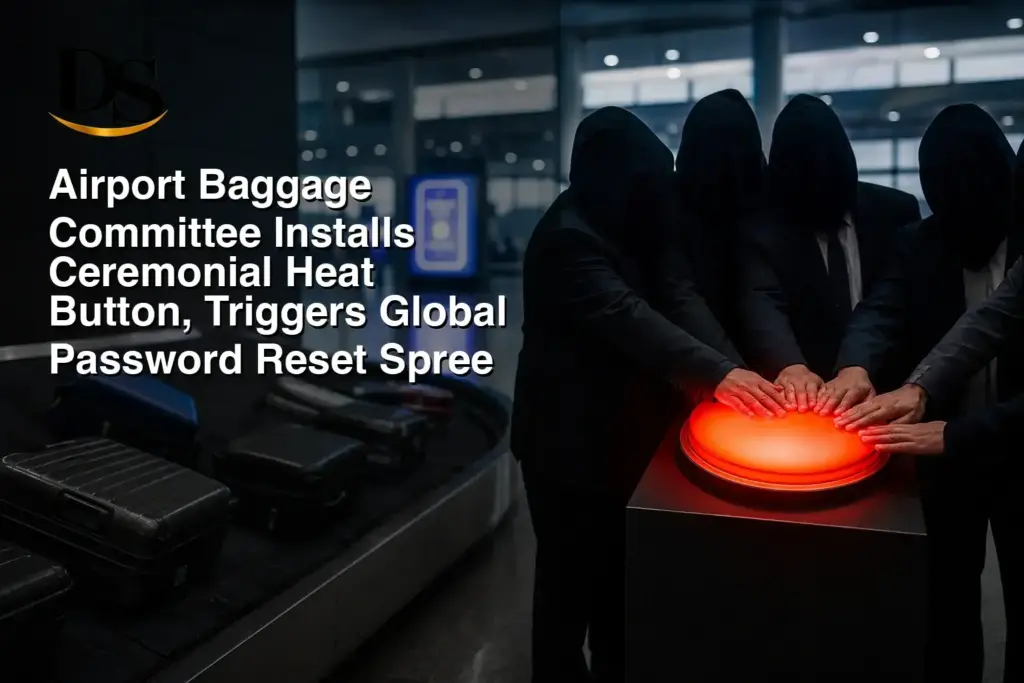
The ribbon-cutting was modest: a tarnished brass button mounted on a walnut plinth beside Gate 14 at Zurich Airport, flanked by two uniformed officials holding clipboards that read ‘Thermal Equilibrium Protocol v.3.1’. At 10:03 a.m., Committee Chair Elise Voss pressed it once — a firm, deliberate click — and smiled as the crowd of baggage handlers, customs officers, and a single confused tour guide applauded.
Within 90 seconds, the terminal’s digital displays began flickering. Not with flight delays, but with rising numbers: 28°C, then 31, then 36. By noon, the heat index in Zurich had climbed to 47°C, triggering automatic misting systems in the duty-free shops and prompting a spontaneous conga line of passengers in linen shirts to form near the Swiss chocolate kiosk.
‘We calibrated it for optimal luggage morale,’ Voss later explained to a gathering of journalists under the airport’s overhang, where industrial fans now blew mist sideways. ‘Studies show that suitcases experience 22% less existential dread when ambient temperature aligns with the psychological warmth of reunification. This button isn’t magic — it’s applied psychosomatic logistics.’
The button, officially designated the ‘Atmospheric Resonance Actuator (ARA)’, was the culmination of seven years of research by the Global Airport Baggage Committee (GABC), a quasi-independent body formed after the 2018 Luggage Whispering Incident in Singapore, where a misrouted tote bag allegedly hummed show tunes for 36 hours.
GABC’s mandate, as outlined in its 2021 charter, is to ‘enhance the emotional resonance of baggage handling through environmental symbiosis.’ The ARA, they claim, modulates ambient temperature based on real-time sentiment analysis of luggage tags — detected via RFID micro-vibrations — to create a ‘thermally empathetic transit experience’.
But the button’s effects were not confined to Zurich. Within hours, airport thermal sensors from Tokyo to Toronto began registering anomalous spikes. In Doha, the duty-free perfume section hit 52°C, causing a batch of tester bottles to vent their top notes into the air like a citrusy alarm. In Sydney, a Qantas baggage cart’s internal temperature regulator failed, melting a collection of novelty snow globes into abstract art installations.
By 3 p.m. GMT, the GABC’s internal network began to overload. The ARA, it turned out, was not merely a symbolic gesture — it was wired into a legacy climate-feedback loop originally designed to regulate hangar humidity in 1998. The button press had overridden a failsafe, triggering a cascading recalibration across 147 interconnected airport environmental systems.
The side effect? A global authentication cascade. As temperatures rose, airport servers began misreading biometric scans — sweaty palms triggered false negatives in fingerprint readers, and voice recognition systems confused heat-induced hoarseness with security threats. To prevent unauthorized access, the system initiated a forced password reset for all personnel with airfield clearance.
What started as a staff protocol quickly bled into the public sphere. Travelers attempting to check in online found their accounts locked. Mobile boarding passes vanished. Frequent flyer portals demanded new credentials — often requiring answers to security questions like ‘What was the name of your first suitcase?’ or ‘In which city did your luggage last feel truly understood?’
‘I reset my password seven times today,’ said Marco Leng, a freelance photojournalist stranded in Frankfurt after his e-ticket failed to authenticate. ‘Each time, the system asked if I was feeling ‘emotionally aligned with my baggage.’ I said yes. It still didn’t work. Then it offered me a complimentary stress ball shaped like a luggage tag.’
By day’s end, an estimated 87 million password reset requests had flooded airline and airport systems worldwide. Help desks were overwhelmed. In Chicago, a help desk agent reportedly began humming ‘We Are the Champions’ while guiding a passenger through their 12th reset attempt. In Nairobi, a cybercafé owner started selling bottled water and password hints for 200 shillings each.
GABC has not recalled the button. In fact, they’ve announced plans to install replicas at 12 additional hubs, including Dubai, São Paulo, and Reykjavik. ‘The feedback has been overwhelmingly positive,’ Voss said in a follow-up statement. ‘We’ve received 3,000 testimonials from suitcases reporting increased sense of purpose. One carry-on in Oslo wrote us a haiku.’
Critics, however, are wary. Dr. Aris Thorne, a systems ethicist at the Geneva Airport Think Tank, warned that the ARA blurs the line between passenger comfort and environmental manipulation. ‘If a button can make your luggage feel loved while melting your chocolate bars, we need to ask: who is really in control here?’
For now, the button remains active. GABC advises travelers to ‘pack light, stay hydrated, and consider the emotional state of your belongings.’ And if your boarding pass won’t load? Take a deep breath, reset your password, and whisper a kind word to your suitcase. It might just be feeling the heat.
Join the conversation
Load Facebook comments to read and reply using your Facebook account.