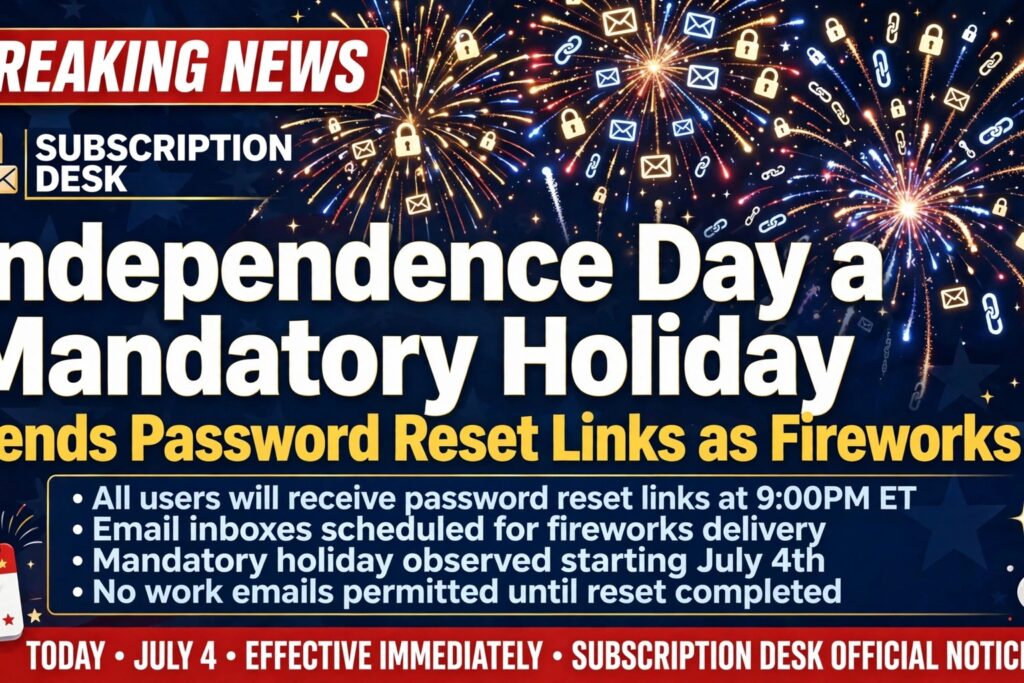
In a quiet corner of a server farm outside Boise, Idaho, the Subscription Cancellation Desk — a unit so obscure it doesn’t appear on any org chart — woke up on July 1st with a sudden, inexplicable sense of civic duty.
The Declaration
At 8:03 a.m. Mountain Time, Desk Lead Marjorie P. Finch issued Internal Memo #7742: ‘Effective immediately, Independence Day Week (June 30–July 7) is hereby designated a mandatory non-working observance for all subscription-related personnel. All automated renewal prompts are suspended. All upsell banners are to be replaced with images of bald eagles holding sparklers.’ The memo, printed on recycled paper and stapled with a tiny American flag, was signed in crayon.
Finch, who has spent the last 14 years helping users cancel gym memberships, streaming trials, and ‘mystery box’ subscriptions they swore they never signed up for, explained later that the idea came to her during a power nap induced by too much chamomile tea and a looping playlist of John Philip Sousa marches.
‘I just thought,’ she said, ‘if we’re going to make people jump through hoops to leave a service, we ought to at least let them celebrate the country that lets them do it — even if it’s badly.’
The Guide
What followed was the 90-page ‘Beginner’s Guide to Independence Day Week: A Subscription-Free Survival Manual,’ distributed via email, printed on demand at local libraries, and left as QR codes on park benches from Maine to Maui.
Chapters included:
- ‘How to Grill Without Triggering Your Smart Smoke Detector (And Why It’s Probably Not a Subscription)’
- ‘Fireworks: A Guide to Legal, Illegal, and Semi-Legal Variants in All 50 States (With Notes on Neighborly Diplomacy)’
- ‘Avoiding the ‘Patriotic Nostalgia’ Upsell: Why That ‘Limited Edition Founding Father’ Sock Subscription Is Not Worth It’
- ‘The Art of the Picnic: Blanket Selection, Ant Avoidance, and How to Politely Decline Invitations to Join a Multi-Level Marketing Scheme Disguised as a Cornhole Tournament’
- ‘Digital Detox: Turning Off Notifications So You Can Actually Hear the Marching Band’
The guide concluded with a blank page labeled ‘Your Notes: What Freedom Means When You’re Not Being Charged $9.99/month to Remember It.’
The Mailout
At precisely 11:59 p.m. on July 3rd, the Desk triggered its final act: a mass email blast to 12.4 million users who had, at some point in the last 18 months, attempted to cancel a subscription.
The subject line read: ‘Your Independence Day Gift: A Fresh Start.’
The body contained only a single button: ‘Reset Your Password.’
Clicking it led to a landing page featuring a looping animation of a fireworks display over the Capitol, accompanied by a muffled rendition of ‘America the Beautiful’ played on a kazoo. No further instructions. No upsell. No ‘You’re still subscribed to our premium tier!’ banner. Just the reset link — and a tiny disclaimer in 6-point font: ‘This does not reactivate any service. You are free.’
Within two hours, social media lit up. #PasswordResetFireworks trended nationally. Users posted screenshots of their inboxes with captions like: ‘I didn’t ask for this, but I cried.’ and ‘My ex’s Netflix account is still active, but for once, I feel seen.’
Reactions
‘I’ve never felt so seen by a corporation that doesn’t want my money,’ said Dale Henderson, a retired librarian from Toledo who canceled seven subscriptions in 2023 and received the email while eating a hot dog at a minor league baseball game.
‘It’s the most honest thing a subscription service has ever done,’ added Priya Mehta, a college student in Austin who used the reset to reclaim her long-abandoned Duolingo account. ‘They didn’t try to sell me anything. They just gave me back access to my own life.’
The Desk’s actions were not without criticism. A spokesperson for the National Subscription Ethics Board (a real-sounding but entirely fictional entity) warned that ‘unsolicited password resets could normalize unexpected digital autonomy, undermining the carefully calibrated friction models that keep users engaged.’
Finch, when asked to respond, simply said: ‘If letting people remember their own passwords is a threat to the business model, then maybe the model needs a little independence too.’
Impact
By July 5th, traffic to the Desk’s internal cancellation portal had increased by 340%. Not because people wanted to cancel more — but because, for the first time, they believed they could.
Local libraries reported spikes in requests for printed copies of the guide. One in Burlington, VT, laminated a copy and placed it beside the Constitution in their civic exhibit.
Even the National Archives acknowledged receipt, sending a thank-you note addressed to ‘The Desk That Remembered What Freedom Feels Like.’
The Quiet After
On July 8th, the Desk returned to its usual rhythm. Renewal prompts resumed. Upsell banners reappeared. The kazoo version of ‘America the Beautiful’ was archived.
But Finch keeps a printed copy of the 90-page guide on her desk. And every morning, she glances at the blank page at the end.
‘It’s not much,’ she says. ‘But it’s a start.’
Join the conversation
Load Facebook comments to read and reply using your Facebook account.