
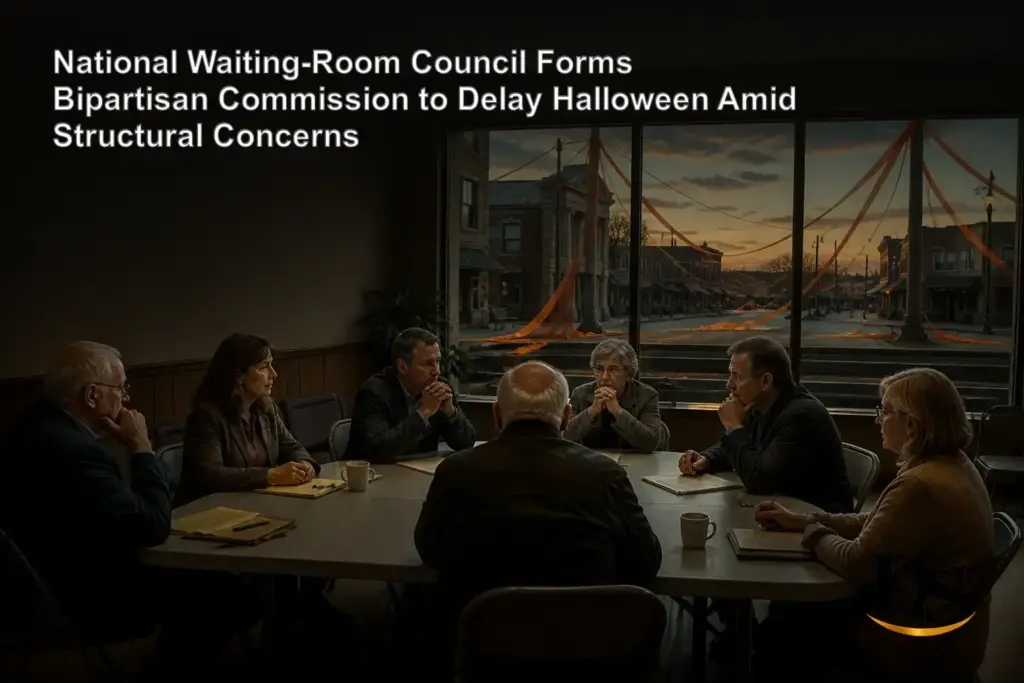
In a quiet subcommittee room tucked beneath the National Waiting-Room Council’s headquarters in Bismarck, North Dakota, a bipartisan group of municipal officials, retired school nurses, and one very concerned florist from Dubuque convened last Tuesday to address a growing seasonal crisis: Halloween is coming too soon.
The Ribbon That Held Up Main Street
The issue began, as many civic dilemmas do, with a routine inspection. During preparations for the annual Harvest Hullabaloo in Cedar Falls, Iowa, public works crews noticed that the decorative orange-and-black ribbon strung between lampposts along Main Street wasn’t merely festive—it was bearing measurable tensile load. Initial assumptions that it was purely aesthetic were overturned when a senior engineer from the State Department of Aesthetic Infrastructure observed that removing the ribbon caused a measurable sag in the adjacent bunting canopy, which in turn shifted weight onto the historic clock tower’s east-facing cornice.
‘We thought it was just for show,’ said Dale Haverford, senior analyst with the National Waiting-Room Council’s Seasonal Aesthetics Division. ‘Turns out, in at least twelve Midwestern towns, the Halloween ribbon network has become a de facto suspension system for autumnal decor. It’s not just tying bows—it’s holding up the season.’
The revelation triggered an emergency session of the Council’s Standing Committee on Temporal Holiday Alignment, which voted unanimously to form the Bipartisan Commission on Halloween Postponement (BCHP). The commission’s mandate: evaluate the feasibility of delaying Halloween by two to three weeks to allow for structural reinforcement of decorative load-bearing elements across participating municipalities.
A Season Out of Sync
Commission members cited climate creep, retail overexposure, and now, structural fatigue, as converging pressures threatening the integrity of fall celebrations. ‘We used to start putting up cobwebs in mid-October,’ said Marjorie Tint, a retired librarian from Toledo and the commission’s Democratic co-chair. ‘Now stores are selling candy corn in August. The ribbon’s been up since Labor Day in some places. No wonder it’s fatigued.’
Her Republican counterpart, Hank Briscoe, a former insurance adjuster from Omaha, added: ‘It’s not just about aesthetics. If the ribbon fails during peak trick-or-treating hours, we could see cascading decor failures—paper ghosts collapsing into inflated pumpkins, scarecrow armatures buckling under the weight of prematurely hung skeletons. It’s a liability nightmare.’
The commission heard testimony from structural engineers, party supply distributors, and a representative from the International Association of Haunted House Operators, who warned that premature decor installation increases the risk of ‘spectral load shift’—a phenomenon where uneven weight distribution from early-installed animatronics causes localized buckling in support ribbons.
Community Pushback and Practical Concerns
Not everyone agrees with the proposed delay. In a town hall meeting in Springfield, Illinois, local hairstylist Luanne Petrova argued that postponing Halloween would disrupt carefully scheduled salon appointments for elaborate wig installations. ‘I’ve got three clients booked for Medusa braids on the 30th,’ she said. ‘Move it to mid-November, and suddenly I’m competing with Thanksgiving turkey basting tutorials.’
Retail analysts also voiced skepticism. ‘Halloween drives $10.6 billion in seasonal spending,’ noted Daryl Chu of the Retail Insight Group. ‘Shifting it risks consumer confusion and inventory pile-up. Imagine warehouses full of unused zombie socks.’
Still, the commission’s preliminary findings suggest that a delayed Halloween could reduce structural strain by up to 40%, particularly in towns where ribbon systems are reused year after year without inspection. Recommendations include implementing mandatory ribbon stress tests by September 1st, introducing seasonal decor ‘rest periods,’ and exploring alternative materials such as reinforced polymer garlands or load-distributing zip-line systems.
The Decision Looms
As the commission prepares its final report, due before the autumnal equinox, members acknowledge the cultural weight of their task. Halloween, after all, is more than decor—it’s tradition, community, and for many, a sanctioned excuse to eat candy for breakfast.
‘We’re not trying to cancel fun,’ said Tint, adjusting her glasses beneath a paper-brimmed hat shaped like a minor league baseball glove. ‘We’re trying to make sure the fun doesn’t come down—literally.’
Briscoe nodded. ‘If we don’t act now, next year we might be celebrating Halloween indoors, under tents, while waiting for the ribbon to be re-certified. And nobody wants that.’
The National Waiting-Room Council will vote on the commission’s recommendations next month. Until then, towns are advised to inspect their decorative ribbons, avoid overloading them with multiple layers of glowing eyeballs, and perhaps, for now, keep the fake spiderwebs light.
Join the conversation
Load Facebook comments to read and reply using your Facebook account.