
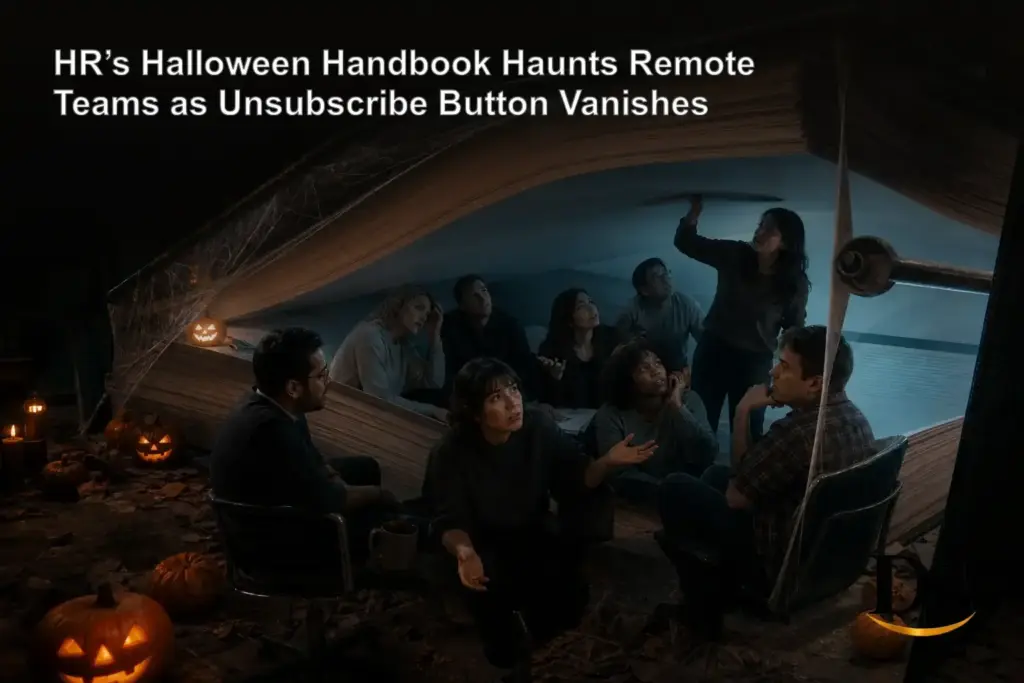
On October 3rd, at 8:17 a.m. Pacific Time, senior analyst Devika Rao opened her company Slack channel to find a pinned message from the Remote-Work Etiquette Board (RWEB): ‘Happy Haunting Season! Please review our comprehensive guide to maintaining professionalism while embracing autumnal spirit.’ Attached was a 90-page PDF titled Spectral Standards: A Beginner’s Guide to Halloween Etiquette in Distributed Work Environments.
What began as a well-intentioned seasonal nudge quickly curdled into digital entrapment. Employees across time zones reported being unable to exit the document after opening it, not due to technical glitches, but because the unsubscribe button—typically tucked in the footer of internal comms—had simply vanished.
The Guide That Wouldn’t Let Go
The manual opened with a cheerful illustration of a ghost wearing noise-canceling headphones and proceeded through sections like ‘Costume Conduct: When Is a Werewolf Onesie Too Much for Tuesday Stand-Ups?’ and ‘Managing Pumpkin Spice Latte Enthusiasm in Asynchronous Channels.’ Page 22 featured a flowchart titled ‘Deciding Whether Your Virtual Background Is Festive or Frighteningly Unprofessional,’ which included branching logic for evaluating the appropriateness of dancing skeletons, cobweb filters, and ambient howling soundtracks.
By page 47, the tone shifted. A subsection on ‘Respecting Cultural Variations in Spookiness’ cited academic sources on Día de los Muertos, Obon, and Samhain, then warned against ‘casual appropriation of dread’ in team icebreakers. Page 63 detailed proper etiquette for declining invitations to virtual haunted house tours without damaging rapport, complete with sample scripts and emoji guidance (👻 → 🙏 → ✨).
’I thought it was a joke,’ said Marcus Till, a UX designer based in Austin. ’I scrolled to the end looking for the ‘Close’ or ‘Unsubscribe’ link. Nothing. I checked the PDF properties—no hidden layers, no JavaScript traps. It was just… there. Like a digital cursed object.’
The Vanishing Act
Initial attempts to resolve the issue were met with bureaucratic silence. The RWEB, a cross-functional committee formed in 2021 to standardize norms around virtual backgrounds, mute-button hygiene, and the appropriateness of pet cameos, had no public FAQ. Their Slack channel, #etiquette-board, had been archived the previous spring ‘to reduce noise.’
When employees reached out to HR, they were directed to reroute inquiries through the RWEB’s official channel—which, as established, no longer accepted messages. One employee reported receiving an auto-reply from a defunct email alias: ‘Your concern has been logged in the Spectral Archive. Please await further guidance during the waxing crescent.’
By October 10th, internal memes began circulating: a screenshot of the PDF open on a laptop beside a burning candle, captioned ‘Summoning the Unsubscribe Spirit.’ Another showed a person meditating in front of their screen, labeled ‘Achieving digital Nirvana through acceptance of the guide.’
’It’s not that we don’t appreciate the effort,’ said Lien Zhou, a remote team lead in Berlin. ’It’s that the guide assumes we want to be haunted by HR. And worse—it won’t let us leave the séance.’
Escalation and Echoes
On October 18th, a junior engineer in Toronto reverse-engineered the PDF’s metadata and discovered a timestamp suggesting the document had been generated on September 30th at 11:59 p.m.—exactly one minute before the cutoff for seasonal communications under RWEB’s own Protocol 7. ‘It feels like they rushed it out just to beat the clock,’ he said. ‘And then locked the door behind them.’
The situation drew attention from external observers. A labor futurist cited the incident in a newsletter as ‘a case study in the overreach of performative inclusivity in asynchronous work cultures.’ A satirical newsletter titled The Cortisol Chronicle ran a parody guide called How to Survive Being Haunted by Your Own HR Department, which ironically began circulating internally as a supposed ‘supplement.’
Still, no official clarification came. The RWEB remained silent. The PDF, meanwhile, continued to auto-pin itself in Slack channels every morning at 8:17 a.m., reappearing even after being manually unpinned—leading some to suspect a cron job, others to whisper about workplace folklore.
Impact on the Haunted
Productivity metrics, according to an anonymous internal dashboard leak, showed a 12% drop in deep-focus time during the first two weeks of October, attributed to ‘repeated attempts to exit the Halloween guide.’ Employee satisfaction surveys, meanwhile, recorded a spike in responses selecting ‘I feel like I’m in a corporate horror movie’ under open-ended feedback.
Some employees embraced the absurdity. A Slack channel called #halloween-haiku emerged, where workers posted 5-7-5 verses about spectral KPIs and ghostly bandwidth limits. One popular entry read: ‘Unsubscribe button fled / into the pumpkin patch night / HR chants in binary.’
Others simply resorted to workarounds: minimizing the PDF to a corner of their screen, treating it like a digital pet rock, or printing it out to use as kindling for actual autumn bonfires—though the latter was discouraged in a subsequent, equally unfindable update to the guide’s ‘Safe Use of Candles in Home Offices’ appendix.
The Final Page
On October 30th, as the workday drew to a close, the PDF updated itself. A new page appeared at the end: Page 91. It contained a single sentence in 12-point Courier New: ‘The unsubscribe button was inside you all along.’ Below it, a tiny illustration of a jack-o’-lantern wearing a lanyard.
Employees stared at their screens. Some laughed. Others sighed. One person, in a moment of uncharacteristic vulnerability, typed into the now-unarchived #etiquette-board channel: ‘Can we just go back to arguing about whether it’s okay to eat cereal on camera?’
The message went unanswered. The guide remained pinned. And at 8:17 a.m. the next morning, it reappeared—ready for another haunting.
Join the conversation
Load Facebook comments to read and reply using your Facebook account.