
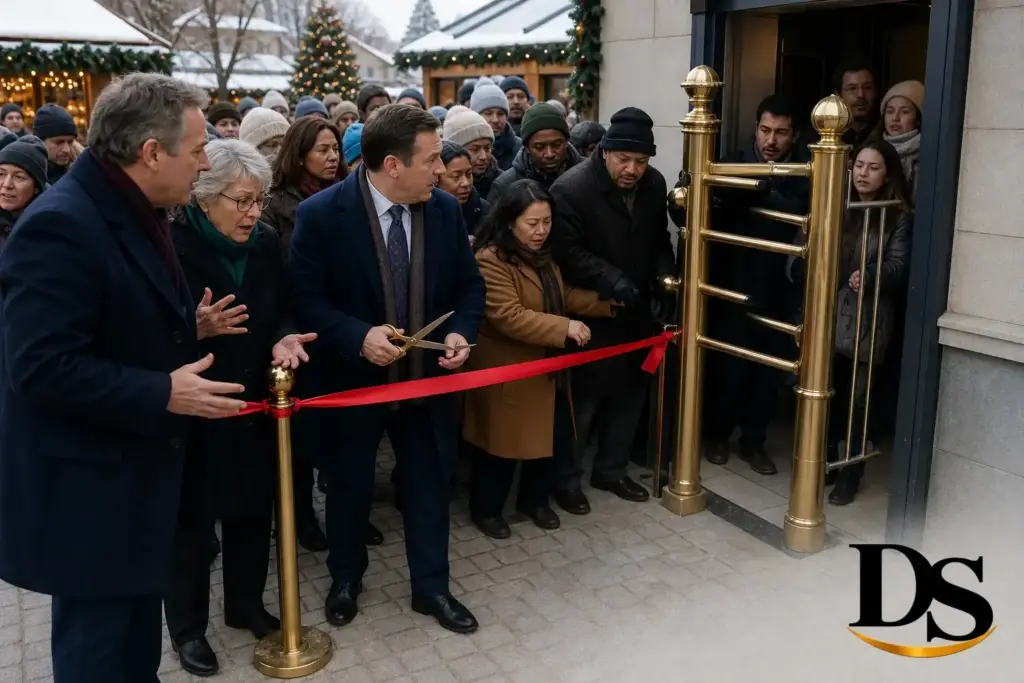
It began with good intentions and a laminated flowchart. The Metropolitan Public Amenities Task Force, convened after years of complaints about holiday-season restroom congestion, unveiled its pilot program on the morning of the city’s annual Winter Bazaar kickoff: dynamic pricing for public toilets, calibrated to foot traffic, time of day, and the perceived urgency of need.
“We looked at ride-share models, concert venues, even airport security lines,” said Task Force Chair Diane Lowell, adjusting her headset near the north entrance of Century Plaza. “If people will pay surge pricing to get home after a concert, why not to relieve themselves after three hours of mall walking?”
The system, dubbed “FlowControl,” used infrared sensors and AI-weighted algorithms to adjust prices in real time. From 8 a.m. to noon, standard stalls were $0.50. By 1 p.m., as the bazaar swelled with shoppers hunting limited-edition knitwear and artisanal hot cocoa, prices climbed to $2.00. Premium stalls — those with extra hooks, ambient lighting, and motion-activated lids — hit $5.00 by 3 p.m.
At first, compliance was patchy but polite. Some shoppers grumbled, others paid without comment. A few teenagers tried to pool funds for a single stall, prompting a brief debate over whether splitting a premium unit violated the spirit of equitable access. By 2:30 p.m., the task force was celebrating a 40% reduction in average wait times.
Then came the ribbon-cutting.
To mark the launch, officials had invited the mayor, the head of the downtown merchants’ association, and a local celebrity baker known for her gingerbread village displays to snip a ceremonial ribbon strung across the main restroom corridor. The ribbon, made of heavy-braided polyester and adorned with tiny jingle bells, was meant to symbolize the “unlocking” of improved public service.
As the mayor pulled the golden scissors, the ribbon snapped — and with it, a section of the false wall beside Stall 7 gave way. Not dramatically, but with a slow, sighing collapse that revealed not pipes or wiring, but a hollow cavity where structural studs should have been. The wall, it turned out, had been draped over a temporary support beam installed during last year’s holiday decor setup and never removed. The ribbon, tensioned across the opening, had been the only thing keeping it upright.
“We thought it was just decoration,” admitted Lowell later, standing amid caution tape and a very confused plumber. “Turns out, it was load-bearing. Who knew festive aesthetics could double as engineering?”
The incident triggered an immediate shutdown of the north restroom bank. Engineers from the city’s public works department arrived within the hour, confirming that the false wall had been supporting a portion of the ceiling load above the adjacent food court. Had the collapse occurred minutes earlier or later, during peak traffic, the consequences could have been far more serious.
Reactions were swift and varied. The merchants’ association called for a full audit of all temporary holiday installations. The plumbers’ union issued a statement praising the “unintentional but effective” stress test. Social media lit up with memes comparing FlowControl to a “pay-to-pee” version of Hunger Games, while others defended the pricing model as a necessary innovation in urban resource management.
Lowell, chastened but undeterred, emphasized that the pricing pilot would continue in other locations — pending structural reviews. “The data showed real benefits,” she said. “We just need to make sure the walls can handle the demand — literally.”
By evening, the Winter Bazaar pressed on, albeit with longer lines and a newfound awareness of the fragility beneath festive facades. Shoppers adjusted their fluid intake, merchants checked their decorations for hidden load-bearing roles, and the task force went back to the drawing board — this time, with a structural engineer on speed dial.
FACT or FICTION? This story is FICTION. While cities do experiment with demand-based pricing for public amenities and holiday installations sometimes overlook structural details, no known public restroom task force has implemented surge pricing that led to the discovery of a load-bearing ribbon. The scenario blends real urban management debates with an absurd, escalating mishap for illustrative and humorous effect.
The Unlikely Hero of Holiday Hygiene
Just as the line outside the newly branded “Serenity Stall™” stretched past the food court and into the parking lot—where a man in a reindeer onesie was reportedly offering foot massages for $20 a pop—something unexpected happened. A retired plumber named Gary, who’d been quietly observing the chaos from a bench while eating a lukewarm cinnamon roll, stood up, adjusted his suspenders, and walked straight into the manager’s office. He didn’t yell. Didn’t complain. He just placed a worn copy of the 1987 International Plumbing Code on the desk and said, “You can’t charge $12 for a paper towel and call it luxury. That’s not premium—it’s piracy with a bidet.”
Gary, it turned out, had spent 40 years fixing toilets in public schools, airports, and one particularly tragic porta-potty at a Dolly Parton tribute concert. He knew the difference between genuine innovation and opportunistic markup. Within twenty minutes, he’d sketched a revised flow diagram on a napkin: motion-sensor faucets (good), heated seats (debatable), but also—crucially—free toilet paper, functioning locks, and a sign that read, “Please don’t flush your gingerbread latte. We’ve seen it before.” The manager, visibly shaken, agreed to a trial run. By 3 p.m., the Serenity Stall™ had reverted to its original name: “The Restroom.” The heated seats stayed. The paper towel fee? Vanished. In its place: a small jar labeled “Tip if you’re feeling festive.” It collected $47 in loose change and one half-eaten gingerbread man.
A Quiet Victory, Flushed with Pride
By closing time, the mall’s usual holiday frenzy had softened into something almost tender. Families lingered not just for the sales, but for the rare luxury of a bathroom visit that didn’t require a spreadsheet, a prayer, or a sworn affidavit. Kids washed their hands without being yelled at. An elderly couple shared a moment at the sink, comparing notes on which soap smelled least like industrial despair. Even the Santa photographer, usually a bastion of forced cheer, admitted, “I haven’t seen this many people smile in a restroom since the ’98 Y2K prep panic—and that was just relief, not joy.”
The true punchline? Gary didn’t take a dime for his consultation. When offered a gift card to the mall’s artisanal hot chocolate stand, he declined, saying, “I’ll take my cocoa where the marshals don’t check your receipt at the door.” As he left, he paused at the doorway, glanced back at the now-humble restroom, and muttered, “Structural reality, huh? Turns out it just needed a little common sense—and a guy who’s seen too many float valves fail.” Then he walked into the snow, cinnamon roll in hand, leaving behind a quiet revolution—one flush, one fair price, one unspoken thank-you at a time.
Join the conversation
Load Facebook comments to read and reply using your Facebook account.