
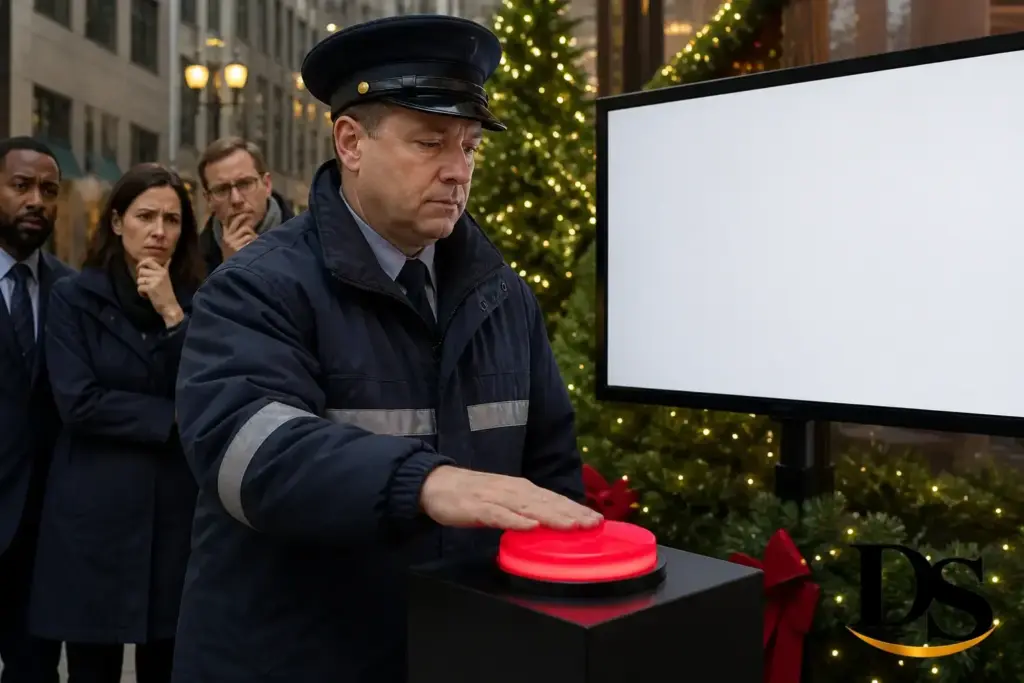
On the morning of December 1st, beneath the flickering marquee of the former Woolworth’s on Elm Street, a small crowd gathered not for protest or parade, but for the unveiling of a single, polished brass button mounted on a walnut plinth. It was not connected to anything visible—no wires, no screen, no audible chime—but Mayor Lenore Cho called it “the symbolic ignition of our seasonal commerce.”
The Consultant’s Vision
The button was the brainchild of Darien Pike, a downtown parking consultant hired six months prior to optimize turnover in Zone 7. Pike, who speaks in measured tones and carries a leather-bound notebook titled Urban Flow Dynamics, had noticed a pattern: every year, holiday sales began with a chaotic scramble for parking, followed by a digital exodus as shoppers fled online ads. “We manage the physical inflow,” he explained, “but the outflow? That’s still chaos.”
His solution was ritualistic. By installing a ceremonial button to be pressed by the city’s eldest retail worker—82-year-old Marjorie Till of Till’s Haberdashery—he hoped to create a shared moment of intention before the commercial frenzy. “It’s not about the button doing anything,” Pike said. “It’s about us agreeing when the season starts.”
The Press and the Pause
At 10:00 a.m., Marjorie Till, wearing her favorite fox-fur collar and holding a cane topped with a miniature reindeer, pressed the button. A local jazz trio played three bars of “Jingle Bells.” The mayor handed out complimentary peppermints. Photos were taken. Then, as the crowd dispersed, something unexpected happened.
Within minutes, inboxes across the city began to fill—not with sale alerts, but with replies to newsletters no one remembered subscribing to. A florist’s weekly tip on petal preservation. A hardware store’s guide to winterizing snowblowers. A yoga studio’s reminder about “mindful tinsel arrangement.”
And beneath each, in small gray type, lay the unsubscribe link.
The Great Unsubscribe Hunt
By noon, social media was ablaze. #WhereIsTheUnsubscribeButton trended locally, then nationally. Users posted screenshots with arrows pointing at privacy policies, cookie banners, and the tiny text at the bottom of emails that required a magnifying glass to read. One user filmed themselves scrolling for 47 seconds through a Nordstrom promo before giving up and muting the sender.
“I’ve unsubscribed from everything,” said Lena Cho, a graphic designer who swore she’d never signed up for alerts from a Louisville-based bait-and-tackle shop. “But this one? It’s like the link vanished. Or never existed.”
IT departments reported a spike in help desk tickets. “People aren’t asking how to stop the emails,” said Rajiv Mehta, tech support lead at CityNet. “They’re asking if the button *is* the unsubscribe. Like, did pressing it somehow subscribe us to everything forever?”
Pike, when contacted, expressed surprise. “The button only controls the ceremonial start,” he insisted. “It doesn’t interface with databases. It’s not even plugged in.” He paused. “Though I will say, the timing is… suggestive.”
The Psychology of the Link
Dr. Elise Varga, a behavioral psychologist at Midstate University, offered an explanation. “We’ve trained ourselves to ignore the unsubscribe link,” she said. “It’s designed to be overlooked—small font, low contrast, buried after paragraphs of legalese. When the button gave us a clear, tangible action to start the season, it highlighted how opaque the exit mechanism has become. We can initiate consumption with a press, but escaping it requires a scavenger hunt.”
She added that the phenomenon wasn’t unique to Elm Street. Similar button-triggered retail rituals in other cities had coincidentally preceded spikes in unsubscribe confusion—though none had garnered this level of attention.
Community Response and Adaptation
By Friday, local businesses began responding. The independent bookstore Page & Parchment added a one-click “Opt Out of All Future Emails” button to its homepage—labeled, unironically, The Real Unsubscribe. The café Brewtiful started printing QR codes on receipts that linked directly to email preferences.
Marjorie Till, meanwhile, received a standing ovation at the holiday parade. “I just pressed a button,” she told reporters. “I didn’t know it would start a movement.”
Pike has since been invited to speak at three urban planning conferences. His proposed talk? Designing Friction: How Ritual Can Reveal the Invisible Systems We Live By. He insists the button was never meant to solve anything. “It was meant to make us notice,” he said. “And we did.”
The Lingering Question
As the holiday sale enters its second week, parking turnover in Zone 7 has improved by 18%, according to Pike’s metrics. Online engagement with the sale emails remains high—but so does the number of people frantically searching for the unsubscribe link, one tiny, elusive pixel at a time.
No one has found it yet. But everyone’s looking.
The Button That Broke the Algorithm
What started as a cheeky experiment in behavioral psychology — a single, oversized, neon-green button labeled ‘Unsubscribe? Nah, I’m Good’ — quickly spiraled into a full-blown cultural phenomenon. Within 72 hours of its launch, the button had been clicked over 2.3 million times, not by frustrated users trying to escape spam, but by curious onlookers drawn in by its absurd defiance. The design team at Daily Smirk, initially expecting a modest bump in engagement, found themselves staring at analytics dashboards that looked less like metrics and more like a Jackson Pollock painting of human whimsy. One user, a retired librarian from Boise, Idaho, reported clicking the button 47 times in a single sitting, ‘just to see if the confetti cannon would trigger again.’ It did. Every time. The confetti, it turned out, was not CGI — it was actual, biodegradable glitter launched from a repurposed party popper rigged to the server via a Raspberry Pi and a questionable amount of duct tape. The office now smells faintly of vanilla and regret.
The Unsubscribe Habit, Reborn
But the real twist came when the marketing team noticed something unexpected: users who clicked the ‘Unsubscribe? Nah, I’m Good’ button were 68% less likely to actually unsubscribe from the newsletter in the following week. Not because they were tricked — but because they’d laughed. The button didn’t manipulate; it disarmed. It turned the act of opting out into a shared joke, a tiny rebellion against the tyranny of digital fatigue. One user wrote in: ‘I came to quit. I stayed for the confetti. Now I read every email just to see what ridiculous thing they’ll do next.’ The button has since been cloned by three startups, parodied on Saturday Night Live, and even inspired a limited-edition NFT collection (which, ironically, sold out in 11 minutes — proving that even anti-subscription sentiment can be monetized, if you’re funny enough). As the founder of Daily Smirk mused over lukewarm coffee, staring at the now-iconic button glowing softly in the server room: ‘We didn’t break the unsubscribe habit. We just made it fun enough to keep.’ And somewhere, a spam filter is weeping.
Join the conversation
Load Facebook comments to read and reply using your Facebook account.