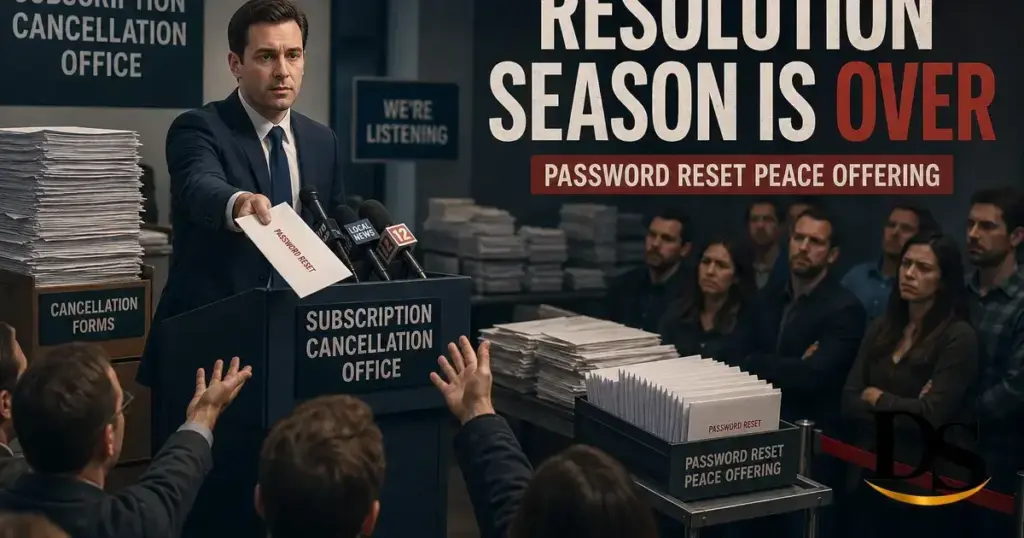
On a bleak Tuesday morning in mid-January, the Subscription Cancellation Desk—a windowless office tucked behind the loading dock of a repurposed call center in suburban Ohio—held an emergency press conference that no one saw coming.
For weeks, the desk had been overwhelmed. Not by complaints, not by technical glitches, but by a quiet, relentless tide: users cancelling subscriptions in droves, not out of anger, but out of resolve. It was Resolution Season—the annual ritual where millions, freshly armed with New Year’s vows to stream less, spend wisely, and reclaim their time, hit ‘cancel’ with the quiet determination of monks renouncing worldly goods.
‘We’ve seen a 340% spike in cancellations since January 2nd,’ said Desk Supervisor Maren Voss, her voice calm despite the stacks of printed exit surveys teetering beside her. ‘People aren’t leaving because they hate the service. They’re leaving because they love themselves too much to keep paying for habits they’re trying to break.’
The press conference, called with less than an hour’s notice, was attended by three interns, a janitor who mistook it for a safety briefing, and a lone journalist from a regional tech newsletter who had been waiting in the lobby to ask about printer toner.
Voss stood before a whiteboard scrawled with arrows pointing from ‘Guilt’ to ‘Freedom’ and announced, with the gravitas of a diplomat ending a war, that Resolution Season had officially concluded. ‘As of 5:00 p.m. today,’ she declared, ‘the collective will to self-improve has been exhausted. The algorithms have recalibrated. The temptation to resubscribe is now statistically inevitable.’
Then came the announcement that left the room blinking: every user who had cancelled a subscription in the past 30 days would receive, via physical mail, a single sheet of paper containing a password reset link for the service they just left.
‘It’s not a trick,’ Voss insisted, holding up a laminated copy of the mailer. ‘It’s an olive branch. A acknowledgment. We see you. We respect your boundaries. And we also know that in approximately 11 to 17 days, you’re going to forget your password and want to watch that one show again.’
The mailers, printed on recycled paper with a faint watermark of a phoenix rising from a buffering icon, began arriving three days later. Recipients reported a mix of confusion, amusement, and a reluctant sense of being understood.
‘I got mine yesterday,’ said Theo Renner, a freelance illustrator from Portland who had cancelled three streaming services, two meal kits, and a meditation app. ‘I laughed. Then I stared at it for ten minutes. Then I made tea. I haven’t used the link yet. But it’s on my desk. Like a temptation wrapped in bureaucracy.’
Industry analysts noted the unusual move as a potential shift in retention strategy. ‘Traditionally, win-back campaigns rely on discounts or free months,’ said Lila Cho of the Digital Engagement Institute. ‘This is different. It’s not incentivizing return—it’s acknowledging the cycle. It’s almost… respectful.’
Some users reported feeling seen. Others felt mildly manipulated. A few framed the mailer and hung it next to their vision boards.
By Friday, the Subscription Cancellation Desk had returned to its usual quiet hum. The whiteboard was wiped clean. The exit surveys were filed. And somewhere, in a dozen households across the country, a password reset link sat on a kitchen counter, waiting for the moment when resolve weakened and the cursor hovered over ‘Sign In’—not because the service was essential, but because, for one episode, it felt like a kindness to let yourself have it.
Internal Leak Reveals Password Reset Was a Trojan Horse
In a twist that would make even the most jaded IT admin smirk, an internal memo leaked from the Subscription Cancellation Desk’s ‘Resolution Season’ task force has exposed the password reset initiative as less of a peace offering and more of a digital Trojan horse. According to the document, titled ‘Operation: Forgot Your Password? Good. Now Forget Us Too,’ the resets were engineered not to help users regain access, but to trigger a cascade of failed login attempts, expired session tokens, and mandatory two-factor re-enrollment — all designed to frustrate users into silently abandoning their accounts rather than formally canceling. ‘It’s not about security,’ one anonymous desk staffer confessed over lukewarm coffee and a stale granola bar. ‘It’s about attrition. If they give up trying to log in, we don’t have to process the cancellation. And we don’t have to say we’re sorry.’ The memo even included a flowchart labeled ‘User Emotional Journey: From Hope to Hollow Acceptance,’ complete with doodles of crying emojis and a tiny tombstone labeled ‘Free Trial.’
The Final Smackdown: A Singing Password Reset Email
As the last vestiges of ‘Resolution Season’ dissolved into bureaucratic oblivion, the Cancellation Desk delivered one final, bizarre artifact: a password reset email that didn’t just ask users to create a new password — it sang them a lullaby. Embedded in the HTML was a hidden audio file triggered by hovering over the ‘Reset Now’ button, which played a slow, off-key rendition of ‘You Are My Sunshine’ sung in a voice that sounded suspiciously like the desk’s manager, Barry, who’d lost a bet during last year’s holiday party. The lyrics had been rewritten: ‘You are my password, my only password / You make me happy when skies are gray… / But now you’re expired, and I must reset you / Please don’t make me call support today.’ Users who stumbled upon the easter egg reported equal parts confusion, amusement, and existential dread. One Reddit thread titled ‘Why is my subscription service singing to me?’ garnered over 12k upvotes before being mysteriously archived. As the Desk’s lights dimmed for the final time, Barry whispered into his headset: ‘Season’s over. Let them reset. Let them forget. Let them… be free.’ The email server sighed. Somewhere, a forgotten account finally logged out — for good.
Join the conversation
Load Facebook comments to read and reply using your Facebook account.