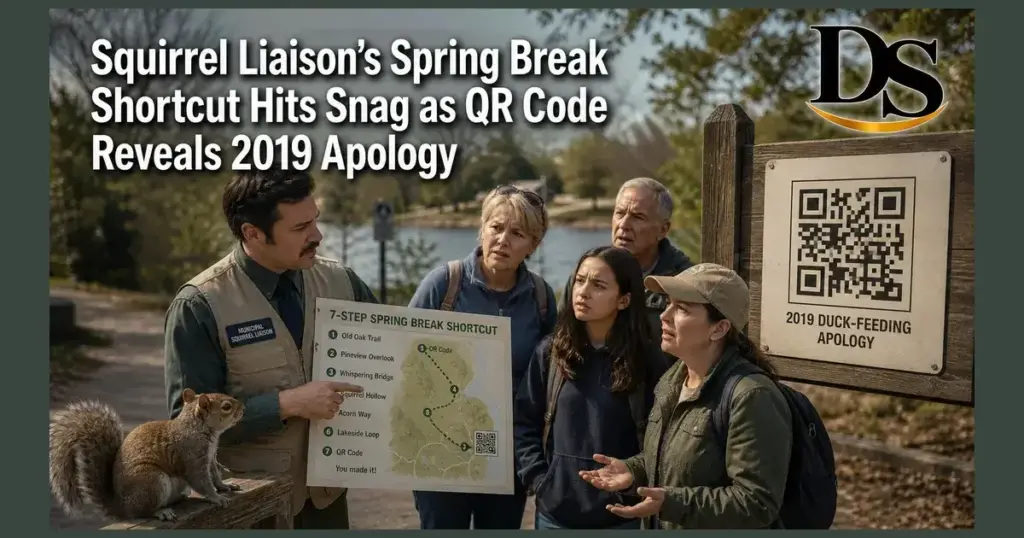
On the first Monday of spring break, residents of Brookfield Hollow gathered at dawn outside the town’s newly renovated Riverbend Pavilion, coffee in hand and sneakers laced tight, eager to follow the municipal squirrel liaison’s much-touted seven-step shortcut to the seasonal wildflower meadows. The promise was simple: bypass the congested main trail, avoid the muddy switchbacks, and reach the blooming hills in half the time—guided, supposedly, by the innate wisdom of the local eastern gray squirrel population.
The Liaison’s Method
Marla Dinsmore, appointed Brookfield Hollow’s inaugural Municipal Squirrel Liaison in 2022 after a successful pilot program tracking nut-cache patterns near Oakridge Elementary, unveiled the shortcut with the solemnity of a city planner announcing a new transit route. ‘The squirrels know the land better than any surveyor,’ she told the local paper at the time. ‘They move with efficiency, avoid human congestion, and always find the driest path.’ Her role, funded by a quirky line item in the town’s sustainability budget, involved observing squirrel movement, interpreting their trail choices as ecological signposts, and translating them into pedestrian guidance.
This year’s shortcut, dubbed ‘The Nutline,’ was her most ambitious yet. Seven distinct waypoints—marked by small, hand-painted acorn symbols on trees and rocks—were said to mirror the foraging route of a particularly adept squirrel named Brigadier, observed over three seasons to consistently reach the meadows 22 minutes faster than the average hiker.
The Trail Begins
Equipped with printed maps and Dinsmore’s enthusiastic briefing, the group set off. The first three steps were intuitive: a left turn at the lightning-struck sycamore, a careful crossing of the seasonal creek using exposed roots as stepping stones, and a gentle ascent along a mossy stone wall where Brigadier was known to pause and assess threat levels (i.e., joggers with dogs). By step four, the path narrowed into a deer trail lined with early trillium, and morale was high.
But at the fifth waypoint—a gnarled hickory tree marked with a fresh acorn symbol and a small, laminated sign reading ‘Scan for Confirmation’—the group paused. Dinsmore produced her phone, adjusted her glasses, and scanned the QR code affixed to the sign.
The Code’s Secret
Instead of a confirmation message, a celebratory animation, or even a fun fact about Brigadier’s nut-hoarding habits, the screen displayed a grainy video from April 2019: Marla Dinsmore, then a volunteer park steward, standing awkwardly beside a overflowing duck pond, reading a prepared statement. ‘I regret to inform the public,’ she began, voice tight, ‘that my well-intentioned but excessive distribution of bread products during last month’s thaw has contributed to water quality issues and altered foraging behavior in the local mallard population. I have since completed a wildlife feeding ethics workshop and will adhere to approved guidelines moving forward.’ The video ended with a timestamp: April 12, 2019.
A beat of silence. Then laughter—nervous, then genuine. Someone whispered, ‘Is this part of the shortcut?’ Another checked the map: the sixth and seventh acorn symbols led not to the meadow, but in a wide loop back toward the pavilion, retracing steps already taken.
Reactions and Reflections
Town officials, contacted for comment, emphasized that the liaison role remains advisory and that no public funds were misused in the creation of the Nutline. ‘Marla’s work is based on genuine ecological observation,’ said Parks and Recreation Director Len Cho. ‘The QR code, however, was not part of the official rollout. It appears to be a leftover from a past community engagement project—possibly a pilot for an augmented reality nature trail that was discontinued.’
Dinsmore, reached via email, declined to elaborate but sent a single sentence: ‘Brigadier’s route is still valid. The humans just need to trust the process—and maybe update their QR codes.’
Local naturalist Dr. Elira Voss, who has studied urban wildlife adaptation for fifteen years, offered a more measured take. ‘Animals do optimize paths—there’s real science in that. But when we institutionalize their behavior without accounting for change—seasonal shifts, human interference, even the squirrels’ own learning—we risk creating rituals that outlive their usefulness. This isn’t a failure of the squirrels. It’s a reminder that even wisdom needs version control.’
The Meadow, Eventually
Undeterred, most of the group followed the original dirt path to the meadows, arriving twenty minutes after the scheduled shortcut time. The wildflowers were in full bloom—purple lupine, yellow balsamroot, and pink phlox painting the hills in soft gradients. A squirrel, possibly Brigadier, watched from a nearby cedar, tail flicking as it buried a hazelnut near a patch of bloom.
No one blamed the squirrel. But as they packed up to leave, several residents paused at the hickory tree, scanning the QR code one last time—half-hoping for an update, half-amused by the persistence of the past. The acorn symbol remained fresh. The code, for now, did not.
Join the conversation
Load Facebook comments to read and reply using your Facebook account.