
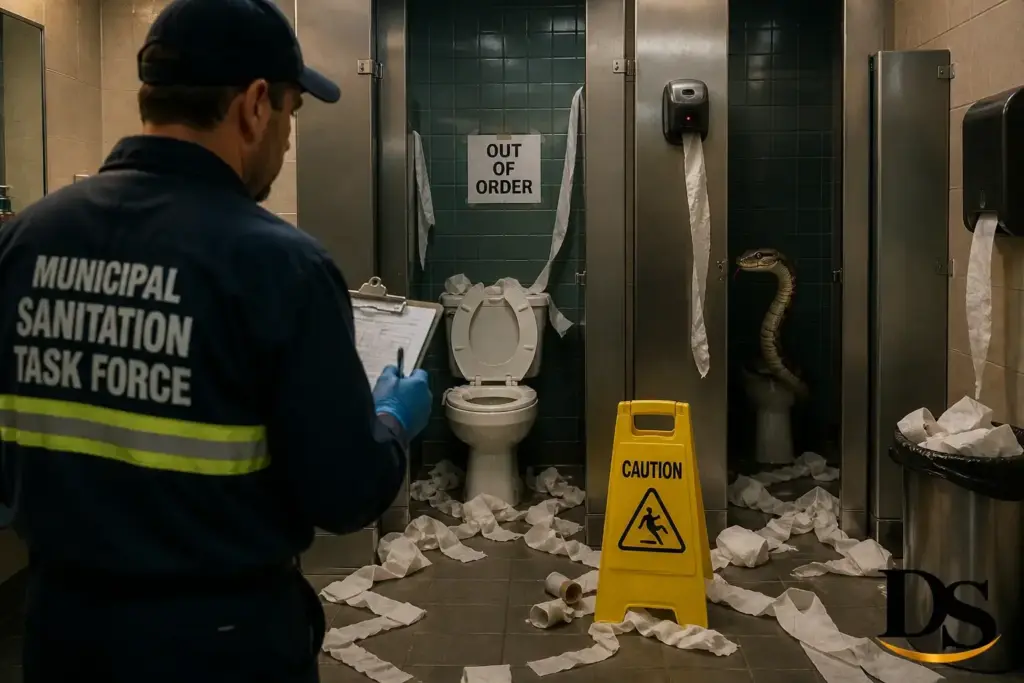
On a rainy Tuesday morning, Marjorie Tillman pushed open the door of the downtown transit station restroom, braced for the usual April 1st gauntlet: a whoopee cushion strategically placed on the seat, a sign reading ‘Please aim for the hole—we’re watching,’ and a trail of confetti leading to a bucket labeled ‘Tears of Joy.’
She emerged unscathed—no glitter in her shoes, no voice modulator announcing her bathroom habits over the intercom—and was handed a small, laminated card by a staffer in a high-vis vest: ‘Official Survivor of April Fools Season 2024. Redeem for one free hand sanitizer refill and priority stall access during next year’s prank window.’
The card was part of a new pilot program unveiled by the Municipal Public Restroom Task Force (MPRTF), a cross-departmental body formed in 2022 to address hygiene, accessibility, and now, seasonal mischief. According to Task Force Chair Diane Lorre, the initiative aims to ‘acknowledge the emotional labor of navigating public spaces during a week when trust in basic fixtures is systematically undermined.’
Background: From Prank Patrol to Prudence Protocol
The MPRTF’s April Fools oversight began after a 2021 incident in which a motion-activated air freshener was reprogrammed to emit a foghorn blast every time someone flushed, triggering a false fire alarm in the city hall annex. Though no injuries occurred, the cleanup cost exceeded $12,000, and several employees reported lingering anxiety around sensor-based fixtures.
In response, the Task Force issued non-binding guidelines: no tampering with emergency systems, no biohazards, and no obstructing ADA-compliant stalls. Yet enforcement proved difficult. By 2023, pranks had evolved—QR codes on stall doors linking to rickrolls, fake ‘out of service’ signs printed on municipal letterhead, and a viral TikTok trend where users filmed themselves attempting to ‘beat the sensor’ by waving arms like semaphore flags.
‘We realized we couldn’t stop the jokes,’ said Lorre in a recent interview. ‘But we could recognize the resilience of those who just wanted to wash their hands without questioning reality.’
Escalation: The Survivor’s Badge and the Retroactive Debrief
The Survivor’s Badge program, launched April 2, offers tiered rewards based on verified participation. Participants submit a brief affidavit (witnessed by a coworker, transit employee, or security camera timestamp) confirming they used a public restroom between March 28 and April 2 and encountered at least one documented prank. Bronze tier: sanitizer voucher. Silver: access to a ‘prank-free’ stall reservation system during next year’s window. Gold: a commemorative lapel pin shaped like a toilet roll with a tiny shield.
More unusually, the Task Force has scheduled a follow-up meeting for May 15—not to plan next year’s defenses, but to debrief participants from last year’s April Fools season. ‘We’re treating this like a after-action review,’ explained Task Force Secretary Rajiv Nadesan. ‘People who survived 2023’s pranks have insights we missed. Did the confetti bucket cause slip hazards? Did the fake ‘wet floor’ sign actually deter use, creating unintended congestion elsewhere? We need to learn.’
The retroactive focus has drawn both praise and confusion. ‘It’s like holding a veterans’ forum for people who survived a whoopee cushion barrage,’ said Lenore Cho, a librarian who volunteers at the central branch restroom monitor desk. ‘But honestly? I appreciate being asked. Last year, I avoided the third-floor restroom for three weeks after the motion sensor started playing polka music. Nobody asked how that made me feel.’
Community Impact: Trust, Humor, and the Unspoken Contract
Early data suggests the program is influencing behavior. In the first 48 hours, over 300 affidavits were filed citywide, with notable clusters near transit hubs and university campuses. Some users reported feeling ‘seen’—a rare sentiment in discussions about public restrooms, which are often framed solely as maintenance or security issues.
Local humorists have mixed reactions. ‘It’s beautiful,’ said stand-up comic Malik Boone, who once filled a soap dispenser with ranch dressing as a prank. ‘They’ve turned our chaos into a civic ritual. Now we’re not just pranksters—we’re part of a resilience ecosystem.’ Others worry it may incentivize over-engineering. ‘If people start expecting rewards for surviving April Fools, where does it end?’ asked transit worker Doris Phan. ‘Do we give medals for making it through flu season without touching the door handle?’
The MPRTF insists the program is not an endorsement of pranks, but a recognition of shared space. ‘We’re not encouraging the jokes,’ Lorre clarified. ‘We’re saying: if you endured them, and you still showed up to wash your hands, that deserves notice. And if we can learn from last year to make this year slightly less chaotic—well, that’s just good governance.’
Closing Beat: A Quiet Moment in the Stall
Back at the transit station, Marjorie Tillman stood at the sink, drying her hands with a recycled-paper towel. She glanced at the Survivor’s Badge peeking from her wallet. Outside, a maintenance worker was reapplying the ‘Please aim for the hole—we’re watching’ sign, chuckling to himself.
She didn’t take it down. Instead, she smiled, wiped her hands one last time, and walked out—just another citizen who’d made it through another April, one questionable fixture at a time.
FACT or FICTION? This story is FICTION. While public restrooms do see seasonal increases in prank-related incidents around April Fools’ Day, no municipal task force currently operates a formal rewards program for surviving such events, nor schedules retroactive debriefs for prior-year participants. The Municipal Public Restroom Task Force, its initiatives, and the described affidavit-based badge system are invented for this feature.
Join the conversation
Load Facebook comments to read and reply using your Facebook account.