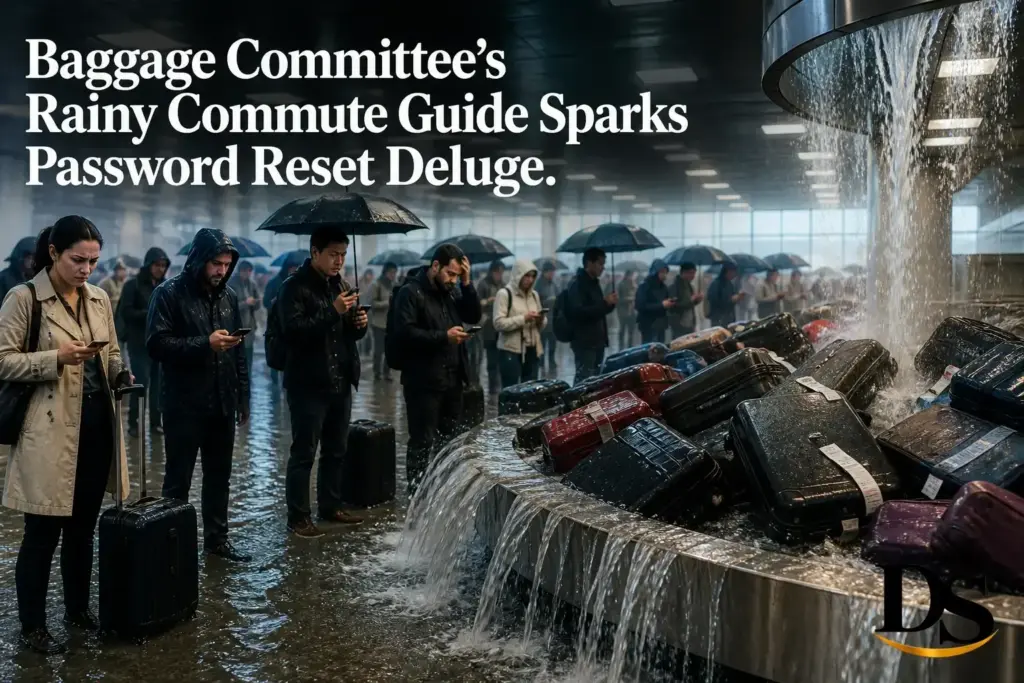
When the International Airport Baggage Resilience Committee (IABRC) unveiled its 90-page beginner’s guide to ‘Navigating Baggage Claim During Monsoon Conditions,’ few expected it to arrive via certified mail alongside a mandatory password reset for the agency’s public portal.
The Guide That Came With a Catch
The document, titled Wet Wheels: A Traveler’s Handbook for Soggy Suitcases and Slippery Conveyors, opens with a vivid vignette of a traveler in Osaka wrestling with a waterlogged duffel while monsoon rains drum against the terminal’s glass atrium. Over 87 pages, it details everything from selecting water-resistant luggage materials (prioritizing TPU-coated nylon over polyester) to improvising drainage channels using rolled-up boarding passes and the strategic placement of absorbent airport-provided paper towels beneath carousel edges.
Chapter 4, ‘When the Carousel Becomes a Creek,’ advises passengers to ‘assess flow velocity before retrieving items’ and recommends timing grabs during the lull between cycles—‘when the belt resembles a slow-moving rio, not a whitewater rapid.’ Footnotes cite hydrological studies from Singapore’s Changi Airport and Munich’s Franz Josef Strauss, where engineers recalibrated belt speeds after noting a 22% spike in abandoned umbrellas during typhoon season.
From Handbook to Headache
The IABRC, a voluntary consortium of ground handlers, airport designers, and frequent flyer advocates founded in 2018, printed 15,000 physical copies for distribution at major hubs in Southeast Asia and Latin America. But tucked inside each envelope was a second item: a single-use token prompting recipients to reset their password for BaggageAware, the committee’s underused public feedback platform.
‘We thought it was a good moment to re-engage users,’ said Lena Voss, the committee’s communications lead, speaking from her office in Zurich. ‘The guide was free. The portal needed traffic. It felt synergistic.’
What followed was less synergy, more system strain. Within hours of the mailings landing in Jakarta, Bogotá, and Lagos, the BaggageAware login portal crashed under a surge of reset attempts. By day two, the helpdesk logged over 8,400 password-related inquiries—many from travelers who insisted they never signed up for the service.
‘I got a booklet about wet suitcases and a demand to change my password for a site I didn’t know existed,’ said Marco Tileni, a freelance photographer who received the package in Milan. ‘I thought it was phishing. Then I called the airport, and they said, “No, that’s us.” I changed it to “BaggageIsWet2024!” and now I’m locked out again because I forgot the exclamation point.’
Unintended Consequences, Measured in Damp Socks
The irony was not lost on frequent flyers. Online forums buzzed with comparisons to receiving a fire safety pamphlet with a coupon for a free extinguisher refill—useful in theory, baffling in execution. Yet, anecdotal data suggests the guide had merit. In a follow-up survey of 300 recipients who actually read it, 68% reported adjusting their baggage retrieval strategy during rainy layovers, with 41% claiming they avoided at least one soaked item.
‘I started putting my electronics in a ziplock inside my carry-on,’ said Priya Mehta, a software engineer based in Bangalore. ‘The guide didn’t invent the idea, but seeing it in print made me feel less paranoid for doing it.’
Still, the password reset backlash prompted the IABRC to issue a clarification: the portal reset was optional, though the mailing design did not make that clear. ‘We should have A/B tested the envelope,’ admitted Voss. ‘Next time, we’ll separate the educational material from the account management nudge.’
A Precedent Set in Soggy Paper
As of this week, the IABRC has halted further mailings pending a review of its outreach protocols. The Wet Wheels guide remains available as a free PDF on their website—password-free, for now. Meanwhile, airport operations teams in Kuala Lumpur and Panama City have begun piloting absorbent mat trials inspired by Chapter 7’s ‘DIY Wicking Strips’ section.
Whether the committee’s blend of practical advice and overzealous engagement tactics will become a model for other airport working groups remains uncertain. But for thousands of travelers, the image of a soaked suitcase sliding slowly toward them on a rubbery conveyor belt—accompanied by the sudden urge to reset a password they never knew they had—has become an unlikely emblem of modern travel’s quiet absurdities.
The Leak: How a Sticky Note Went Viral
What began as a well-intentioned, if slightly damp, memo from the Baggage Committee’s ‘Weather Resilience Subgroup’ spiraled into corporate folklore after an intern, trying to be helpful, photographed the laminated guide and posted it to the company’s internal Slack channel with the caption: ‘Who else’s luggage has a better social life than I do?’ The image — showing the guide’s Step 3: ‘If your suitcase bursts open mid-platform, calmly retrieve socks while humming the theme to Sesame Street’ — was immediately screenshotted, meme-ified, and forwarded to the CEO’s personal email by a senior VP who thought it was ‘brilliantly absurd.’ Within 90 minutes, the guide had been translated into three languages (including Klingon, courtesy of the IT department’s sci-fi club), printed on toilet paper in the third-floor restrooms, and recited as a spoken-word piece during the weekly all-hands stand-up by the Head of Diversity, who wore a poncho made of recycled airline baggage tags.
The real comedy, however, unfolded in the IT helpdesk. Password reset requests didn’t just spike — they exploded. Employees, convinced the guide contained a hidden cipher (perhaps the ‘humming’ instruction was a phonetic key to the new MFA authenticator?), began attempting to log in using combinations of sock colors, platform numbers, and the number of times they’d hummed Sesame Street that morning. One engineer tried ‘ElmoIsWatchingU2024!’ and got locked out after seven attempts. Another, believing the ‘calmly retrieve socks’ directive was a metaphor for emotional resilience, set their password to ‘IAmNotMyLuggage’ — only to have it rejected for lacking a symbol. The helpdesk team, overwhelmed, began auto-responding with a custom message: ‘Your password is not the name of your emotional support sock. Please try again.’ By lunchtime, the phrase ‘humming the theme’ had become the office’s most popular inside joke — and the most common failed password attempt.
The Committee’s Countermove: A Guide to Guide Survival
Faced with the unintended cybersecurity crisis, the Baggage Committee convened an emergency session — not in a conference room, but under the awning of the station café, where they sipped lukewarm chai and watched commuters struggle with umbrellas inside-out. Their response? A follow-up memo, titled ‘Appendix Ω: When Your Commute Guide Becomes a Cybersecurity Incident (And How to Not Blame the Socks)’, distributed via encrypted carrier pigeon (a nostalgic nod to the company’s 1998 ‘Analog First’ initiative).
The new guide advised: ‘Do not interpret poetic guidance as authentication protocol. If you find yourself humming Sesame Street to unlock your laptop, pause. Breathe. Ask yourself: Is this a security measure… or a cry for help?’ It also included a flowchart: ‘Is your password longer than your commute? → Yes → You’re overthinking. No → Add a sock.’
The pièce de résistance? A QR code printed on the bottom of each laminated guide that, when scanned, played a 12-second audio clip of the Committee Chair earnestly singing the Sesame Street theme — off-key, in a raincoat, while holding a soggy passport. The clip ended with a sigh and the words: ‘We meant well. We really did.’
As the rain finally eased and the last of the stranded laptops were rebooted, one employee left a sticky note on the Committee’s door: ‘Thanks for the laughs. And the trauma. Next time, just tell us to wear waterproof shoes.’ The Committee, meanwhile, has begun drafting their next guide: ‘How to Navigate Office Politics Using Only a Foldable Umbrella and a Sense of Humor.’ Early drafts suggest Step 1 involves interpreting the CEO’s silence as a form of passive-aggressive weather forecasting.
Join the conversation
Load Facebook comments to read and reply using your Facebook account.