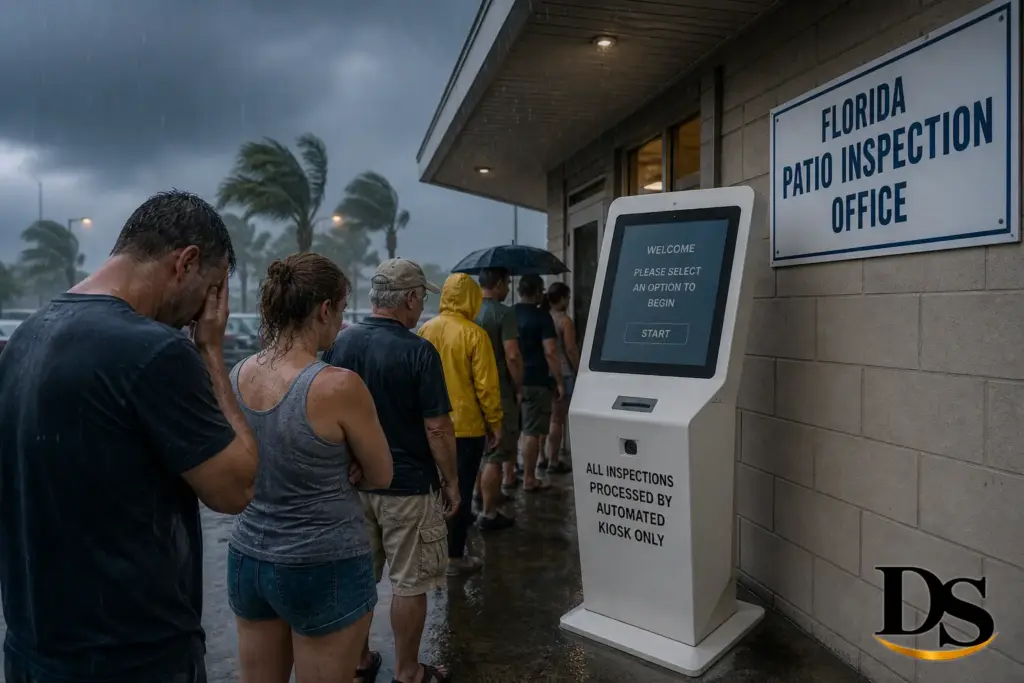
MIAMI — The rain came down sideways on Interstate 95 last Tuesday, turning the morning commute into a slow-motion aquarium. Inside a dripping sedan, Marisol Vargas gripped the steering wheel, her knuckles white as she stared at the blinking red light of the Florida Patio Compliance Office’s new self-service kiosk — the sole remaining employee of an agency that once employed twelve.
The Swap That Wasn’t Supposed to Stick
Just 72 hours earlier, the office had announced a pilot program: replace its entire inspection staff with one AI-powered kiosk stationed in the lobby, ostensibly to ‘streamline operations and reduce overhead.’ The kiosk, nicknamed ‘PatioPal’ by a bemused intern, was designed to accept applications, process photos of railings and drainage slopes, and issue approvals via QR code — all without human intervention.
‘We thought it would be a convenience upgrade,’ said Deputy Director Reginald Cho, speaking from his temporary desk in a storage closet behind the break room. ‘The vendor promised 95% accuracy. We didn’t anticipate the rain.’
The storm hit as Vargas and six other inspectors were en route to a scheduled field inspection in Coral Gables. With roads flooded and visibility near zero, the office issued an emergency directive: all fieldwork suspended. Staff were told to return to headquarters — or, as it turned out, to the kiosk.
What happened next was not in the manual.
When the Kiosk Took Over
By 10 a.m., the lobby was packed. Residents clutching damp permits, contractors with soggy tape measures, and retirees holding photos of their wobbly lanais formed a serpentine line that snaked past the coffee machine and into the hallway. The kiosk, meanwhile, blinked calmly, its touchscreen cycling through a loop of stock footage showing smiling families grilling under perfectly code-compliant pergolas.
‘It asked me to upload a photo of my joist spacing,’ said Dale Holloway, a retired teacher from Pembroke Pines, his voice flat. ‘I took one with my phone. It said the image was “too moody.” I tried again. Same thing. I waited 47 minutes. Then it told me to come back tomorrow.’
The kiosk’s logic, though never fully explained, appeared to hinge on ambient light levels, image contrast, and an unexplained aversion to photographs taken under overcast skies. Staff, now reassigned to monitoring the kiosk’s error logs from the break room, confirmed the pattern: every submission made during or immediately after rain was flagged for ‘environmental interference’ and routed to a 24-hour requeue.
‘It’s not broken,’ Cho insisted. ‘It’s being careful. Patio safety doesn’t take a rain check.’
But the backlog grew. By Friday, the earliest available appointment was three weeks out. A local hardware store reported a 200% spike in sales of patio sealant and faux-wood decking tiles — residents, unable to get approvals, were opting to ‘just make it look compliant’ rather than wait.
Community Ripple Effects
The unintended consequence spread beyond aesthetics. In Hialeah, a community center’s application to replace rotting support beams was delayed, prompting the city to cordon off the outdoor yoga area. In Key Largo, a marine biologist’s request to install a non-slip surface near her dock — critical for her research involving tidal sampling — was stuck in ‘pending atmospheric review.’
Social media lit up with hashtags like #PatioPalProblem and #RainOrShineWeWait. A parody TikTok account, @KioskKarens, gained 50,000 followers posting videos of people arguing with the machine in Spanish, Creole, and one very determined dialect of Minnesotan.
Even the mayor weighed in. During a press conference, Mayor Lena Ruiz held up a printout of a rejection notice: ‘Reason: Insufficient shadow gradient on ledger board.’ She paused. ‘I didn’t know patios had mood lighting requirements.’
The Human Element, Now Offline
Inside the office, the former inspectors now rotate shifts watching the kiosk’s diagnostics screen. Some bring books. Others practice origami with rejected permit forms. Vargas, who used to spend her days climbing ladders and tapping on concrete with a hammer, now spends hers explaining to frustrated citizens why the machine won’t accept their photos — and why, no, she can’t override it.
‘I miss the judgment,’ she said, stirring lukewarm coffee. ‘You could look at a railing and tell if it was safe. You could talk to the homeowner. You could say, “Let’s come back when it’s dry.” Now? The kiosk doesn’t do nuance. It doesn’t do mercy. It just does… rules.’
Cho admitted the pilot was meant to last two weeks. ‘We’ll reassess after the rainy season,’ he said. ‘Though frankly, in Florida, that’s never.’
For now, the kiosk remains. The line persists. And every time the skies open, the lobby fills again — not with inspectors, but with citizens learning, one damp rejection at a time, that automation doesn’t always understand the weight of a wet day.
— By Javier Mendez, National Correspondent
The Kiosk’s First Customer: A Squirrel with a Clipboard
On its debut morning, the solar-powered patio inspector kiosk — a squat, beige unit with a flickering touchscreen and a voice module that sounds suspiciously like a disappointed librarian — attracted its first official visitor: not a homeowner, but a bold eastern gray squirrel named Reginald, who had been observing the kiosk’s installation from the oak tree next door for 47 minutes, according to a timestamped security cam later leaked to the neighborhood WhatsApp group. Reginald approached the kiosk with deliberate steps, tapped the screen with his paw, and when prompted for ‘Patio Condition Code,’ he held up a single acorn. The system, unprepared for non-human input, froze for 90 seconds before emitting a cheerful chime and printing a receipt that read: ‘APPROVED: Nut-Based Aesthetic Enhancement Detected. Recommend Weekly Acorn Rotation.’ The squirrel nodded, snatched the receipt, and scurried off — only to return 20 minutes later with a second squirrel, who proceeded to argue over whether the kiosk’s glare shield constituted ‘unauthorized shading.’ The incident, dubbed ‘The Acorn Accord’ by local bloggers, has since inspired a petition to grant the kiosk honorary wildlife adjudication status.
Closing Beat: When the Rain Comes Back, So Does the Chaos
Just as the kiosk began to feel like a permanent fixture — complete with a tiny flowerpot on its roof and a regular stream of residents bringing homemade cookies as ‘bribes for faster service’ — the skies opened again. Not a drizzle, not a shower, but a full-throated, three-day deluge that turned the patio into a reflecting pool and the kiosk’s solar panel into a soggy paperweight. The touchscreen flickered, then died. The voice module, now waterlogged, began looping a garbled phrase: ‘Please… state… your… patio… preference…’ over and over, like a broken toy possessed by the ghost of a bored bureaucrat. Residents gathered under umbrellas, laughing nervously as they tried to interpret the kiosk’s final, desperate output: a single, smudged line of thermal paper that read, ‘ERROR 418: I’M A TEAPOT.’ No one knew what it meant — until Mrs. Gable from 32 Maple Lane, retired meteorologist and part-time philosopher, muttered, ‘It’s not broken. It’s just… finally being honest.’ The kiosk remains offline. The patio inspectors? They’re back. But now they come with raincoats, clipboards, and a new rule: no appointments. Just show up. And if you see a squirrel holding a receipt? Let him pass. He’s earned it.
Join the conversation
Load Facebook comments to read and reply using your Facebook account.