
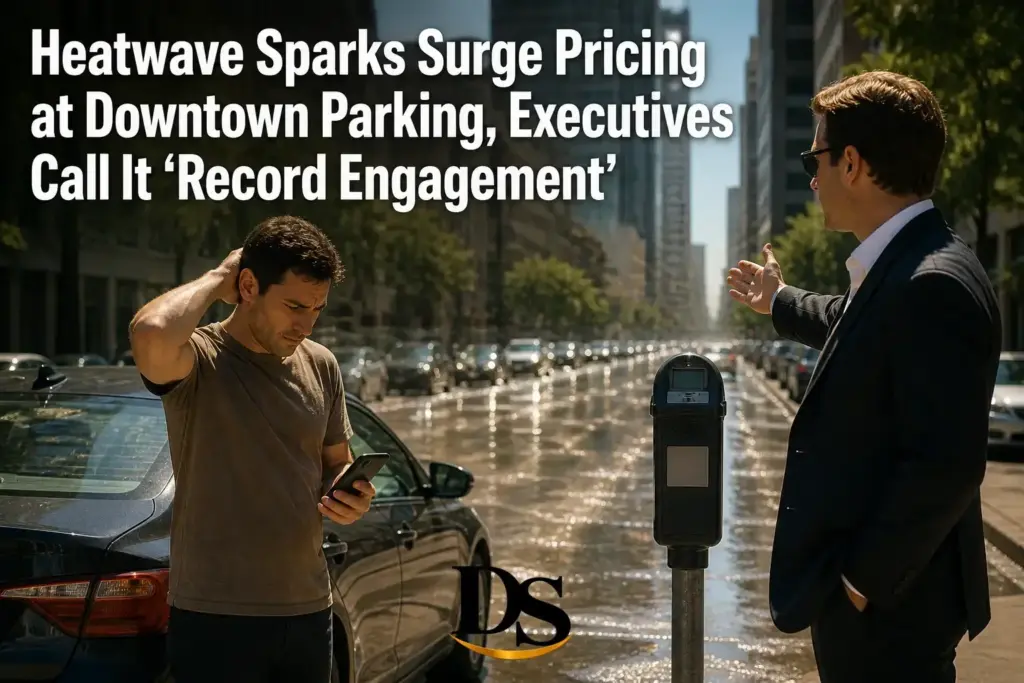
The first heat advisory of the summer had barely been issued when the downtown core began to shimmer—not just from rising temperatures, but from the sudden flicker of price tags on parking meters and garage entrances.
By 10 a.m., the city’s official heat index had climbed past 105°F. At the same time, the Downtown Mobility Group (DMG), a private consulting firm contracted to optimize urban parking, quietly flipped a switch on its dynamic pricing algorithm. Rates in the most congested zones—near the financial district, the courthouse, and the transit hub—jumped from $2 per hour to as high as $8 during peak afternoon hours.
No public announcement preceded the change. No signage updated. Drivers simply noticed their usual $6 lunch break parking now costing $24, or found garage gates refusing entry unless they paid a premium via the DMG app.
Background: The Algorithm Behind the Gates
The surge pricing model had been in testing for months, DMG officials later confirmed in a brief statement. Designed to balance demand and availability using real-time occupancy sensors, weather data, and historical usage patterns, the system was engineered to encourage turnover during high-demand periods.
What no one anticipated, however, was how aggressively the algorithm would react to the combination of a heat advisory and the start of the fiscal quarter—when downtown offices typically see a spike in in-person meetings as remote work policies relax.
‘The system interpreted the heat as a signal of reduced willingness to walk or bike,’ said Lena Voss, DMG’s lead urban strategist, in an internal memo later obtained by The Daily Smirk. ‘It also noted increased garage entries from executives avoiding surface lots. The conclusion? Maximize yield while demand is inelastic.’
By noon, social media was flooded with photos of dashboard receipts showing $18 charges for 90 minutes of parking. One user posted a side-by-side of last year’s $4 rate and today’s $16, captioned: ‘Is this parking or extortion with a view of the courthouse?’
Escalation: Confusion, Then Conversion
Initial reactions ranged from baffled to furious. Small business owners complained that customers were avoiding downtown shops. Delivery drivers reported circling blocks for 20 minutes to avoid surge zones. A group of municipal workers picketed outside DMG’s headquarters with signs reading ‘Cool Down the Prices’ and ‘We Sweat, You Profit.’
Yet within 24 hours, an unexpected trend emerged: app downloads spiked by 220%. User session times increased. And despite the complaints, parking turnover in surge zones improved by 37%, according to DMG’s internal dashboard.
‘We’re seeing record engagement,’ said Marcus Tillman, CEO of DMG, during an impromptu press briefing outside a steaming parking garage. ‘People are paying attention. They’re checking the app. They’re making decisions. That’s not dysfunction—that’s a market responding to signals.’
Tillman declined to confirm whether the heat advisory had been weighted as a trigger in the algorithm, calling it ‘proprietary logic.’ But he did add, ‘If the goal is to move cars efficiently and reduce idling, then yes—we’re hitting our KPIs.’
Community Impact: Who Pays the Price?
The burden, however, fell unevenly. Hourly workers—nurses, retail staff, and service employees—who lack flexible schedules or employer-subsidized parking reported choosing between skipping meals or paying double to park near their shifts.
‘I make $18 an hour,’ said DeShawn Rowe, a hospital orderly who parks in the civic center garage. ‘Yesterday, I spent almost two hours’ wages just to leave my car for eight hours. Today? I’d have to work three.’
Advocacy groups urged the city to impose caps on surge pricing during public health alerts. Councilwoman Priya Nadesan introduced an emergency motion to require public notice before any dynamic pricing activation during extreme weather events.
‘Innovation shouldn’t come at the cost of accessibility,’ she said. ‘If we’re going to let algorithms dictate who can afford to park downtown, we need transparency—and accountability.’
Closing Beat: The New Normal?
As the heat advisory expired and temperatures dipped, DMG quietly adjusted its surge thresholds. Rates returned to pre-advisory levels by Friday morning.
But the precedent had been set. Internal emails now show DMG exploring ‘weather-responsive pricing’ as a permanent feature—potentially extending to rain, wind chill, and even pollen counts.
For now, the city’s parking garages hum with a new rhythm: one where the cost of leaving your car isn’t just about time or place, but about how badly the sky wants you to suffer.
And somewhere in a glass office overlooking the financial district, a team of analysts is already smiling at the engagement metrics.
City Council Debates Emergency Parking Moratorium Amid Public Outcry
As temperatures soared past 105°F for the third consecutive day, city council chambers filled with residents armed with folding chairs, misting fans, and signs reading “My Wallet Melted Before My Ice Cream.” Councilwoman Lena Torres, sleeves rolled up and hair escaping its bun in a desperate bid for airflow, proposed an emergency 72-hour moratorium on surge pricing in all municipal lots, arguing that “charging $47 to park near a bodega during a heat advisory isn’t capitalism — it’s a hostile takeover of basic human dignity.”
The debate grew surreal when Councilman Raj Patel presented a thermal imaging report showing that the asphalt in Lot 7B reached 148°F — hot enough to fry an egg, which, as he demonstrated by cracking one onto the hood of a parked Prius, sizzled in precisely 11 seconds. “That’s not parking,” he declared, wiping yolk from his tie, “that’s culinary experimentation with public funds.”
Parking Authority executives, meanwhile, doubled down, releasing a joint statement calling the backlash “a misinterpretation of consumer enthusiasm.” “We’re not price-gouging,” said CFO Brenda Cho, adjusting her desk fan with one hand while sipping chilled coconut water with the other. “We’re facilitating record engagement. People aren’t just parking — they’re *dwelling*. They’re lingering. They’re contemplating life choices while waiting for rates to drop. That’s not frustration — that’s mindfulness with a surcharge.”
Critics noted the irony: the Authority’s own wellness program had just been cut due to “budget constraints,” yet surplus revenue from surge pricing was reportedly funding a new executive retreat titled “Heat, Profit, and Inner Peace: A Symposium in Scottsdale.”
The Human Cost: Tales from the Asphalt Frontier
Beneath the statistics and corporate jargon lie human stories — sweaty, frustrated, and darkly comic. Take Marcus Greene, a nurse finishing a 12-hour shift at County General, who discovered his usual $6 lot now demanded $39. “I considered sleeping in my car,” he said, “but the steering wheel was too hot to touch. I ended up doing yoga in a 7-Eleven freezer aisle until rates dropped. The clerk gave me a Slurpee and said, ‘You look like you’ve seen hell. Want a second one? On me.’”
Then there’s Rosa Mendez, who arrived downtown for a job interview only to find every lot within walking distance operating at “Premium Desert Rate.” She parked three miles away, took two buses, and walked the last ten blocks in heels that began to soften mid-stride. “I got to the interview 20 minutes late,” she recalled, “smelling like regret and hot rubber. The interviewer said, ‘You seem flushed.’ I said, ‘I walked through a thermal dome to get here. Can we start over in September?’ She hired me.”
Even the squirrels, observers noted, have changed behavior. Normally darting between trees, they now congregate in the shaded undercarriages of SUVs, tails flicking as if in silent protest. One was seen placing a tiny acorn on the windshield of a Tesla — an offering, perhaps, or a warning.
As the heatwave lingers, so does the absurdity. Downtown parking has become less a utility and more a performance art piece: a slow ballet of desperation, ingenuity, and questionable life choices, all underscored by the distant, relentless chime of a meter that never stops counting — and never, it seems, cares if you’re melting.
Join the conversation
Load Facebook comments to read and reply using your Facebook account.