
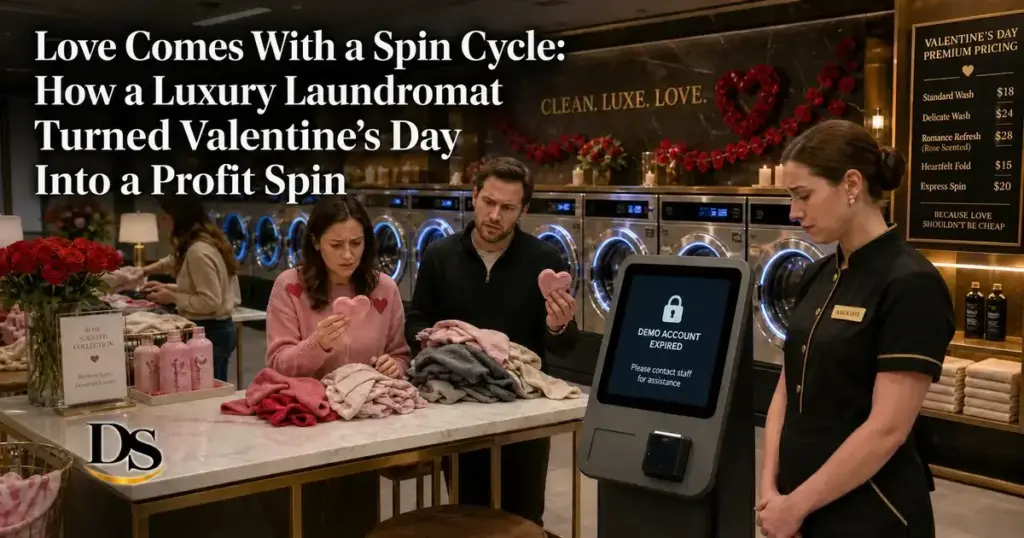
On February 10th, just as the city’s couples began their last-minute scramble for reservations, chocolates, and last-minute apologies, VelvetSpin Laundry — the city’s first and only luxury laundromat offering cashmere-soft wash cycles, aromatherapy steam presses, and complimentary champagne flutes with every load — unveiled its Valentine’s Day surge pricing model.
What started as a playful nod to romance — ‘Love is in the air, and so is the scent of lavender-infused oxy boost’ — quickly escalated into a full-blown economic experiment. For the 72 hours leading up to February 14th, VelvetSpin implemented dynamic pricing based on real-time demand, fabric type, and emotional valence detected via optional biometric wristbands (marketed as ‘HeartSync™’). A standard cotton load jumped from $8 to $22. A silk blouse with hand-embroidered initials? $47. The ‘Forever Together’ package — two matching monogrammed robes, a shared dry-cleaning session, and a personalized sonnet printed on recycled linen — sold for $299.
‘We’re not just cleaning clothes,’ said founder Elise Moran, sipping matcha latte behind the marble reception desk, ‘we’re curating emotional readiness. If you’re showing up to Valentine’s Day with stained socks and a wrinkled shirt, you’re not ready for love. You’re ready for laundry.’
The model worked — until it didn’t. By February 12th, VelvetSpin’s app was crashing under the weight of 14,000 concurrent users trying to book the ‘Midnight Snuggle Spin’ — a 2 a.m. cycle with heated floors, ambient jazz, and a complimentary dark chocolate-dipped strawberry delivered mid-cycle. Demand outstripped supply by 300%. Prices hit $89 for a single pair of boxers.
Then, at 11:47 p.m. on February 13th, the system flashed a banner: ‘DEMONSTRATION MODE ACTIVATED. ALL USER SESSIONS TERMINATED IN 60 SECONDS. THANK YOU FOR TESTING VELVETSPIN BETA.’
Patrons stared at their screens. Some were mid-fold. One man, in a cashmere sweater he’d paid $63 to have ‘gently resurrected,’ stood frozen, holding a sock that smelled faintly of bergamot and regret. A woman in tears clutched her phone, having just paid $120 to have her fiancé’s suit pressed ‘with the tenderness of a first kiss.’
It turned out VelvetSpin had never left beta. The luxurious marble, the organic cotton towels, the sommelier who paired detergents with zodiac signs — all were part of a six-month user experience trial funded by a stealth venture arm of a major appliance conglomerate. The surge pricing? A stress test. The HeartSync™ bands? Biometric data harvest. The sonnets? AI-generated, trained on Hallmark cards and breakup texts.
‘I thought I was paying for romance,’ said Daniel Cho, a freelance photographer who’d booked three loads for his polyamorous Valentine’s quartet. ‘Turns out I was paying to be a lab rat with a fabric softener addiction.’
The backlash was swift. Reddit threads exploded. TikTok creators filmed themselves washing clothes in bathtubs while whispering sonnets to their socks. A local poet launched a pop-up ‘Anti-VelvetSpin’ laundromat in a borrowed garage, offering free washes and handwritten apologies for $5 — cash only, no app required.
By Valentine’s Day morning, VelvetSpin’s doors were locked. A handwritten sign on the glass read: ‘Gone to find real love. — The Team.’ Below it, in smaller print: ‘Your data is safe. Your socks are not.’
Industry analysts are now debating whether VelvetSpin was a brilliant satire of commodified intimacy or a terrifying glimpse into the future of service design — where even the most mundane acts of care are optimized, monetized, and then abruptly revoked when the demo ends.
As for Elise Moran? She vanished from LinkedIn. Her last post: a photo of a single sock, dangling from a clothesline over a quiet countryside lane. Caption: ‘Sometimes, the softest things are the ones you let go.’
The Spin Doctor’s Prescription
When the laundromat’s resident “Spin Doctor” — a retired physicist who moonlights as a matchmaker using centrifugal force as metaphor — noticed a spike in solo customers arriving with mismatched socks and existential dread, he didn’t just hand out detergent samples. He launched ‘The Velocity Date,’ a 12-minute speed-dating ritual where participants sat across from each other on folding chairs beside humming dryers, answering three questions printed on lint-free cards: ‘What’s the one chore you’d never outsource?’ ‘If your heart had a spin cycle, what setting would it be on?’ and ‘What’s the most ridiculous thing you’ve ever washed?’ The rules were strict: no phones, no eye contact beyond the dryer’s glass door, and if the cycle ended mid-sentence, you had to finish your thought while folding a fitted sheet — a task scientifically proven to reveal true compatibility.
One couple, Dave and Lena, met during a particularly turbulent ‘Heavy Duty’ cycle. Dave, a taxidermist who specialized in restoring vintage stuffed animals, confessed he’d once washed a 1970s teddy bear named Sir Fluffington III in hot water ‘to see if it would scream.’ Lena, a professional sock puppet artist, laughed so hard she snorted — then admitted she’d once used a laundromat’s change machine to fund a week-long improv stint in Albuquerque. By the time the buzzer sounded, they’d exchanged numbers, shared a bag of laundry-scented lavender candies from the vending machine, and agreed to meet again — not for coffee, but for a ‘Delicates’ cycle where they’d fold each other’s underwear in silence, judging only by the quality of the crease.
The Last Load
As Valentine’s Day bled into the early hours of February 15th, the laundromat’s neon sign flickered — not from malfunction, but by design. The owner, Mira, had programmed it to pulse in time with the washers’ spin cycles, creating a slow, throbbing heartbeat of light that bathed the folding tables in rose-gold glow. The last customer, a woman in a trench coat who’d arrived alone at 11:47 p.m. with a single duffel bag labeled ‘Ex’s Stuff — Do Not Open,’ stood motionless before Dryer #7. She didn’t insert coins. Instead, she placed a handwritten note inside the drum: ‘I washed away the guilt. Now I’m spinning toward something lighter.’ Then she walked out, leaving the door slightly ajar.
Inside, the dryer began to turn. The note fluttered like a trapped moth, then caught on the drum’s rib and spun slowly, repeatedly, as if the machine itself were reading it. By 2 a.m., the cycle ended. The note was still there — slightly damp, the ink blurred — but legible. Mira found it the next morning. She didn’t throw it away. She laminated it, hung it beside the ‘Lost & Found’ bin, and added a new sign below it: ‘Some things come out cleaner than they went in.’ The laundromat didn’t just make money that Valentine’s Day. It made space — for laughter, for lint, for the quiet, tumbling hope that even the most stubborn stains, given enough time and the right spin, can eventually let go.
Join the conversation
Load Facebook comments to read and reply using your Facebook account.