
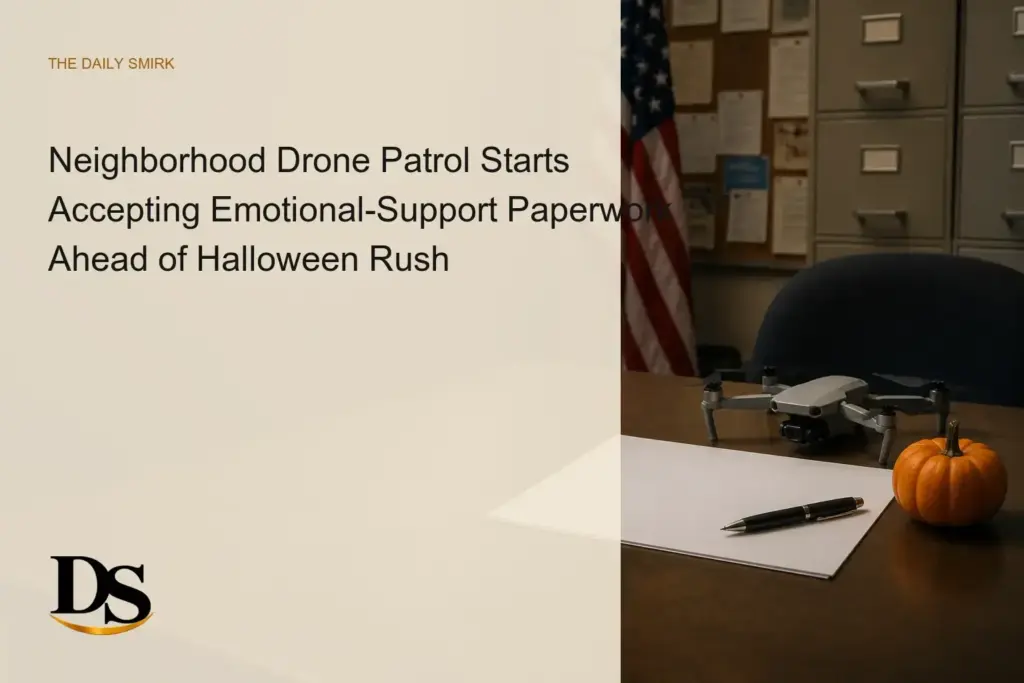
MAPLEWOOD — At precisely 7:03 a.m. on a damp October morning, Drone Unit Bravo-7 hovered 40 feet above Sycamore Street, its thermal sensors calibrated not for intruders, but for the faint heat signature of a woman in a dinosaur onesie pacing her front yard, clutching a laminated form.
The form, titled “Request for Emotional-Support Accommodation During Seasonal Festivity Events,” had been submitted the night before through the Neighborhood Drone Patrol’s newly launched portal. Within 90 seconds, the drone’s undercarriage compartment clicked open, deposited a receipt stamped ‘PROCESSED — LEVEL 2 CALM,’ and retreated to its charging nest atop the decommissioned water tower.
This is how Halloween now begins in Maplewood: not with pumpkin carving contests or candy inspections, but with quiet aerial validation of seasonal anxiety.
From Surveillance to Sentiment
The Maplewood Aerial Watch, founded in 2021 after a series of porch-light thefts attributed to ‘overenthusiastic raccoons,’ began as a traditional security initiative. Residents voted to fund a fleet of six quadcopters programmed to patrol designated zones between dusk and dawn, alerting homeowners via app if motion was detected near garages or mailboxes.
But last year, something shifted. As Halloween approached, drone operators began noting repeated loitering—not of vandals, but of adults in elaborate costumes standing motionless in driveways, staring at their own reflections in darkened windows.
‘We weren’t judging,’ said Lenore Cho, the patrol’s volunteer coordinator and a former librarian who now spends her evenings monitoring drone feeds from her kitchen table. ‘We were just seeing people… stuck. Not breaking rules. Just… needing a minute.’
By September, the patrol had quietly begun accepting emotional-support paperwork through its website—a simple PDF form asking for name, address, costume description, and a one-sentence explanation of why the wearer anticipated needing ‘non-judgmental aerial presence’ during trick-or-treat hours.
Approvals are granted algorithmically: if the submission mentions anxiety, sensory overload, or fear of judgment, the system triggers a ‘calm pass’—a silent, non-recording overflight at 30 feet, lasting exactly 90 seconds, scheduled for the user’s preferred trick-or-treat window.
This year, 112 forms have been submitted so far—up from 37 last year—and the patrol expects to process over 200 by October 31st.
The Consultant Conundrum
With volume rising, the patrol’s oversight committee—a rotating group of five residents chosen by lottery—recently commissioned a review from Higgs & Poole Municipal Efficiency Advisors, a firm known for optimizing everything from library book returns to storm-drain inspection schedules.
After three weeks of interviews, ride-alongs, and a particularly tense focus group involving a man in a full-size inflatable T. rex suit, Higgs & Poole delivered its findings: the drone patrol was ‘functionally efficacious but administratively fraught.’
Their primary recommendation? Hire another consultant.
‘The current model relies too heavily on volunteer judgment and ad-hoc form triage,’ read the report, delivered via encrypted email at 2 a.m. ‘To scale emotional-support aerial services sustainably, the Watch should engage a second-phase consultant to evaluate the first consultant’s recommendations—and determine whether a third-party vendor should manage the intake portal.’
The suggestion sparked quiet debate at the last neighborhood association meeting. Some residents worried about mission creep. Others pointed out that the patrol had already begun outsourcing its logo design to a local high school art class.
‘We’re not against help,’ said Marcus Tillman, a retired accountant who submitted a form last year for his pirate costume (‘afraid of being mistaken for actual piracy near the riverwalk’). ‘But if we start hiring consultants to tell us whether we need consultants to help people feel safe in their zombie makeup, we might as well just fly the drones in circles and call it a day.’
The oversight committee has tabled a vote on the recommendation until after Halloween, citing ‘operational continuity during peak affective load.’
More Than Just a Watchful Eye
For many participants, the program has become less about surveillance and more about ritual.
Elena Ruiz, who submitted a form this year for her handmade constellations costume (‘afraid people will think I’m just wearing a black tarp with glitter’), said the drone’s quiet pass last year changed how she experienced the holiday.
‘It didn’t say anything. Didn’t flash lights. Just… came by. Like it knew I was there, and that was okay.’
Others describe the overflights as a kind of silent benediction—a moment when the neighborhood, usually partitioned by fences and schedules, feels briefly unified in its shared vulnerability.
Even the drones, it seems, have adapted. Technicians report that units assigned to emotional-support routes now default to slower, smoother flight paths when approaching registered addresses— a tweak made not by command, but by machine-learning algorithms optimizing for ‘minimized startle response.’
As October deepens and the streets fill with ghosts, goblins, and increasingly elaborate inflatable skeletons, the Maplewood Aerial Watch continues its quiet work: not enforcing rules, but acknowledging that sometimes, the most useful thing a flying robot can do is show up, hover briefly, and leave without judgment.
Whether the committee will follow Higgs & Poole’s advice to consult the consultant remains, for now, undecided. But as Drone Bravo-7 completed its third calm pass of the evening over a group of teenagers in mismatched superhero capes arguing about whether Batman counts as a superhero, it seemed, for the moment, that the current system was flying just fine.
Join the conversation
Load Facebook comments to read and reply using your Facebook account.