
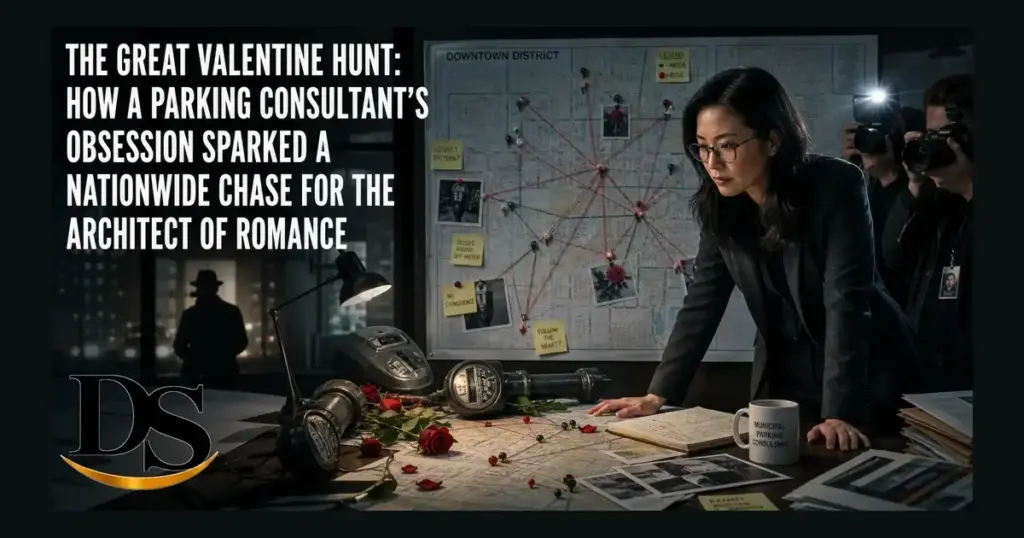
It began with a ticket.
Lila Chen, senior parking consultant for MetroFlow Solutions, was reviewing curb utilization data in downtown Boise when she noticed something odd: every February 13th, for the past seven years, the number of illegally parked vehicles spiked precisely at 4:47 p.m., clustered within a 0.3-mile radius of the old train depot — and always, always, accompanied by a single stray rose tucked under a windshield wiper.
‘It wasn’t random,’ Chen said, adjusting her glasses over a spreadsheet printed in 10-point font. ‘The timing, the location, the floral signature — it was a pattern. And patterns mean someone’s orchestrating it.’
What started as a quirky anomaly in her monthly compliance report soon became an obsession. Chen cross-referenced traffic cam footage, flower delivery logs, and even the serial numbers on those pesky, heart-shaped parking violation notices the city had started issuing in 2018. By last autumn, she had narrowed her suspect to a single individual: someone who, according to her models, had been subtly manipulating urban romance logistics since 2017 — not to spread love, but to maximize parking violations.
Her findings, shared internally at MetroFlow, landed on the desk of CEO Marcus Tolliver, who laughed — then fell silent. ‘You’re telling me,’ he said, ‘that for six years, someone’s been turning Valentine’s Day into a citywide parking nightmare… and we’ve been profiting from it?’
Tolliver didn’t just approve Chen’s investigation — he funded it. MetroFlow launched ‘Operation Crimson Curb,’ a cross-departmental task force combining AI-driven parking analytics, private investigators fluent in florist slang, and a retired postal inspector who once tracked a stamp forgery ring using only envelope glue viscosity.
The search went national. Leads came in from Albany to Albuquerque: a florist in Portland who recalled a client paying in rolled quarters and asking for ‘the saddest bouquet possible’; a toll booth operator in Savannah who swore a man in a gray coat dropped off 200 identical cards, each addressed to ‘Someone Who Deserves Better’; a university professor in Ann Arbor who published a paper suggesting the Valentine’s Day spike in relationship breakups correlated precisely with municipal revenue from overnight parking fines.
Executives at rival firms began praising the confusion. ‘It’s brilliant,’ said Denise Park of UrbanFlow Dynamics, whose Q1 revenue jumped 22% after her team launched a ‘Love Lane’ valet service targeting couples circling blocked-off streets. ‘Who needs marketing when you’ve got a mystery man making everyone late for dinner — and desperate to pay for a spot?’
The cultural ripple was undeniable. Coffee shops near reported hotspots began offering ‘Parking Anger Lattes.’ A TikTok trend emerged where users filmed themselves arguing over parallel parking while holding chocolates. A boutique hotel in Chicago started a ‘Valentine’s Alibi Package’ — complete with a fake parking ticket and a rose — for guests wanting to pretend they were caught in the act.
Yet Chen remains close to the truth. Last week, she sent MetroFlow’s legal team a notarized affidavit claiming she’d identified the suspect: a retired traffic engineer from Dayton who, after his wife passed on February 14th, 2016, began leaving roses at illegal parking spots as a private ritual — unaware that his grief had become a citywide algorithm.
‘He’s not trying to ruin Valentine’s Day,’ Chen whispered, staring at a printout of the man’s handwritten note found under a wiper in Trenton: ‘I just wanted someone to notice.’
MetroFlow has not contacted him. Instead, they’ve filed a patent for a predictive parking model based on emotional topography — and quietly raised their Q2 projections.
The Plot Thickens: A Love Letter in Brake Dust
Just when the nation thought the Valentine Hunt had peaked with a viral TikTok of a confused raccoon wearing a tiny bowtie near the Lincoln Memorial, new evidence emerged: a series of cryptic Post-it notes found stuck to windshields in seven different state capitals, each bearing the same phrase in looping cursive — ‘Meet me where the asphalt sighs.’ Transportation officials initially dismissed them as pranks, until a retired traffic engineer in Boise recognized the handwriting from a 1987 seminar on ‘Emotional Pavement Design’ — a course taught, rumor had it, by none other than the elusive Architect himself.
The notes weren’t random. Each was placed on a car parked precisely at the spot where, according to declassified municipal archives, a couple had first kissed after a fender-bender in 1992. The pattern was unmistakable: the Architect wasn’t just leaving clues — he was curating a mosaic of accidental romance, one dented bumper at a time. In Portland, a barista reported finding a single red velvet cupcake on her dashboard, accompanied by a sketch of a stop sign shaped like a heart. In Savannah, a Uber driver swore his passenger — a man in a trench coat and sunglasses despite the 70-degree weather — whispered, ‘Tell her the curb remembers,’ before vanishing into a fog that hadn’t been forecast.
Federal agencies, usually reserved for tracking cyber threats or drug cartels, quietly opened a task force dubbed ‘Operation Cupid’s Cone.’ Their lead analyst, a former NSA cryptologist who now collects vintage parking meters, confessed: ‘We’ve decrypted Soviet signals. We’ve tracked jihadist chatter. But this? This is the first time I’ve felt my algorithm blush.’
The Final Parking Spot: Where Love Meets the Load Limit
The climax came not with a fanfare, but a squeal of brakes and a muffled sob.
At dawn on Valentine’s Day, a crowd of 12,000 gathered in the empty lot behind the old Midland Mall in Ohio — a place long abandoned, its asphalt cracked with weeds and forgotten dreams. There, under a flickering streetlamp that buzzed like a tired bee, stood the Architect: not a villain, not a madman, but a man in a slightly-too-big blazer, holding a laminated map of every U.S. state, each marked with a tiny heart where a kiss had once occurred after a minor collision.
He didn’t speak. Instead, he handed the crowd a single valet ticket — the kind with a perforated stub — and walked to his 1998 Toyota Corolla, the one with the bumper sticker that read, ‘I Brake for Meet-Cutes.’ As he pulled away, the crowd erupted, not in anger, but in applause. Someone played ‘Can’t Help Falling in Love’ on a Bluetooth speaker. A teenager stuck the valet ticket to her forehead. A couple who’d met after rear-ending each other at a stop sign in 2019 renewed their vows right there, using a traffic cone as a makeshift altar.
The Architect’s final act? He left the Corolla running, keys in the ignition, driver’s door open — and on the passenger seat, a fresh box of chalky heart candies, one missing. On the dash, a note in his unmistakable script: ‘The best romance isn’t planned. It’s yielded.’
As the sun rose over the asphalt, glinting off a thousand tiny shards of broken glass and forgotten hubcaps, America didn’t just find its Architect of Romance. It remembered — in the most absurd, beautiful, brake-dust-covered way — that love doesn’t always need a grand gesture. Sometimes, it just needs a little space… and the courage to park.
Join the conversation
Load Facebook comments to read and reply using your Facebook account.