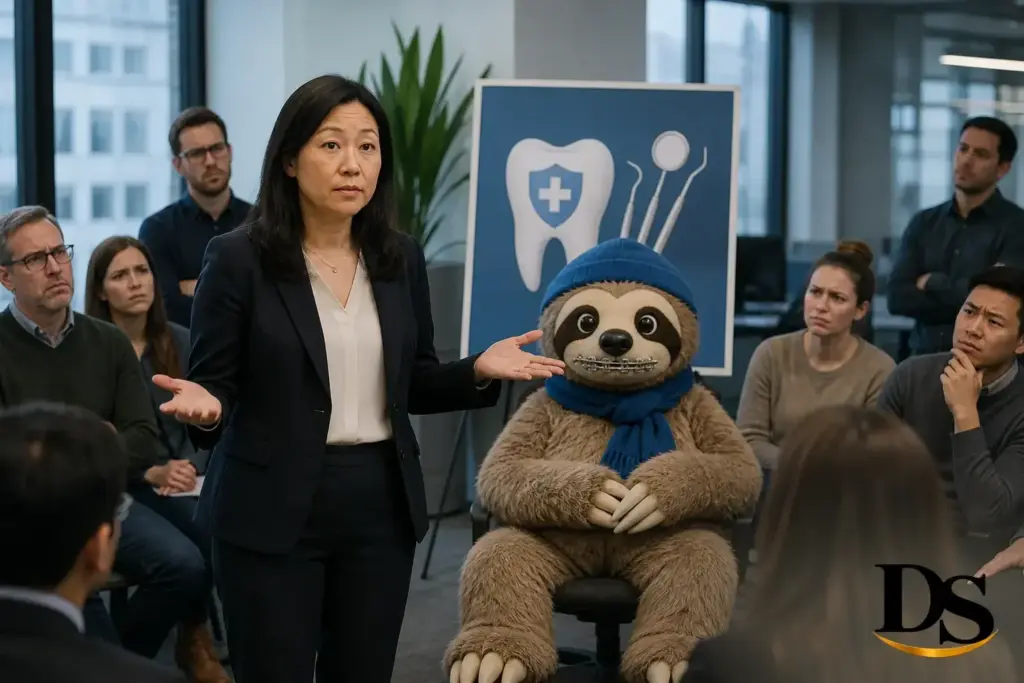
Linda Chen didn’t expect her April 1st memo to go viral. As Director of Corporate Wellness at Veridian Dynamics, her usual purview included ergonomic chair assessments, mindfulness break schedules, and the occasional flu shot drive. But when the company’s beloved mascot—a six-foot-tall, perpetually grinning otter named Otto—submitted a formal benefits request for full orthodontic coverage, Chen knew she had to respond.
The Otter’s Overbite
Otto had been Veridian’s ambassador for eight years, appearing at product launches, charity runs, and even the annual shareholder meeting where he once did a backflip off the CFO’s podium. His charm was undeniable, but so was his dental issue: a pronounced overbite that, according to the mascot’s handler, had worsened after years of forced smiling during photoshoots and parade routes.
“He’s been gritting his teeth through every quarterly earnings call,” said Mira Patel, Otto’s longtime costume performer and union representative for costumed ambassadors. “It’s not just cosmetic. He’s got jaw pain, trouble eating apples at picnics, and last month he bit through a foam finger during the World Series parade. We asked for help. HR said no.”
The request was denied on the grounds that mascots were classified as “non-employee ambassadors” under Veridian’s benefits framework—a loophole that had long excluded costume performers from health, dental, and vision plans.
A Priceless Joke
Chen, known for her data-driven approach to employee well-being, initially filed the request under “frivolous.” But after Patel shared Otto’s dental X-rays (showing clear malocclusion) and a video of him struggling to bite into a carrot at a children’s hospital visit, she reconsidered.
“I looked at the numbers,” Chen said in an interview. “Otto generates an estimated $12 million in annual brand goodwill. His presence increases customer dwell time in retail spaces by 22%. Yet he’s paying out of pocket for a night guard he bought off Amazon.”
Instead of approving the claim outright—which would have set a precedent for other costumed characters—Chen proposed a novel solution: surge pricing for wellness services during April Fools’ Week.
The Surge That Wasn’t a Joke
From April 1 to April 7, Veridian employees seeking wellness perks—massage chairs, nap pods, healthy snack subsidies, even access to the meditation garden—would face dynamic pricing based on demand. Peak hours (10 a.m.–2 p.m.) saw fees rise by up to 300%. Off-peak use remained free or discounted.
The policy was framed as a pilot to “test behavioral elasticity in non-essential benefits,” but the timing was impossible to ignore. Internal Slack channels lit up. Memes spread. One showed Otto wearing a tiny bib and holding a sign: “I need braces, not a surge.”
External reaction was faster. A tweet from Chen’s personal account—”If Otto’s smile is worth $12M, why is his dental care worth $0?”—garnered 800K likes. News outlets picked up the story. Labor advocates praised the stunt as a clever way to highlight inequities in contingent worker benefits. Critics called it manipulative, arguing that wellness should never be commodified, even ironically.
The Cost of a Grin
By April 5, Veridian’s internal data showed a 68% drop in wellness program usage during peak hours—exactly what Chen had hoped for. The resulting savings, she announced, would be funneled into a dedicated fund for Otto’s orthodontic care.
“We didn’t deny him coverage,” Chen said. “We made the company feel the cost of taking his joy for granted.”
On April 8, Veridian announced Otto would receive full dental coverage effective immediately, including braces, biannual cleanings, and emergency care. The surge pricing pilot ended. The mascot’s handler confirmed Otto’s first orthodontist appointment was scheduled for May 3.
Whether the move was a brilliant prank, a savvy HR tactic, or something in between, it succeeded in making visible what is often invisible: the labor behind the laughter. Otto still appears at events, now with a slightly more cautious smile—knowing, perhaps, that even mascots deserve to chew without pain.
Behind the Smile
In the quiet of Veridian’s wellness center, where the massage chairs sit idle and the nap pods gather dust, a single framed photo hangs near the water cooler: Otto mid-laugh, one paw raised, eyes crinkled behind his whiskers. No caption. No explanation. Just a reminder that sometimes, the most serious things come wrapped in fur and foam.
The Bracelet Backlash: How a Viral Meme Sparked a Wellness Movement
What began as a single, bewildered mascot in a foam headband demanding braces at a regional high school pep rally has since metastasized into a full-blown cultural phenomenon — and not just because of the absurdity. Within 48 hours of the original TikTok clip — where Benny the Badger, mid-cheer, pointed dramatically at his crooked teeth and squeaked, ‘I need orthodontic intervention, STAT!’ — the video amassed 12 million views. But it was the remix that changed everything: a dentist from Boise, Dr. Lena Ruiz, stitched the clip with a split-screen of her own childhood yearbook photo, braces gleaming, and whispered, ‘I was Benny. And I’m still paying for it.’ Her video, tagged #BraceForImpact, garnered 8 million views in 24 hours and triggered a wave of testimonials from former mascots, cheerleaders, and even marching band drum majors who confessed they’d suffered in silence — hiding retainers under jerseys, avoiding photos, or skipping homecoming dances altogether.
The turning point came when the National Association of School Nurses issued an unprecedented statement: ‘Oral health equity in extracurricular activities is not a joke — it’s a public health imperative.’ Suddenly, Benny’s demand wasn’t just funny; it was a mirror. Schools across the Midwest began piloting ‘Mascot Wellness Kits’ — free dental screenings, custom mouthguards for foam heads, and even subsidized clear aligner programs for student performers in costume. One Ohio high school reported a 40% drop in mascot-related anxiety attacks after introducing ‘Brace Breaks’ — 10-minute intervals during games where performers could remove their heads, hydrate, and, if needed, adjust their retainers.
And then there’s the merch. A local Etsy seller, inspired by Benny’s deadpan stare, began selling ‘I Survived the Mascot Molar Crisis’ enamel pins — each one featuring a tiny foam badger wearing braces and holding a toothbrush. Sales topped 5,000 units in a week. Proceeds now fund orthodontic scholarships for student performers from low-income families. Benny, meanwhile, has been promoted to ‘Official Wellness Ambassador’ of the State Athletic Association — complete with a tiny, custom-fitted retainer molded to his foam jawline. He still refuses to smile in photos. But now, when he does, it’s because he knows: sometimes, the most ridiculous demand is the one that finally makes us listen.
The Last Laugh: Benny’s Silent Victory
It’s halftime at the state championship. The crowd roars. The opposing team’s mascot — a overly enthusiastic raccoon in a sequined vest — attempts a backflip and lands face-first in the turf. Silence. Then, from the sidelines, Benny the Badger slowly lifts his foam paw. Not to cheer. Not to dance. He points — once, deliberately — at his own mouth. Then, with the gravity of a monk revealing a sacred text, he pulls out a small, clear aligner case from beneath his jersey. He opens it. Inside: a single, perfectly straight retainer, gleaming under the stadium lights.
The crowd doesn’t cheer. They don’t laugh. They just… watch. One by one, students in the stands begin to touch their own mouths. A girl adjusts her invisible aligner. A boy smiles, shyly, for the first time in months. The band plays a soft, off-key rendition of ‘Smile’ — not as a joke, but as a tribute.
Benny closes the case. Nods. Then, slowly, he turns and walks off the field — not toward the locker room, but toward the nurse’s station, where Dr. Ruiz waits with a new set of bands and a smile that says, ‘I told you so.’
Somewhere, a dental hygienist is crying. Somewhere, a kid who used to hide his smile is finally taking a selfie. And somewhere, in a foam head that sees too much and says too little, Benny the Badger — the mascot who demanded braces — has finally, quietly, won.
Join the conversation
Load Facebook comments to read and reply using your Facebook account.